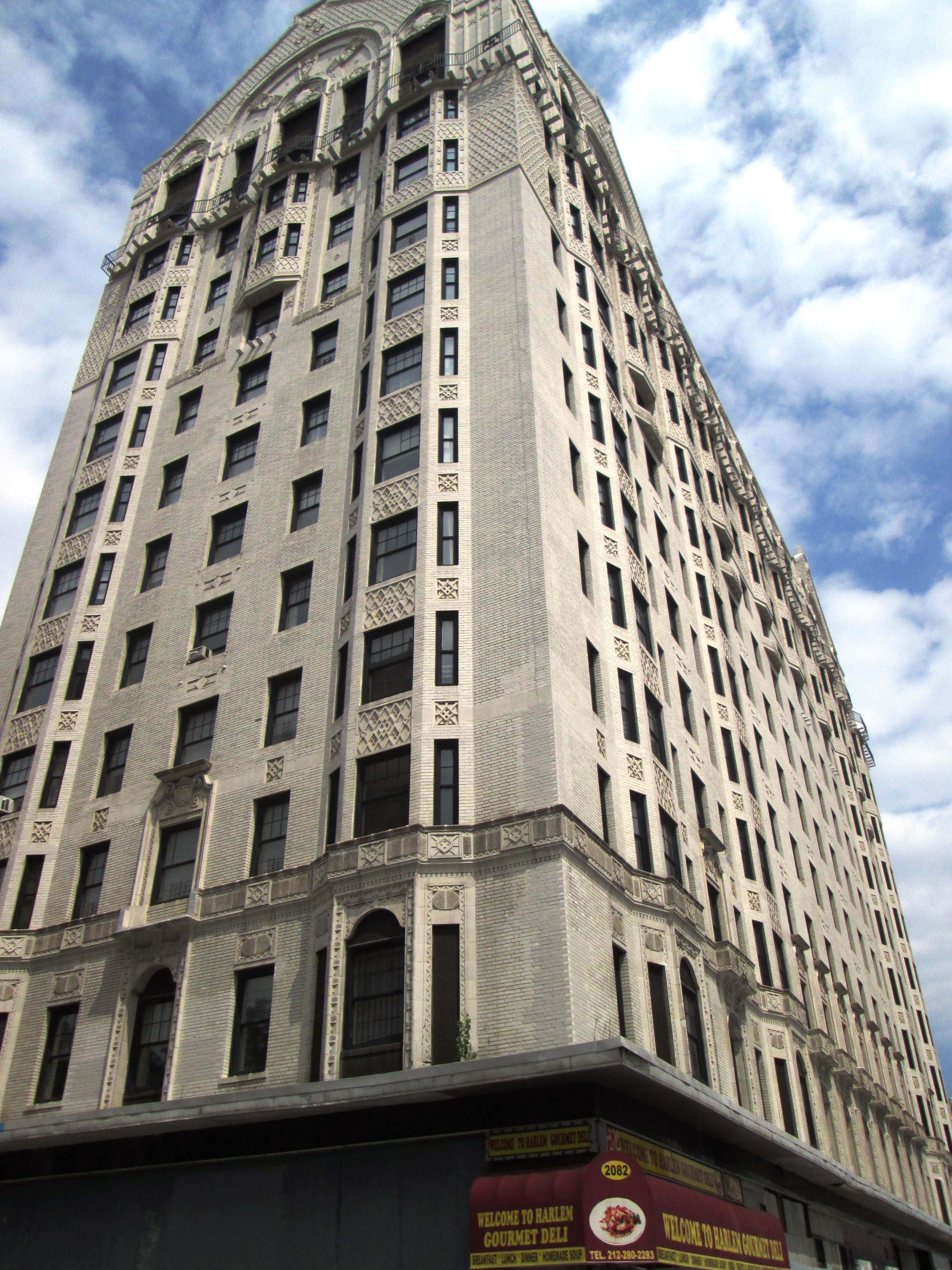
Hotel Theresa
In September 1960, Fidel Castro stormed out of a midtown Manhattan hotel, claiming discrimination, and drove uptown to Harlem. Malcolm X had helped arrange rooms at the Hotel Theresa, a 13-story building with a gleaming white terracotta facade at the corner of 125th Street and Adam Clayton Powell Jr. Boulevard. Castro rented eighty rooms for eight hundred dollars a day, plucked chickens in his suite, and held court for a parade of visitors that included Soviet premier Nikita Khrushchev. The spectacle was absurd and historic in equal measure -- and it was perfectly in character for a hotel that had spent decades at the center of Black cultural and political life in America.
A Palace on 125th Street
German-born stockbroker Gustavus Sidenberg built the hotel in 1912-13 and named it after his wife. The architectural firm of George and Edward Blum designed it with custom terracotta ornamentation -- not prefabricated stock pieces, but details crafted specifically for the building. The result was striking enough to earn a reputation as one of the most visually distinctive structures in northern Manhattan. For its first decades, however, the Hotel Theresa was a whites-only establishment in the heart of a predominantly Black neighborhood, a cruel irony on the main street of Harlem. That changed around 1940, when the hotel began admitting African American guests, and the transformation was swift. Within a few years, the Theresa had become the social headquarters of Black America.
The Waldorf of Harlem
The nickname captured something real. In an era when segregation barred African Americans from most first-class hotels in the city, the Theresa became the place to see and be seen. Duke Ellington stayed there. So did Louis Armstrong, Josephine Baker, Lena Horne, and Zora Neale Hurston. Muhammad Ali, Sugar Ray Robinson, and Joe Louis used it as a base. Ray Charles, Jimi Hendrix, Little Richard, and Sam Cooke all passed through its doors. The lobby hummed with musicians, activists, writers, and athletes whose options for elegant accommodation in their own city were grotesquely limited. Ron Brown, who would become the first African American Secretary of Commerce, grew up in the building -- his father managed it. A young Charles Rangel, future congressman, worked the front desk.
Cold War Stage
Castro's 1960 visit turned the Theresa into an unlikely venue for Cold War diplomacy. According to the New York Times, Castro believed that Black Americans would be sympathetic to his revolution, and the enthusiastic crowds that gathered on 125th Street proved him partly right, though protesters also appeared. Other leaders from the developing world followed Castro's lead: Patrice Lumumba of the Republic of the Congo chose the Theresa when visiting New York. The following month, John F. Kennedy campaigned for the presidency at the hotel alongside Eleanor Roosevelt. In a few short weeks, the Theresa had hosted a Communist revolutionary, an African independence leader, and a future American president -- a convergence that no other building in the city could have produced.
Decline by Desegregation
The hotel's undoing arrived through an unexpected door: progress. As segregation ended elsewhere in the city during the 1950s and 1960s, African Americans with means no longer needed to stay in Harlem. They had choices now, and the Theresa -- which its owners had not upgraded or modernized in decades -- could not compete. Harlem itself was deteriorating, and the hotel slid with it. New owners began converting the building to office space in 1966, and the hotel closed in 1967. The building was renovated and reopened in 1970 as Theresa Towers, with its original exterior largely preserved rather than replaced with the aluminum-and-glass facade that had been considered. A sign with the old name still adorns the side of the building. Today it houses commercial tenants, a Columbia University Teachers College campus, and the Touro College of Pharmacy. Colson Whitehead set a fictional heist there in his 2021 novel Harlem Shuffle, drawn from a real 1959 robbery -- proof that even as office space, the Theresa remains irresistible as a stage.
From the Air
Located at 40.809N, 73.949W in central Harlem, Manhattan, at the intersection of 125th Street and Adam Clayton Powell Jr. Boulevard. Visible from low altitude as a 13-story building along Harlem's main commercial strip. Nearby airports: La Guardia (KLGA) 6 nm east, Teterboro (KTEB) 9 nm west.