Hotel Walhalla
The carved figures watching over the front door are the four evangelists - Matthew, Mark, Luke and John - plus Jesus, looking down on Bierstraße in the heart of Osnabrück's old town. They have been there since 1690, when the bailiff Gerdt Heindrich Meuschen finished the three-storey half-timbered house that would one day call itself Hotel Walhalla. The name is borrowed straight from Norse mythology - Valhalla, the warrior's afterlife - and over three-and-a-third centuries the guest book has filled with people who would never have shared a table: a Lutheran jurist, a Tibetan monk, a Spanish king, an East German novelist eating boiled beef in 2004 and writing about it in Die Zeit two weeks later.
The Bailiff's House
There was a house on this corner before Meuschen built his. The first known structure went up in 1530, and may well have burned in the great Osnabrück fire of 1613, when 900 houses across the city went up in flame. By 1690, the bailiff was ready to put something more permanent in its place. He built three storeys of half-timbered oak with a steeply gabled roof, the upper floors corbelled out over Bierstraße in the typical north-German manner. Above the main door he set a medallion bearing the family arms of himself and his wife, Susanne Gertraud née von Lengerken. The half-timbered consoles - the carved brackets that support the protruding upper floors - he had decorated with the evangelists and Christ, the kind of personal pious extravagance that bailiffs of the period sometimes indulged in when business was good. The back of the building rose as a Steinwerk, a fortified stone keep, a relic of older Osnabrück when prosperous townspeople kept defensible cellars.
The Council Tavern
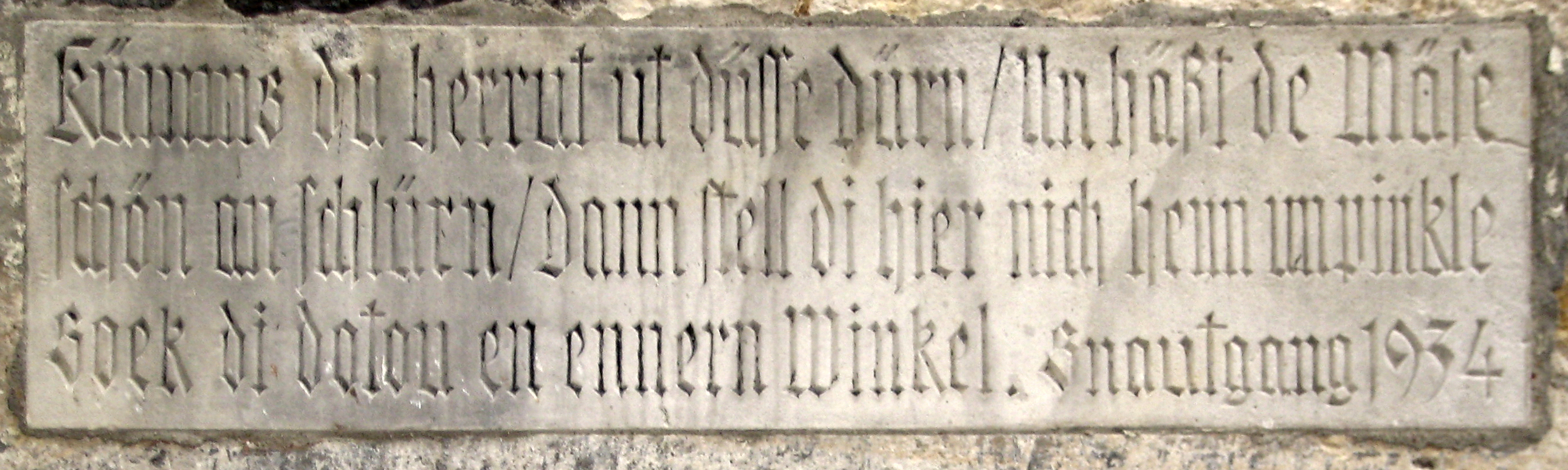
By 1740, the house belonged to wine merchants - Meuschen's daughter and then his granddaughter had each married into the trade - and a relative named Christian Jäger set up a tavern in the ground floor. Because the town hall stood barely a hundred metres away, the place was nicknamed the Ratsschenke, the Council Tavern. Aldermen drank here. Justice Möser drank here. Möser was Osnabrück-born, in 1720, and grew up to become one of Germany's most influential eighteenth-century jurists and historians, a man whose conservative legal philosophy Goethe admired and Herder argued with. He came here for the wine. The first guest rooms upstairs did not appear until 1820. From 1876 to 1971 the building belonged to the Grabe family, who sometimes ran it and sometimes leased it out. On a side door, in 1934, a memorial stone was set with an inscription in Low German from the Heger farmers' annual boundary walk - a request, more or less, that whoever needed to relieve themselves please go around the corner first.
September 1944
On the night of 13 September 1944, RAF and USAAF bombers struck the Osnabrück town centre. The town hall a block away was burned to its foundations. The cathedral was hit. The Walhalla took an incendiary bomb in its attic, which burned out. The rest of the house, somehow, was saved - the carved evangelists kept their places, the bailiff's medallion held above the door. The hotel had to close for a time, the work of two-and-a-half centuries narrowly avoiding the fate of so many timbered houses across Germany that night. In 1985 a merchant bought the building and began a renovation that finished the following year. In 1992 the hotel absorbed two neighbours - one of them the Katzenhaus on Heger Straße, a 1616 half-timbered structure thrown up three years after the great fire, restored in 1977. Today the complex holds 66 rooms and 100 beds across four linked historic houses.
The 350th Anniversary
In 1998 Osnabrück marked 350 years since the Peace of Westphalia, the treaty negotiated in the town hall down the street that ended the Thirty Years' War. The royal houses of Europe came to commemorate it, and the Walhalla put them all up. Queen Silvia and King Carl XVI Gustav of Sweden checked in - Sweden's envoys had been the ones who sat in Osnabrück in 1648 to sign their part of the treaty. King Harald V and Queen Sonja of Norway arrived. Queen Margrethe II of Denmark and Prince Consort Henrik. King Albert II and Queen Paola of the Belgians. Queen Beatrix of the Netherlands. King Juan Carlos I of Spain. The German Federal President Roman Herzog was there, as were the presidents of Italy, Poland, Latvia, Estonia and Lithuania. Queen Silvia had stayed at the Walhalla the previous year on her own. The Dalai Lama had come in 1997 as well. Two doors down from where the treaty had ended Europe's most destructive religious war, the rulers of a thinly-rewoven Europe ate breakfast under the same beams.
Boiled Beef in Die Zeit
In December 2004 the novelist Martin Walser - one of postwar Germany's most contentious literary figures - sat in the Walhalla restaurant and ordered Tafelspitz, the simmered beef of the Austro-Bavarian tradition. He drank beer with it, which he confessed in the resulting Die Zeit essay he did not particularly care for, as though beer was actually my sort of drink. The article was about his meetings around Osnabrück, but the line about the beer became the line everyone quoted. The Walhalla, run today by the merchant's daughter and her husband, has a way of inducing that kind of confession from its guests. Beneath the carved evangelists and the bailiff's medallion, on furniture installed when Erich Maria Remarque - born in Osnabrück in 1898 - was still a schoolboy down the road, people order the boiled beef and admit things they had not planned to.
From the Air
The hotel sits at 52.28°N, 8.04°E on Bierstraße in Osnabrück's Altstadt, less than 100 metres from the town hall and market square. EDDG (Münster/Osnabrück International) is the obvious approach, 30 km to the north. From 5,000-7,000 feet on the downwind, the city's old town reads as a dense triangle of tile roofs between the Hase river loops and the medieval wall remnants.