Houdaille Quarry
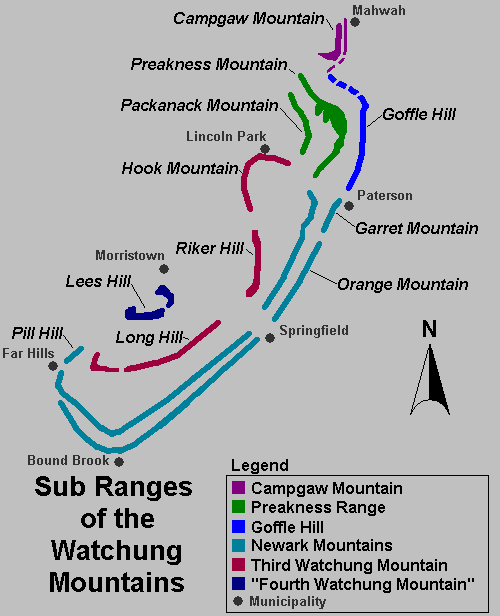
They call it the Grand Canyon of Union County, and while that nickname carries some New Jersey hyperbole, there is genuine drama in the description. Cut into the first ridge of the Watchung Mountains in Springfield Township, the Houdaille Quarry is 120 acres of vertical basalt walls, talus slopes, and stillness — owned by Union County, closed to most visitors, and slowly becoming a forest. Interstate 78 splits the property. A bridge was once built over the highway to keep the quarry trucks moving; now the highway carries commuters past walls of exposed volcanic rock that have been silent since the 1970s.
A Century of Rock
The quarry began operating in the early 1900s under Louis Keller, known then as the Commonwealth Quarry. The hard Orange Mountain Basalt — part of the First Watchung ridge, formed by ancient lava flows — was blasted loose and crushed into gravel for road construction across the growing region. Over the decades the property changed hands, eventually landing with the Houdaille Construction Materials Company in the 1950s, which ran operations until 1977. The 1973 oil embargo was the finishing blow: rising fuel and asphalt prices made the quarry uneconomical, and within a few years the trucks stopped running. The Rahway Valley Railroad had once counted the quarry among its major customers. That railroad too is now abandoned, its right-of-way occasionally discussed as a potential trail corridor.
Crystals in the Cliff
Geologists and mineral collectors know Houdaille for reasons unrelated to road gravel. The exposed basalt faces have yielded crystals of greenockite — cadmium sulfide, a rare species with a deceptively simple chemistry. Fine crystallized greenockite specimens are found in only a handful of places worldwide, and Houdaille Quarry is considered possibly the best locality in the United States, and certainly the finest in New Jersey. The crystals sit on matrices of green prehnite, occasionally accompanied by chalcopyrite. Pumpellyite has also been collected from the site. For mineral enthusiasts, the quarry's closed status has long made its specimens precious — accessible only through occasional ecological tours and, evidently, through specimens collected before the gates were locked.
Rewilding Without a Plan
What happens when you fence off 120 acres of blasted rock and leave them alone for fifty years? Houdaille has provided an answer: native plants move in. The quarry is at what ecologists call early succession — the beginning of its long journey from bare basalt toward old-growth forest. Because the site has been isolated since operations ceased, it contains fewer invasive species than the neighboring Watchung Reservation. A Kean University scientist who studied the site noted the unusual abundance of native wildflowers, mosses, and lichens — species that get crowded out wherever invasives establish themselves first. The quarry's inadvertent wildness has become one of its most ecologically significant features.
The Devil's Teeth and an Unsolved Mystery
The quarry's high cliff faces carry an informal name: the Devil's Teeth. In the 1970s, those cliffs became part of one of New Jersey's most haunting unsolved cases, when the remains of a teenage girl named Jeannette DePalma, who had lived with her family in Springfield, were discovered atop the formation. The circumstances of her death were never fully explained, and the case drew national attention decades later through true-crime coverage and a 2015 book. The quarry today holds both its geological splendor and this darker memory — two stories of the same remote landscape, neither one canceling out the other.
From the Air
Houdaille Quarry sits at approximately 40.71°N, 74.34°W in Springfield Township, Union County, New Jersey. The quarry cut is visible from low-altitude flight as a distinctive scar along the first Watchung ridgeline. Interstate 78 bisects the property and provides a clear visual reference. Newark Liberty International (KEWR) is approximately 10 miles to the northeast. The Watchung Mountain ridgeline runs roughly northeast-southwest and is a prominent terrain feature at altitudes of 1,500–3,000 feet AGL in this area.