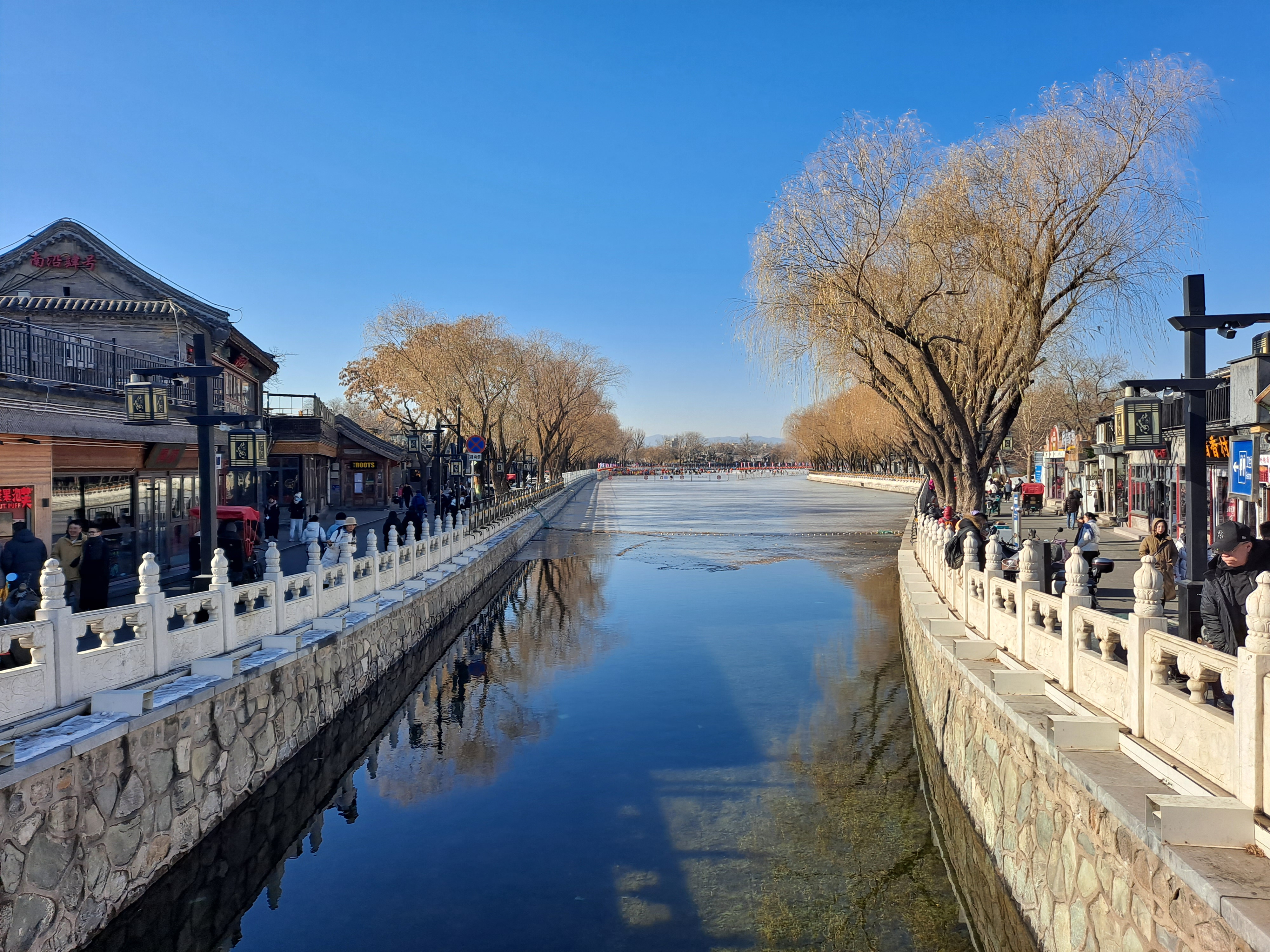
Houhai
Walk north along the shore of Qianhai on a summer evening and the transformation announces itself in stages. First the tourist shops thin out. Then the old courtyard walls press closer to the water. Then the music starts -- drifting from converted residences where bars and restaurants have colonized buildings that once housed Qing dynasty officials and their families. Houhai, the largest of the three lakes that compose the Shichahai district in central Beijing, has reinvented itself more dramatically than almost any neighborhood in the city, while the water at its center has remained essentially unchanged since Mongol engineers dug it seven hundred years ago.
Mongol Water, Imperial Privilege
The lake of Houhai was constructed during the Yuan dynasty, when Beijing was called Dadu and served as the winter capital of Kublai Khan's empire. The three connected lakes -- Qianhai (Front Lake), Houhai (Back Lake), and Xihai (Western Lake) -- formed part of the city's water system, providing both transportation and aesthetic pleasure to the Yuan court. The area was gentrified from the start, reserved exclusively for the royal family. When the Ming dynasty replaced the Yuan, the neighborhood retained its elite character. The street network laid out by Yuan planners survives in the hutong alleys that radiate from the shore, including the 787-meter-long Nanluogu Lane, considered one of the oldest hutong streets in Beijing. Many of the low-rise courtyard buildings along these lanes exhibit the traditional architectural features -- gray brick walls, ornamental roof tiles, carved doorframes -- that once defined the city's visual identity.
Where Old Beijing Comes Out at Night
The early 2000s changed Houhai from a quiet residential lakeside neighborhood into one of Beijing's liveliest destinations. Residences along the shore began converting into restaurants, bars, and cafes, their terraces extending toward the water's edge. The area drew foreign tourists first, then Beijing's expatriate community, and eventually younger generations of locals who found in Houhai's combination of historic atmosphere and modern nightlife something that did not exist elsewhere in the city. On warm evenings, the lake reflects strings of colored lights from the surrounding establishments while traditional Chinese boats glide across the surface. In winter, the lake freezes solid enough for ice skating, and the silence of the cold months provides a counterpoint to summer's energy.
Mansions Among the Hutongs
The Houhai neighborhood shelters some of Beijing's most significant historical residences. The Former Residence of Soong Ching-ling, the wife of Sun Yat-sen and later Honorary President of the People's Republic, sits on the lake's northern shore at a compound that once belonged to Qing dynasty princes. Prince Gong Mansion, one of the best-preserved princely estates in Beijing, occupies a sprawling complex nearby. The Drum Tower stands just east of the lake, marking time as it has for centuries. These landmarks anchor the neighborhood in a deeper history than the bars and cafes suggest, reminding visitors that the hutong alleys they walk through were laid out when Beijing was a Mongol capital and the lake at the center of it all was reserved for emperors who ruled an empire stretching from Korea to Hungary.
From the Air
Located at 39.9411N, 116.3789E in central Beijing's Xicheng District. Houhai is the northernmost of the three Shichahai lakes visible from the air as a chain of connected water bodies north-northwest of the Forbidden City. The Drum Tower is visible to the east. The lakes provide a useful visual reference point when navigating over central Beijing. Beijing Capital International Airport (ZBAA) is approximately 28 km to the northeast. Best viewed at 1,500-3,000 ft AGL.