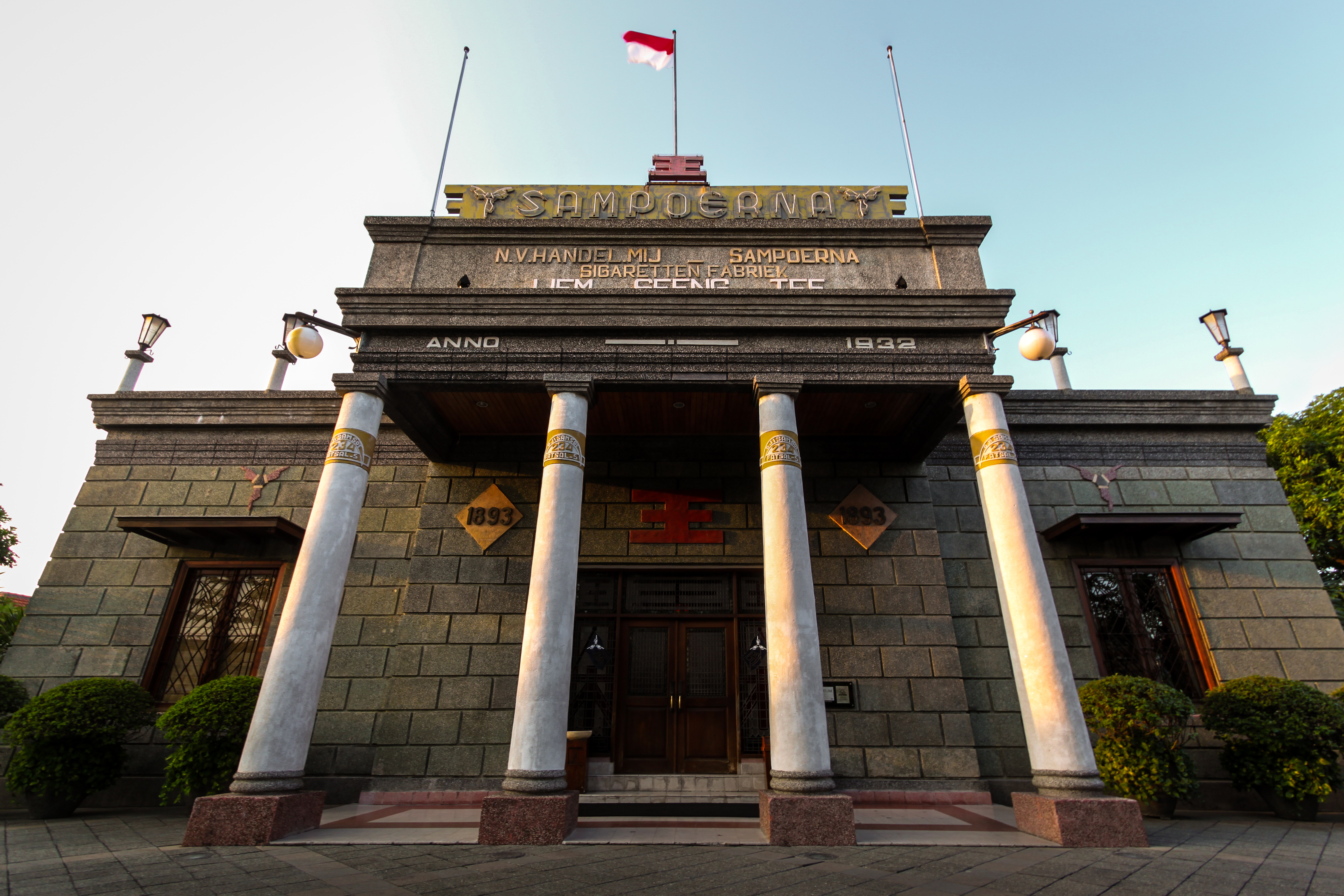
The Perfection of Smoke: Surabaya's House of Sampoerna
The smell hits you before you see anything. Cloves and tobacco, warm and sweet, drifting through the corridors of a 19th-century Dutch colonial building in Surabaya's old port district. Somewhere upstairs, hundreds of women sit at long tables, rolling kretek cigarettes by hand at the rate of 325 per hour each -- a rhythm so practiced it looks effortless. This is the House of Sampoerna, where Indonesia's most famous cigarette brand was born and where the factory floor doubles as a museum exhibit. Visitors walk through the ground-floor galleries, past sepia photographs and antique match collections, while above them the production line continues as it has for nearly a century. The building itself predates the business by seventy years. What began as a Dutch orphanage in 1862 became the foundation of a tobacco dynasty when a Chinese immigrant named Liem Seeng Tee bought the compound in 1932 and filled it with the scent of cloves.
From Charcoal to Cloves
Liem Seeng Tee arrived in Java from China's Fujian province in 1898 with nothing. He saved enough to buy a secondhand bicycle, which he rode around Surabaya selling charcoal. By 1913, he and his wife had scraped together enough to begin buying tobacco from local traders, experimenting with blends that mixed robust leaf with aromatic cloves and spices. The result was kretek -- the distinctive clove cigarette that crackles when smoked, named for the popping sound the cloves make as they burn. Liem launched his first brand, Dji Sam Soe, whose name derives from the Hokkien dialect meaning "two-three-four," a reference to the precise proportions in his closely guarded formula. The cigarettes sold fast. When success finally came in the 1930s, Liem changed his surname to Sampoerna -- an Indonesian word meaning "perfection." It was the kind of name a man chooses after a lifetime of proving he deserved it.
An Orphanage Reborn
The compound Liem purchased in 1932 was no ordinary factory site. Built in 1862 as a Dutch colonial orphanage, it featured a grand central auditorium flanked by two smaller buildings, with rows of single-story warehouse structures behind. Liem converted the side buildings into family residences and transformed the open warehouses into processing floors for every stage of kretek production: tobacco curing, clove blending, hand-rolling, packaging, and printing. The family lived where they worked, and the compound became a self-contained world of commerce and domesticity. For Sampoerna's 90th anniversary in 2003, the family restored the central auditorium into a museum. The eastern wing became a cafe and art gallery. The western building remains the family residence. A 1972 Rolls-Royce Silver Shadow, once used by the Sampoerna family, sits parked beside the main entrance -- an artifact of the wealth that cloves and tobacco built.
The Living Factory
What makes the House of Sampoerna unusual among museums is that it is still alive. The upper floors remain a working factory where more than 400 women hand-roll kretek cigarettes daily. Visitors can watch them through observation windows, each worker deftly shaping the tobacco-and-clove blend into tight cylinders with a speed that borders on mechanical. Photography is forbidden on the production floor, which only adds to the mystique. These hand-rolled kretek occupy a complicated place in Indonesian culture -- cherished as artisanal tradition, criticized as a health crisis, and economically vital to the thousands of families whose livelihoods depend on the rolling tables. In 2005, Philip Morris International acquired nearly 98 percent of Sampoerna, folding the family dynasty into the world's largest tobacco corporation. The hand-rolling continues, but the empire Liem built now belongs to different hands.
Tracing Old Surabaya
The House of Sampoerna also serves as a gateway to the city's colonial past through the Surabaya Heritage Track, a sightseeing program that departs from the museum. Passengers board a bus modeled after the tramcars that once rattled through Surabaya's streets, winding through the old port district known as North Surabaya or "Old Surabaya." The route passes Dutch-era warehouses, Chinese shophouses, and the remnants of a trading city that once rivaled Batavia in commercial importance. Surabaya has never polished its colonial architecture for tourists the way Jakarta or Yogyakarta have. Buildings decay where maintenance cannot reach, and commerce fills the structures that survive. The Heritage Track offers a curated glimpse into this layered history -- the "Babad Surabaya" traditional chronicles, the multicultural trading networks, and the architectural evidence of a port city that has reinvented itself repeatedly over centuries.
From the Air
Located at 7.23S, 112.73E in Surabaya's old port district near the Kalimas River. Juanda International Airport (WARR/SUB) lies approximately 20km to the south. The building compound is in the dense urban fabric of North Surabaya near the waterfront. At lower altitudes, the colonial architecture of the old port district is visible along the river. The Madura Strait and Suramadu Bridge are visible to the northeast. Tropical monsoon climate with high humidity year-round.