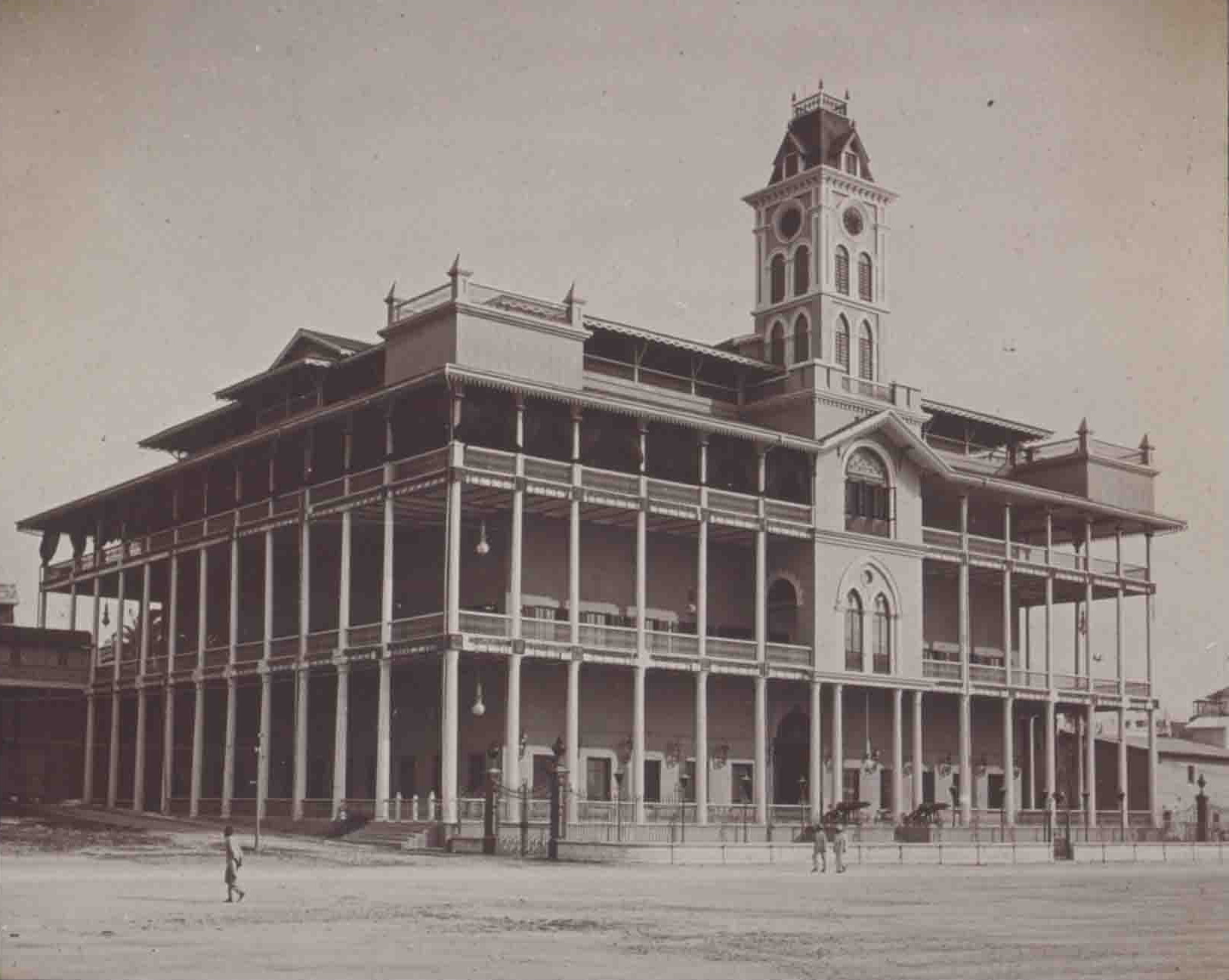
House of Wonders
It was the first building in Zanzibar to have electricity. The first building in all of East Africa to have an elevator. When Sultan Barghash bin Said commissioned this ceremonial palace in 1883, he wanted the world to know that Zanzibar was modern, powerful, and watching the future. The Zanzibaris called it Beit al-Ajaib -- the House of Wonders -- and the name stuck, outlasting the sultan, his dynasty, the British who took it over, the revolutionaries who converted it, and even parts of the building itself, which collapsed in December 2020 while workers were trying to save it.
A Sultan's Statement
Barghash bin Said, the second Sultan of Zanzibar, built the House of Wonders as a declaration. Designed by a British marine engineer, the palace introduced architectural elements unknown in Zanzibar: wide external verandas supported by cast-iron columns that allowed for uniquely high ceilings, an openness that mixed European engineering ambition with tropical necessity. The building materials were themselves a statement of synthesis -- coral rag, concrete slabs, mangrove shoots called boriti, and steel beams, combining local tradition with imported technology. Inside, marble floors and silver decorations arrived from Europe, while inner doors were carved with inscriptions from the Quran. Covered passages called wikios connected the House of Wonders above street level to two adjacent palaces, Beit al-Hukum and Beit al-Sahel, allowing the royal women to move between buildings unseen. The sultan reportedly had the main door built wide enough for him to ride an elephant through, and kept wild animals chained outside for display.
Forty-Five Minutes of War
On 27 August 1896, the Anglo-Zanzibar War -- often called the shortest war in recorded history -- changed the Stone Town waterfront. British warships bombarded the seafront, destroying a lighthouse that stood in front of the House of Wonders and reducing the adjacent Beit al-Hukum Palace to rubble. The House of Wonders survived with minor damage, and during reconstruction in 1897 a clock tower was added to its facade. Because Beit al-Hukum was never rebuilt and its site became a garden, the House of Wonders gained the visual dominance along Mizingani Road that it holds today. The Sultan and his harem finally occupied the palace fully only after the bombardment. But that residency was brief in historical terms. By 1911, the British had transformed it into government offices and their main secretariat in Zanzibar.
Revolution and Reinvention
The Zanzibar Revolution of 1964 overthrew the sultanate and ushered in a new era. The House of Wonders was converted into a school and later a museum for the ruling Afro-Shirazi Party, with North Korean assistance in the conversion. Through the following decades, the building accumulated new layers of purpose and meaning. Beginning in 1992, museum development transformed it again. By the early 2000s, the House of Wonders Museum had opened with permanent exhibits on Swahili and Zanzibari culture and the East African environment. A traditional Swahili sailing vessel called a mtepe dominated the inner courtyard, and Abeid Karume's car sat on display upstairs. As Stone Town earned UNESCO World Heritage status, the House of Wonders became one of its most recognizable landmarks -- the largest and tallest building in the old town, its tiers of verandas and clock tower facing the Forodhani Gardens on the seafront.
A Building Falls
The coral rag that gives Stone Town its warm reddish color is also fragile. The House of Wonders began deteriorating visibly in the 2010s. Large sections of the veranda collapsed in 2012. Part of the roof followed in 2015. The museum relocated. A rehabilitation effort funded by the government of Oman, valued at 10 billion Tanzanian shillings, was underway when, on 25 December 2020, much of the frontal facade -- including the iconic clock tower -- came down. Two workers died in the collapse; four others were rescued from the rubble. The shock among Zanzibaris was profound. This was not just a building but a symbol, a structure that had survived bombardment and revolution only to crumble during the attempt to preserve it. Plans for reconstruction using the original architectural drawings were announced, but the loss was felt as something that blueprints alone could not restore.
From the Air
The House of Wonders (6.16S, 39.19E) stands on Stone Town's waterfront along Mizingani Road, facing the Forodhani Gardens. From the air, Stone Town's dense historic core is visible on Unguja's western coast. The House of Wonders is the largest structure in the old town, though partial collapse in 2020 has altered its profile. It sits between the Old Fort (to the south) and the Palace Museum (to the north). Nearest airport: Abeid Amani Karume International Airport (HTZA/ZNZ), approximately 5km south. The seafront buildings and Forodhani Gardens provide orientation landmarks from altitude.