Housesteads Roman Fort
Two skeletons lie beneath a freshly laid floor. When archaeologists lifted the flagstones of a building in the civilian settlement outside Housesteads, they found the remains and named the structure the "Murder House" -- a cold-case mystery almost two millennia old. It is a fitting introduction to this place. Housesteads is not a sanitised ruin but the most complete picture we have of daily life on Rome's most dramatic frontier.
Perched on the Edge of Empire
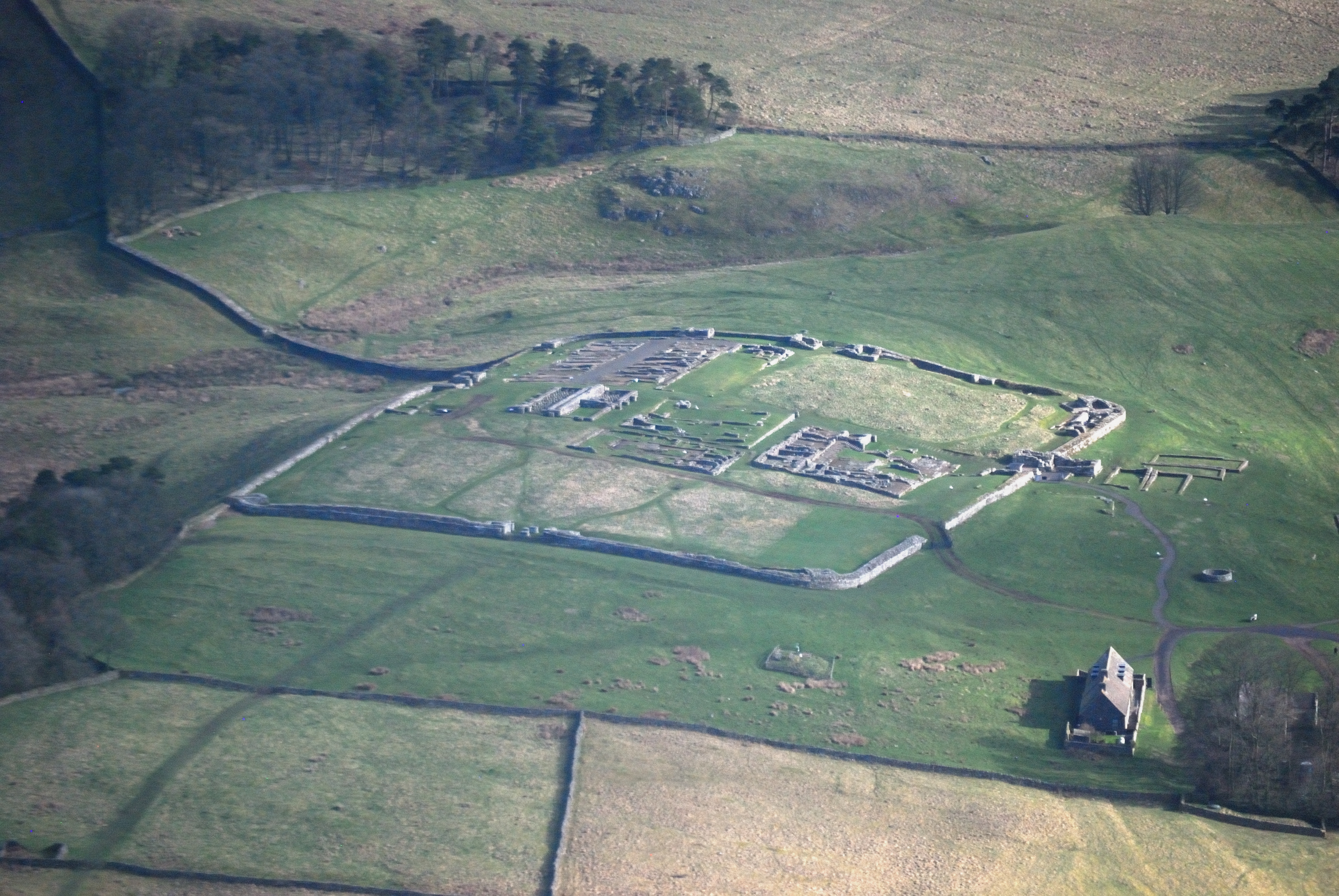
The fort sits on a mile-long crag of the Whin Sill, a ridge of dark dolerite that gives Hadrian's Wall its most spectacular stretch. The Romans called it Vercovicium, and from its ramparts the view sweeps north over empty, rolling hills that were once enemy territory. Built in stone around AD 124, the fort was one of a series added to the Wall after a change of plan -- originally, the barrier was to have only smaller milecastles. A turret on the site was demolished to make way for the new fort, its northern wall sitting directly on the original Broad Wall foundation. For nearly three hundred years, soldiers garrisoned this windswept outpost, watching the land beyond the Wall and maintaining order along the frontier.
Where Soldiers Sat Together
The latrines at Housesteads are among the best-preserved in Roman Britain, and they tell a story no inscription could. Placed at the lowest corner of the fort for drainage, the stone seats are arranged along three walls with a water channel running beneath them and a tank at the rear still showing its original lead sealing. There were no cubicles, no privacy. Roman soldiers used communal sponges on sticks, rinsed in a gutter of running water at their feet. The intimacy of the arrangement speaks to a military culture in which shared hardship was the norm. Nearby, the granary floors were raised on stone pillars to keep food dry and free from vermin -- a practical solution visible in the rows of squat columns that still stand.
Tungrians on the Frontier
Housesteads was not garrisoned by Italians. From around AD 205, it was home to the First Cohort of Tungrians, a unit recruited from what is now Belgium, nominally a thousand strong. They were supplemented by the Cuneus Frisionum, a Frisian cavalry unit whose name refers to the wedge formation they used in battle, and the numerus Hnaudifridi, a Germanic scout unit. According to the Notitia Dignitatum, the late-Roman military register, the Tungrians were still posted here in the fourth century. These were not Roman citizens by birth but auxiliary troops who earned citizenship through service -- men from the flatlands of northern Europe spending their careers on a wind-blasted English ridge, thousands of miles from home.
The Town Outside the Walls
Beyond the fort's southern gate, a substantial civilian settlement grew up to serve the garrison. Stone foundations of shops, taverns, and homes are still visible, their outlines tracing the streets of a small frontier town. It was here that the Murder House stood, its grim secret sealed beneath a new floor. The settlement was abandoned around AD 270, well before the Romans left Britain entirely in AD 409. Why it emptied while the fort continued is unclear -- perhaps the frontier grew too dangerous for undefended civilians, or perhaps the economy that sustained the town simply collapsed. What remains is remarkably unusual for Roman Britain: the fort had no running water supply and depended entirely on rainwater, collected in large stone-lined cisterns arranged around its walls.
Clayton's Rescue
After the Romans left, centuries of neglect buried the fort under soil and later buildings. In 1838, amateur historian John Clayton purchased the farm that had grown up against the south gate. Clayton was methodically buying Roman Wall properties to protect them from destruction, and at Housesteads he cleared away later structures and built a new farmhouse nearby around 1860. When his descendant attempted to auction the fort in 1929, it failed to reach its reserve price -- and was donated to the National Trust in 1930. Today the site is managed by English Heritage, and finds from Housesteads can be seen in the site museum, at Chesters, and in the Great North Museum in Newcastle. The fort endures as the grandest station on the Wall, a place where the machinery of empire is laid bare in stone.
From the Air
Housesteads Roman Fort sits at 55.013N, 2.331W on the dramatic Whin Sill escarpment. The fort's rectangular outline is clearly visible from the air, set against the snaking line of Hadrian's Wall running east-west along the crag. Best viewed at 1,500-3,000 ft AGL. The Wall path and surrounding Northumberland National Park provide striking context. Nearest ICAO: EGNT (Newcastle) approximately 25nm east.