Houtong Cat Village
Drivers entering Houtong are greeted by a sign that reads: A lot of stray cats here. Drive slowly. It is not the kind of welcome most villages aspire to. But Houtong is not most villages. This former coal mining settlement in Ruifang District, perched in the green mountains above the Keelung River, was dying - hollowed out by the same industrial decline that gutted mining communities worldwide. Then the cats showed up, or rather, someone noticed they had been there all along, and everything changed.
The name Houtong - sometimes romanized as Houdong - originally derived from the Hokkien term Kau-tong, a reference to a cave once inhabited by monkeys. The monkeys are long gone. The cats, emphatically, are not.
Black Gold to Black Lung
Before the cats, there was coal. Houtong sits in the mountains of Ruifang, a district whose geology made it one of Taiwan's most productive mining regions during the Japanese colonial era and the decades that followed. At its peak, Houtong produced roughly 220,000 tons of coal annually - the largest output of any single area in Taiwan. The wealth attracted immigrants, and the village swelled to some 900 households with a population exceeding 6,000 people. A coal purification factory, built in 1920, processed the raw material before it was shipped out by the railway that connected the village to the broader network. The railway, built during the Japanese occupation, became the lifeline of a community entirely dependent on what lay beneath the mountain. When coal declined in the 1990s, that lifeline went slack. Young residents left to find work elsewhere. The population dropped to a few hundred. Houtong became one of countless former mining villages across Asia - places with impressive infrastructure and no economic reason to maintain it.
The Viral Rescue
In 2008, a local cat enthusiast organized an effort to care for the abandoned and stray cats that had accumulated in the depopulated village. Cats had gravitated to Houtong for the same reasons cats gravitate anywhere: food scraps, shelter in empty buildings, and an absence of the human density that tends to drive feral populations away. The enthusiast photographed the cats and posted the images online. The response was immediate and overwhelming. Cat lovers across Taiwan discovered the village, shared the images, and began visiting. Within months, Houtong had transformed from a forgotten mining relic into a destination. CNN Travel, the Wall Street Journal, and other international outlets covered the story of a village resurrected by felines. The cats were not props imported for tourism. They were the natural consequence of abandonment, and their presence gave the village a second identity strong enough to replace the first.
Infrastructure for Whiskers
Houtong adapted to its new residents with a seriousness that borders on civic devotion. A special elevated bridge was constructed above the busy railway line, designed specifically to give cats safe passage between the two halves of the village. Shops and cafes opened along the old mining streets, their menus featuring cat-themed desserts and their walls decorated with feline art. The cats themselves are managed with care: a sterilization program keeps the population stable, and neutered cats have one ear trimmed as identification, allowing caretakers to track which animals have been processed and to identify newcomers. The system balances welfare with spectacle - the cats are not pets, but neither are they entirely wild. They occupy a middle ground, cared for by the community but free to roam the steps, rooftops, and alleyways of a village that now exists, in large part, for their benefit. From nearby Jiufen, the famous hilltop tourist village, Houtong is a ten-minute taxi ride and roughly NT$350, making it an easy addition to a day trip through the mining district.
Green Water and Mountain Trails
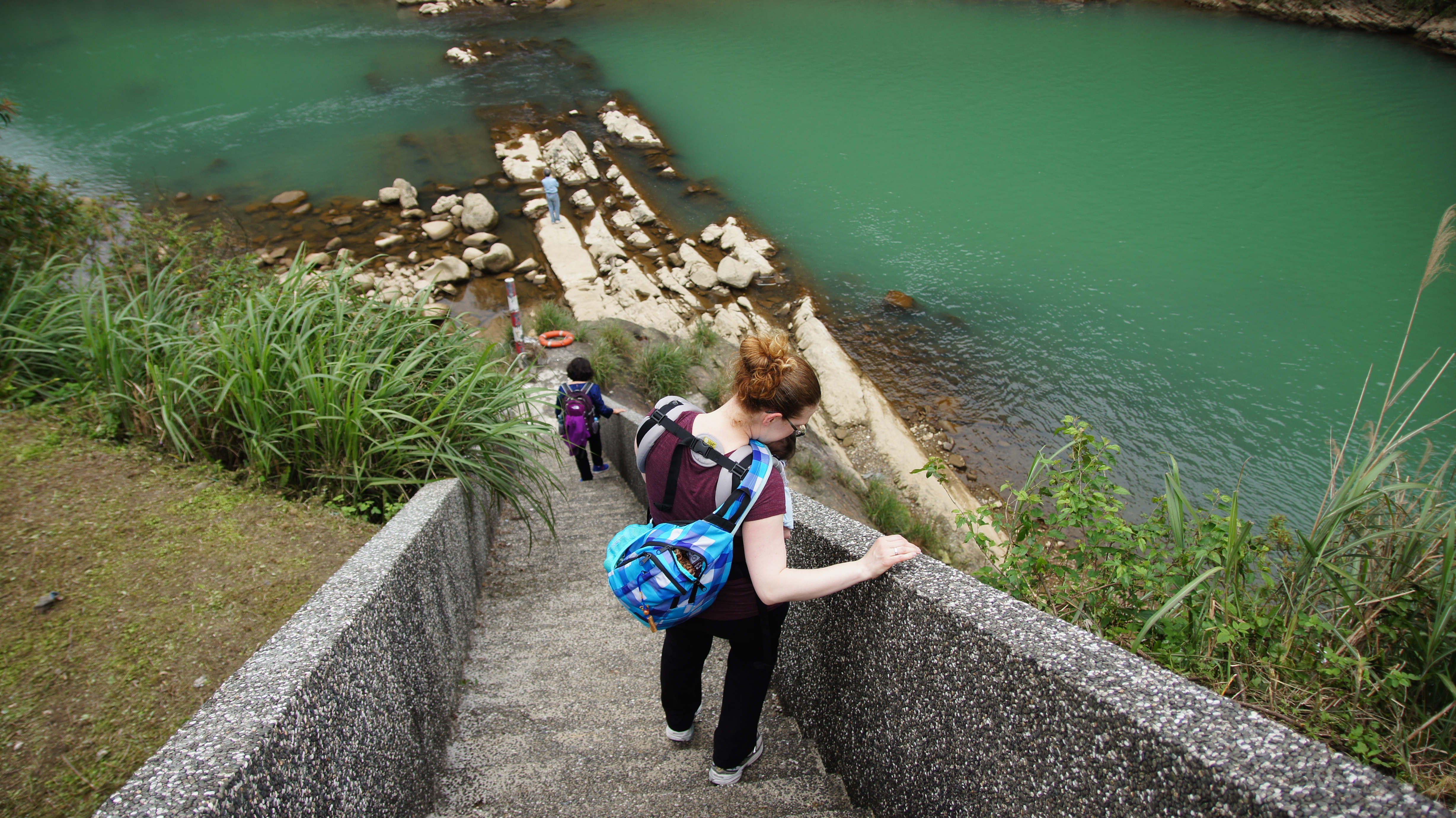
Beyond the cats, Houtong offers something that its tourist branding tends to underplay: genuine natural beauty. The village sits near the headwaters of the Keelung River, and the water here runs clear and green, accessible via stone steps from the village. The surrounding mountains are laced with hiking trails, two of which connect Houtong directly to Jiufen - a walk through forested ridgelines that the mining railway once served for entirely different purposes. The landscape is the same one that drew miners a century ago: steep, verdant, rich with the geological wealth that funded the railway, the purification factory, and the 6,000-person community that once thrived here. The coal is gone. The miners are gone. What remains is the terrain itself - the river, the mountains, the railway that still carries passengers through Houtong station - and several hundred cats who have claimed the ruins of one industry as the foundation of another.
From the Air
Located at 25.09°N, 121.83°E in the mountainous Ruifang District of New Taipei, Taiwan. The village sits in a narrow river valley along the Keelung River, with the railway line running through the center. From altitude, look for the railway cutting through steep green mountains northeast of Taipei. Houtong station is on the Taiwan Railway Administration's Yilan Line. The village of Jiufen is visible on a nearby hillside to the east. Taipei Songshan Airport (RCSS/TSA) is approximately 25km to the west. Taiwan Taoyuan International Airport (RCTP/TPE) is about 55km to the west-southwest. The terrain is steep and heavily forested, with the river valley providing the only flat ground. Weather is frequently wet, with mountain fog common in the mornings.