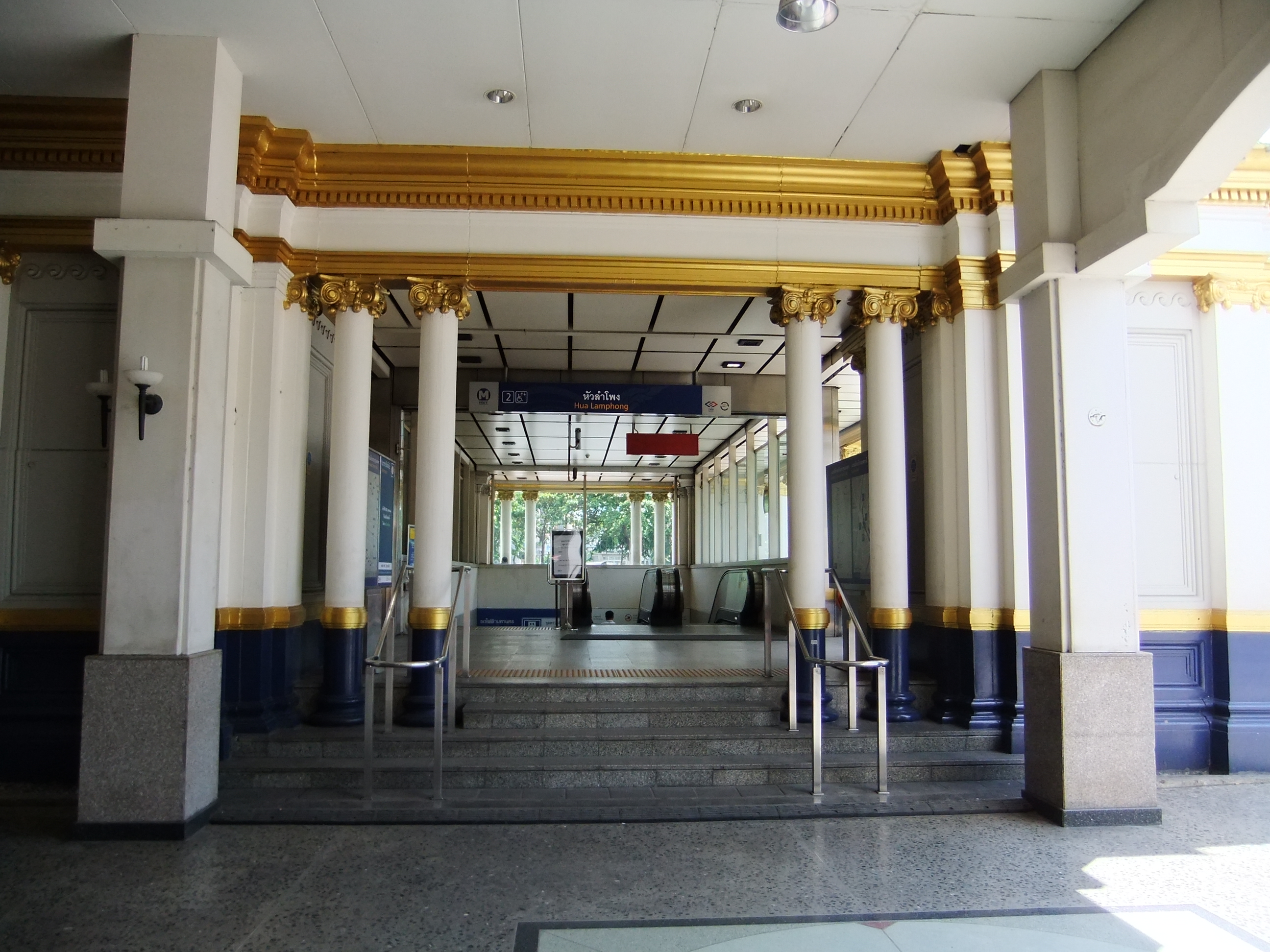
Hua Lamphong Railway Station
The name comes from a toxic plant. Datura metel -- called lamphong in Thai -- once grew wild in the plains where cattle grazed on the outskirts of old Bangkok. Another theory traces it to a Malay word for a temporary floating bridge. Either way, the name stuck to a canal, then a road, then a railway station that would become the place where Thailand's rail network began and, more than a century later, where it quietly ended. Hua Lamphong opened in 1916 with a Neo-Renaissance facade designed by Turin-born architect Mario Tamagno, and for 107 years it was the terminus where every long-distance train in Thailand either started or stopped. In January 2023, those trains moved to a gleaming new station across town. Hua Lamphong remains, beautiful and half-empty, a building caught between monument and museum.
An Italian Cathedral for Thai Rails
King Chulalongkorn -- Rama V -- visited Frankfurt in 1907 and was struck by the grandeur of its Hauptbahnhof. He returned to Siam with a vision for Bangkok's central station that was European in ambition. The architects he chose were Italian: Mario Tamagno and Annibale Rigotti, the same pair responsible for the Ananta Samakhom Throne Hall and Bang Khun Phrom Palace. Construction began in 1910, and the station opened on 25 June 1916. What Tamagno created looks like a piece of northern Italy transplanted to the tropics -- arched windows, a soaring hall, and stained-glass panels that filter Bangkok's fierce sunlight into green tones in the departure hall and warm amber in the arrivals area. The wooden roofs are ornately decorated. The overall effect is of a cathedral dedicated not to worship but to movement, a space designed to make the act of departure feel significant.
The Hub That Built a Nation
Thailand's first railway line, connecting Bangkok to Ayutthaya, was inaugurated by King Chulalongkorn and Queen Saovabha Phongsri on 26 March 1896. Large photographs of that event still hang above Hua Lamphong's platform entrances. Over the following century, the station grew into the nerve center of Thai rail travel -- 14 platforms, 22 ticket counters, and at its peak, roughly 200 trains and 60,000 passengers passing through daily. Between 1927 and 1969, the station even operated a transit hotel called the Rajdhani, with ten rooms for travelers who arrived too late to continue their journeys. During World War II, Allied bombing raids on Bangkok prompted the construction of a large air raid shelter in front of the station; after the war, it was replaced by a fountain featuring Erawan, the three-headed elephant of Hindu mythology, which still stands in the forecourt.
The Day the Trains Ran Free
Not all of Hua Lamphong's history is graceful. On 8 November 1986, six coupled locomotives at Bang Sue Depot had their engines left running during maintenance. Unmanned and unbraked, they rolled out of the depot and gathered speed along the tracks toward the city center. The runaway locomotives crashed into Hua Lamphong station, killing four people and injuring four others. The incident exposed vulnerabilities in the rail system's safety protocols and became one of the more unusual disasters in Thai railway history -- six engines, no driver, a straight path into the busiest station in the country.
A Station Without Trains
Plans to close Hua Lamphong began circulating in the 2010s, and the idea provoked fierce resistance. Protesters hung signs at stations across Thailand: 'Stop destroying Thai rail history. Cancel the closure of Hua Lamphong.' The cultural attachment ran deep -- generations of Thais associated the station with homecomings, departures, and the particular melancholy of long-distance travel. Google honored its 103rd anniversary with a Doodle in 2019. Still, on 19 January 2023, all long-distance trains were transferred to Krung Thep Aphiwat Central Terminal. Hua Lamphong now handles only ordinary and commuter trains on some lines, plus all Eastern line services. The grand hall, built to echo with the sounds of a nation in transit, has grown quieter. Plans call for a future MRT station beneath the building and potential conversion into a museum. For now, the stained glass still filters the light, the Erawan fountain still runs, and the station waits -- not quite abandoned, not quite alive -- for its next purpose.
From the Air
Located at 13.7389N, 100.5167E in the Pathum Wan district of central Bangkok. The station's distinctive arched roof and forecourt are identifiable from low altitude. It sits near the Khlong Phadung Krung Kasem canal. Nearest airports: Don Mueang (VTBD) approximately 14 nm north; Suvarnabhumi (VTBS) approximately 16 nm east-southeast.