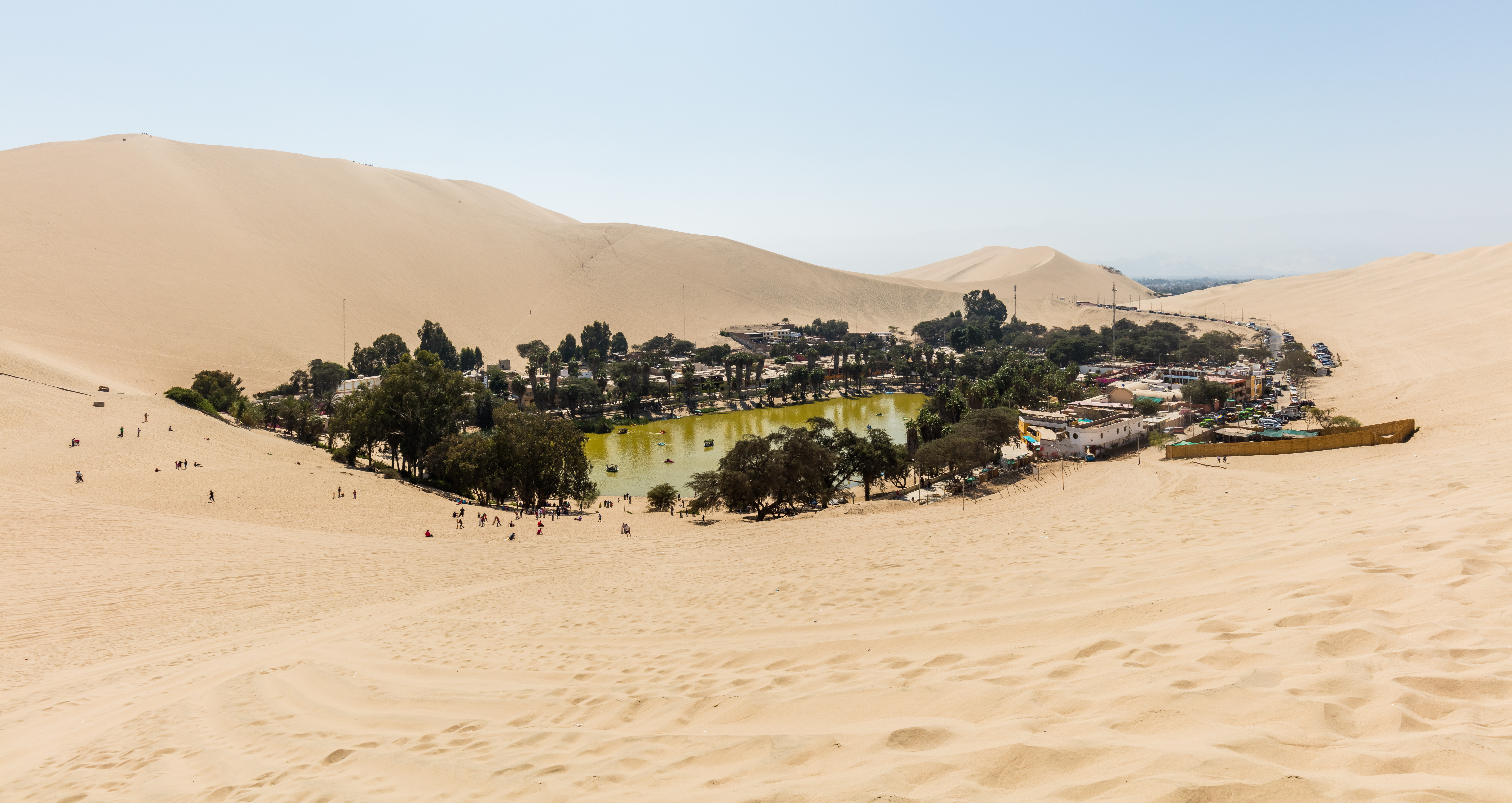
Huacachina
The lagoon appears like a hallucination. After kilometers of bone-dry desert outside the city of Ica in southern Peru, a cluster of palm trees and low buildings surrounds a pool of blue-green water, hemmed in on all sides by sand dunes that rise dozens of meters above the rooftops. Huacachina is so improbable that Peru put it on the 50 soles banknote -- the 1991 issue, one of three versions still circulating. The entire village can be crossed on foot in minutes. Its economy runs on a single product: the surreal experience of an oasis in the desert, amplified by dune buggies, sandboards, and sunsets that turn the sand from gold to copper to violet.
An Oasis Running on Borrowed Water
Huacachina's lagoon formed naturally from underground aquifer seepage, a rare upwelling in one of the driest regions on Earth. For generations, the water sustained itself. Then well-drilling in the surrounding area tapped into the same aquifer, and the lagoon began to shrink. By the early 2000s, the oasis that anchored the village's entire identity was visibly disappearing. In 2015, local business groups began pumping water into the lake to compensate for the loss -- an act of artificial life support that preserved the tourist destination but fundamentally changed what the lagoon is. What visitors see today is partly natural wonder, partly managed illusion. The palms are real, the sand is real, but the water level is maintained by human intervention, a desert oasis kept alive because too many livelihoods depend on it to let it die.
The Mermaid and the Dunes
Local legend holds that a mermaid lives in the lagoon and claims one man every year. The drownings are real -- the warm surface water can mask colder layers below, and muscle cramps have been blamed for the deaths of swimmers caught off guard by the temperature change. The legend persists because the place invites the mythic. Sand dunes tower over the village with the authority of canyon walls, their ridgelines sharp against a sky that rarely sees clouds. Walking to the crest of the tallest dune takes up to an hour, depending on fitness and stubbornness. The reward is a view in every direction: the green dot of the oasis below, the city of Ica shimmering to the northeast, and rolling dunes stretching to the horizon like frozen waves. At sunset, the light performs. The sand shifts through a spectrum of warm colors that photography flatters but cannot quite capture.
Sandboards and Dune Buggies
Huacachina's main attractions are loud, fast, and covered in sand. Dune buggy tours, typically two hours long, launch in the late afternoon when the light is golden and the sand has cooled enough to touch. Drivers pilot modified vehicles up near-vertical dune faces and down the other side at speeds that blur the line between tourism and survival instinct. Sandboarding follows: boards waxed with cera for speed, riders pointed downhill on slopes that would intimidate a skier. Most visitors abandon the standing position within minutes and finish face-down on their stomachs, sled-style, which turns out to be both simpler and alarmingly fast. The combination of adrenaline and absurdity -- surfing down sand dunes in one of the driest places on Earth -- is what keeps Huacachina on the backpacker circuit despite its small size and limited infrastructure.
Pisco Country
The surrounding Ica valley is Peru's heartland for pisco and wine production. Bodegas range from family-run artisanal operations, where grapes are still crushed by foot during the February and March harvest, to industrial facilities that supply the national market and export to Europe and the United States. Visiting the bodegas is a standard side trip from Huacachina -- tours are often free, since the wineries profit from sales rather than admission. The artisanal bodega Catador and the larger operations at Tacama and Vista Alegre are among the most visited. The connection between the oasis and the surrounding wine country runs deeper than tourism logistics: this is the same region whose vineyards once made Peru the leading wine producer in the Americas, before the devastating earthquake of 1687 destroyed the cellars and shifted the industry permanently to Chile.
From the Air
Located at 14.09S, 75.76W, approximately 5 km southwest of the city of Ica in southern Peru. The oasis is visible from 3,000-5,000 feet AGL as a small green patch surrounded by massive sand dunes, contrasting sharply with the surrounding desert and the urban grid of Ica to the northeast. Nearest airport: Ica / Las Dunas Airport. Pisco / Capitan FAP Renán Elías Olivera Airport (SPSO) is approximately 60 km to the west. Lima's Jorge Chávez International Airport (SPJC) is about 300 km to the northwest. The Nazca Lines are roughly 140 km to the southeast.