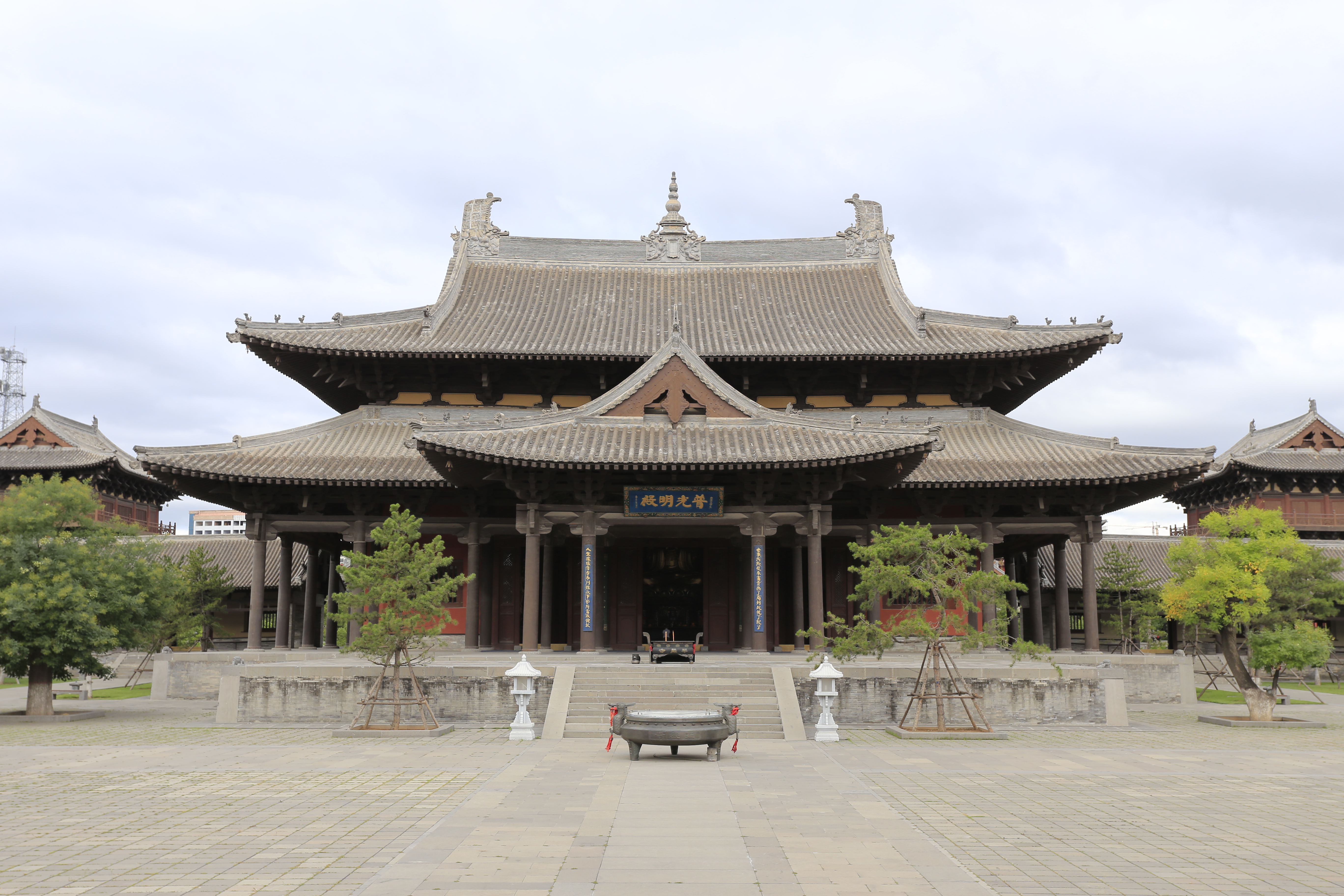
Huayan Temple (Datong)
Fire has been the recurring antagonist in Huayan Temple's story. Founded in 1038 during the Liao dynasty, burned in 1122 during the Liao-Jin war, rebuilt in 1140, expanded to hundreds of halls under the Yuan dynasty, destroyed again in battle between Mongol and Hongjin armies, confiscated during the early Ming, and then reduced to ashes once more in 1648 -- Huayan Temple has been rebuilt so many times that its survival feels less like luck than like sheer institutional willpower. Through it all, two structures endured: the massive Daxiongbao Hall and the Bojia Jiaozang Hall, their Liao and Jin dynasty bones intact beneath layers of repair.
Named for a Sutra
The temple takes its name from the Avatamsaka Sutra, known in Chinese as the Huayan Sutra, one of the most influential texts in East Asian Buddhism. Established during the seventh year of the Chongxi period under the Liao dynasty, the temple was built to face east rather than the more conventional south -- an orientation that reflects Khitan architectural preferences. The Liao rulers, who were of Khitan ethnicity, maintained their own building traditions even as they absorbed Chinese Buddhist practice, and Huayan Temple stands as evidence of that cultural negotiation.
A Hall the Size of a Dynasty
The Daxiongbao Hall is staggering in its dimensions. Nine rooms wide and five rooms deep, it covers 1,559 square meters and stands on a platform more than four meters high. The hall is one of the two largest surviving historical temple buildings in China, matched only by the Daxiongbao Hall of Fengguo Temple in Liaoning. The roof ridge ornaments alone reach 4.5 meters in height, with each glazed tile measuring 76 centimeters and weighing 27 kilograms. At each end of the main ridge sits a giant Chiwen, a dragon-headed, fish-tailed creature rendered in colorful glaze -- relics from the Jin and Ming dynasties that survived the 1648 fire. Inside, the hall enshrines the Five Tathagatas, carved during the Ming dynasty's Xuande period, three in wood and two in clay.
Walls That Teach
Nearly 900 square meters of murals cover three walls of the Daxiongbao Hall. Painted during the Qing dynasty's Guangxu period by a group of craftsmen, they depict scenes from Buddhist scripture: Sudhana's pilgrimage to fifty-three spiritual teachers from the Avatamsaka Sutra, children worshipping the Bodhisattva Guanyin, and the thousand-armed manifestation of Guanyin known as Qianyan Qianshou. The ceiling holds 73 painted panels depicting dragons, phoenixes, flowers, and Sanskrit characters. Outside the hall entrance, four stone steles bear inscriptions of the Yijing by Zhu Xi, the great Neo-Confucian scholar, bridging Buddhist architecture with Confucian scholarship on a single wall.
The Library That Time Preserved
The Bojia Jiaozang Hall -- the Bhagavan Sutra Hall -- is where Huayan Temple stores its most precious contents. Built in 1038, the hall retains Tang dynasty architectural elements in its deep, double-tiered eaves and gently sloping beams. Inside, thirty-one Liao dynasty statues remain in their original positions, representing the Three Buddhas of the Three Times: Dipankara for the past, Sakyamuni for the present, and Maitreya for the future. Thirty-eight pavilion-style wooden wall cabinets, arranged in a circular layout on waist-high Sumeru pedestals, hold more than 18,000 volumes of Buddhist scripture from the Ming and Qing dynasties. The temple received national cultural site protection in 1961 and designation as a National Key Buddhist Temple in 1983.
From the Air
Located at 40.09°N, 113.29°E in the old city of Datong, Shanxi Province. The temple compound is within the walled city, near Shanhua Temple and the Prince's Palace. Nearest airport is Datong Yungang Airport (ZBDT). The temple's east-facing orientation and large hall rooflines distinguish it from surrounding structures.