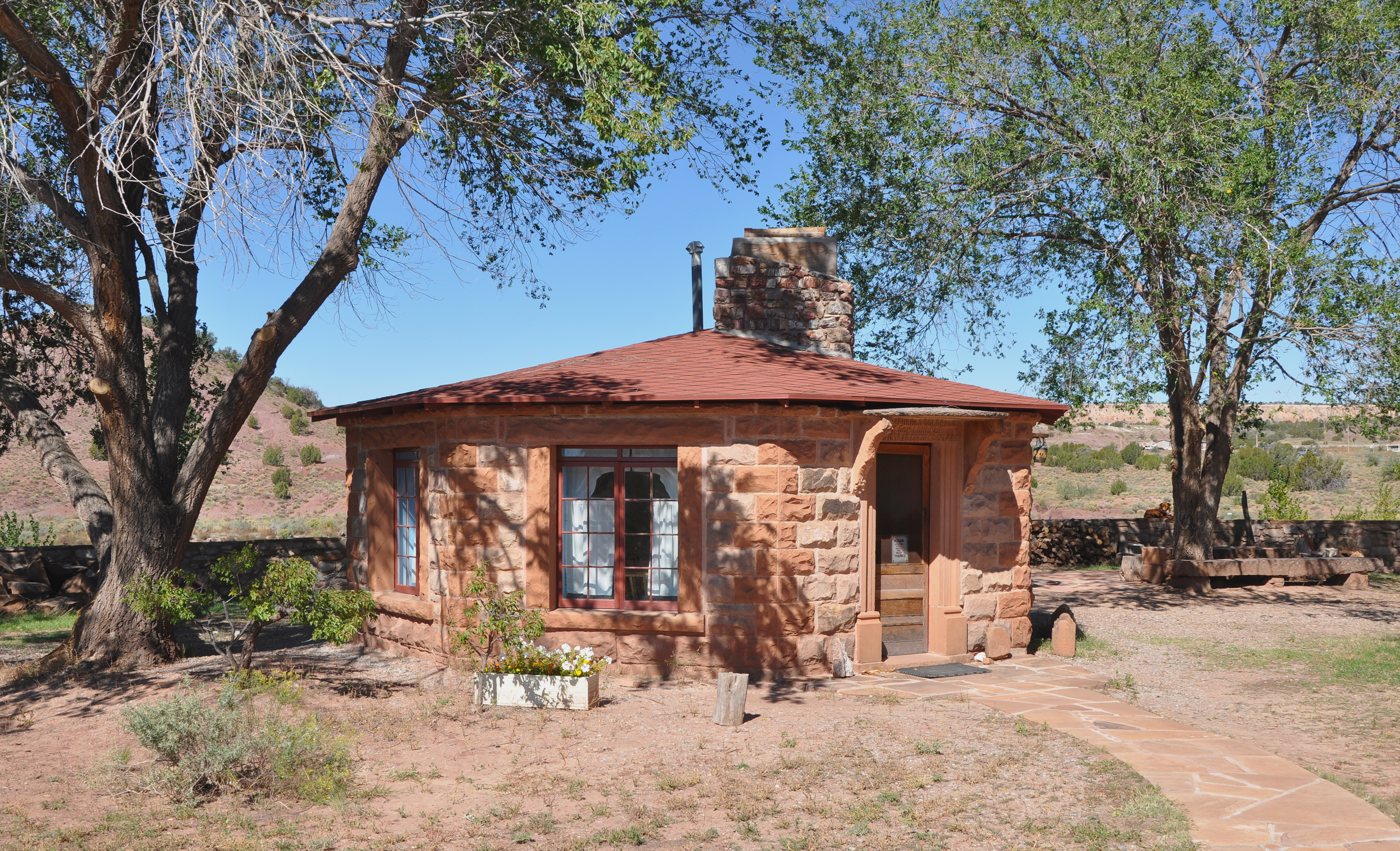
Hubbell Trading Post National Historic Site
At the top of a cone-shaped hill northwest of the trading post, John Lorenzo Hubbell and a Navajo herdsman named Many Horses lie buried side by side. They were friends for decades, separated by culture and language but united by something harder to name -- a mutual respect forged over countless transactions of wool, silver, and turquoise. That friendship, and the commerce that sustained it, still echoes through the sandstone walls of Hubbell Trading Post in Ganado, Arizona. Established around 1878 and operating continuously ever since, this is the oldest trading post on the Navajo Nation, a place where two cultures met and, remarkably, kept meeting for nearly 150 years.
After the Long Walk
When the Navajos returned from the Long Walk in 1868, they came home to devastation. Their herds had been decimated, their fields destroyed. The Treaty of 1868 allowed survivors to leave the Bosque Redondo internment camp and return to a portion of their ancestral homeland -- roughly one-fourth the territory they had inhabited before forced removal. Executive orders and Congressional legislation gradually expanded the reservation to its current size of more than six million acres, but in those early years the Navajo people faced severe economic depression. Trade became a lifeline. Native American tribes in the Southwest had traded among themselves for centuries, but the four years of internment at Bosque Redondo had introduced the Navajos to new goods: flour, sugar, coffee, tobacco, tools, and cloth. They needed suppliers, and the trading post became the institution that bridged two worlds.
The Trader of Ganado
John Lorenzo Hubbell arrived in the Ganado Valley in 1876, less than a decade after the Long Walk. He was twenty-three years old, trilingual in English, Spanish, and Navajo, the son of an Anglo father and a Hispanic mother raised in the village of Pajarito just south of Albuquerque. In 1878, he purchased a small compound from trader William Leonard and began building what would become a commercial empire of more than twenty trading posts. Hubbell was not merely a shopkeeper. He served as banker, postmaster, and cultural intermediary. Navajo customers pawned silver and turquoise for credit. Wool, sheep, rugs, jewelry, baskets, and pottery flowed across his counter in exchange for staple goods -- and it was years before cash entered the equation. Unlike other traders who left families back east, Hubbell brought his wife Lina Rubi and their four children to live in Ganado year-round, gradually transforming a plain adobe building into a comfortable home decorated with paintings, artifacts, and large Navajo rugs.
Sandstone, Pine, and Cornstalks
Heavy sandstones quarried from the surrounding area in 1883 formed the walls of the trading post's main building, set along the southern banks of the Pueblo Colorado Wash. Construction of the barn began in 1897 and was completed in 1900 by local builders who fashioned roofs in the style of ancient Ancestral Puebloan dwellings: layers of ponderosa pine beams, aspen poles, juniper bark, cornstalks, and dirt, each at right angles to the one below, lifted into place by mules and pulleys. The ponderosa timbers came from high ground east of Ganado Village, while the aspen poles traveled farther, from the Chuska Mountains straddling the Arizona-New Mexico state line a hundred miles to the north. The guest house, built in the 1930s by Hubbell's son Roman and daughter-in-law Dorothy, follows the traditional Navajo hogan style -- one room, six or eight sides, door facing east. Artists, anthropologists, statesmen, and ordinary travelers all found lodging there.
Where Water Drew People
The Pueblo Colorado Wash courses along the northern boundary of the Hubbell settlement, and in sections of the Ganado-Cornfields valley it runs year-round, fed by springs. In the arid Southwest, dependable water has always been a magnet for settlement. Ancestral Puebloans built villages up and down this valley hundreds of years ago. The Navajos came later, and then the traders -- all drawn to the same resource. Hubbell homesteaded his land before the reservation expanded to surround it, and it took an act of Congress for him to keep his home. Freight wagons hauled supplies from the railroad town of Gallup, New Mexico -- two to four days' travel in good weather -- and returned loaded with huge sacks of wool. Corrals built of juniper logs driven upright into the ground held lambs and sheep purchased from Navajo stockmen, waiting to be herded to the railroad.
Still Trading
Hubbell maintained friendships with many of his Navajo customers until his death in 1930. His son Roman then ran the business until his own death in 1957, after which Roman's wife Dorothy managed the post for another decade. In 1967, the family sold the property to the National Park Service. The trading post had already been declared a National Historic Landmark in 1960. Today, the site encompasses 160 acres of the original homestead, including the trading post, family home, outbuildings, and a visitor center. The non-profit Western National Parks Association operates the store, maintaining the trading traditions the Hubbell family established. Visitors can watch weaving demonstrations and walk across the same wooden floors that generations of traders and Navajo weavers once crossed. The initials carved on the gate of the privacy wall still stand for John Lorenzo Hubbell -- the young man who bet his future on understanding another culture.
From the Air
Located at 35.72°N, 109.56°W in Ganado, Arizona, on the Navajo Nation. The settlement sits along the Pueblo Colorado Wash in a broad valley. Hubbell Hill with the family cemetery is visible northwest of the compound. Nearest airport: Window Rock Airport (KRQE) approximately 25 nm east. Gallup Municipal Airport (KGUP) is about 50 nm east-southeast. Terrain elevation approximately 6,300 ft. Best viewed at lower altitudes in clear conditions for the historic compound and surrounding valley.