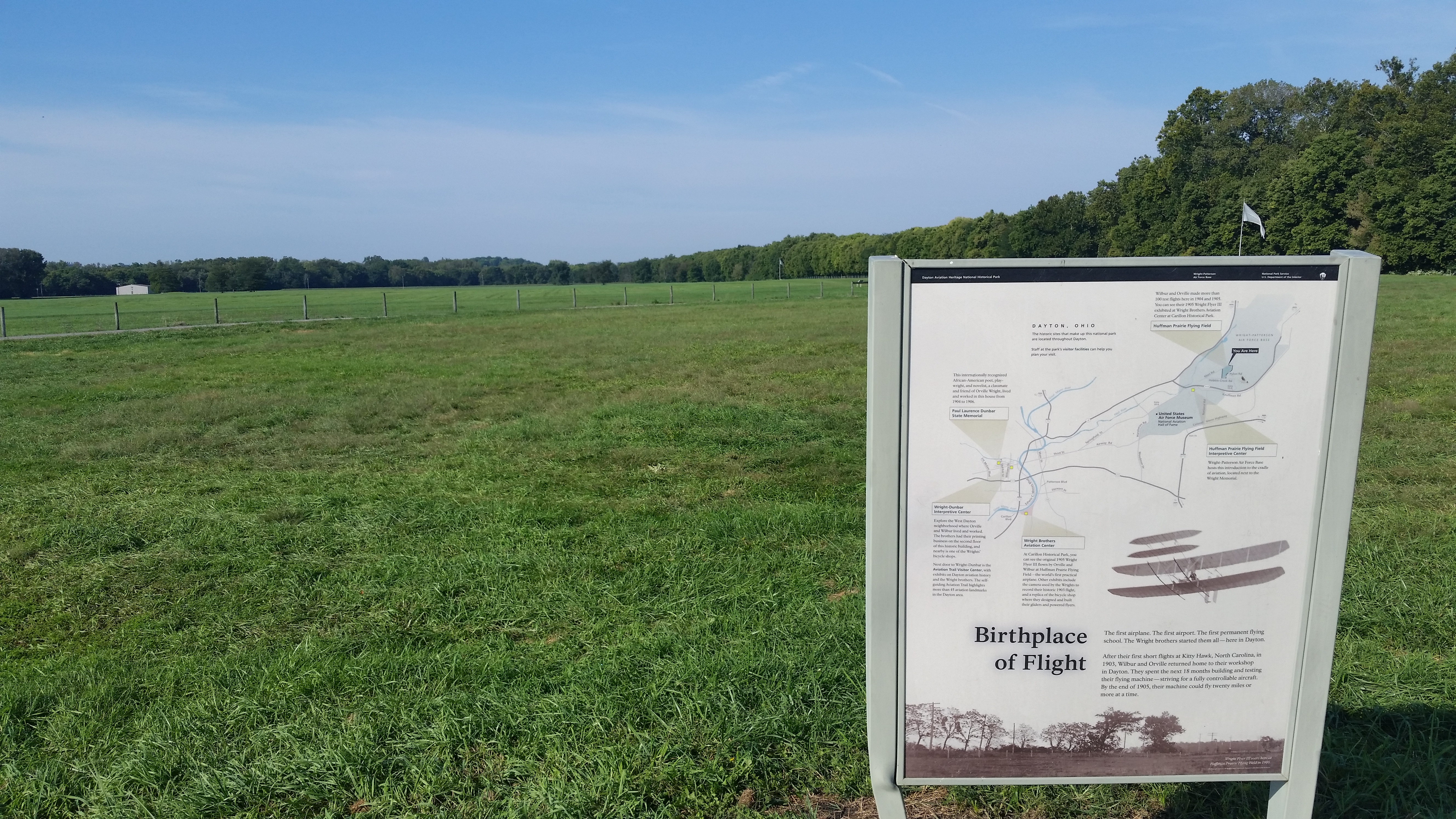
Huffman Prairie: The Cow Pasture Where Flight Became Real
Kitty Hawk gets the glory, but Huffman Prairie is where the airplane actually learned to fly. After their famous twelve seconds of powered flight on the North Carolina dunes in December 1903, Wilbur and Orville Wright came home to Dayton with a machine that could barely stay aloft and a problem nobody else was solving: how to make an airplane that a pilot could actually control. They needed a practice field. Dayton banker Torrence Huffman offered them 84 acres of rough cow pasture near a trolley stop called Simms Station, free of charge, with one reported condition - that they shoo his cows out of the way before flying.
From Twelve Seconds to Thirty-Nine Minutes
The Wrights made approximately 150 flights at Huffman Prairie between 1904 and 1905, a period of relentless experimentation that transformed aviation from a stunt into a technology. Their Wright Flyer II, tested beginning in April 1904, was an improvement over the Kitty Hawk machine but still unstable and difficult to control. Flight after flight, crash after crash, they refined the design. By 1905, the Wright Flyer III could bank, turn, and fly figure eights over the pasture. On October 5, 1905, Wilbur flew for 39 minutes and 23 seconds, covering 24 miles in circles above the field. The brothers considered the Flyer III the world's first practical airplane - a machine that could take off, maneuver, and land under full pilot control. That restored aircraft now sits in Carillon Historical Park in Dayton.
The School That Trained Generals
In 1910, the Wright Company established its testing operations and Wright Flying School at Huffman Prairie. The school trained more than a hundred pilots, among them some of the most consequential figures in American military aviation. Henry H. "Hap" Arnold, who would become the commanding general of the Army Air Forces during World War II and the only person to hold the rank of General of the Air Force, learned to fly here. Thomas DeWitt Milling, who became one of the Army's first rated pilots, trained at the same field. The pasture where two bicycle mechanics taught themselves to fly became the proving ground for the men who would build American air power.
From Prairie to Air Force Base
The United States Army Signal Corps purchased Huffman Prairie and 2,000 surrounding acres in 1917, renaming the installation Wilbur Wright Field. The small cow pasture had become a military asset. In 1948, the field merged with nearby Patterson Field to form Wright-Patterson Air Force Base, which today employs roughly 27,000 people and serves as headquarters for Air Force Materiel Command. The original 84-acre flying field sits within the base perimeter, preserved but enclosed by a vast military-industrial complex that traces its origins directly to two brothers and a borrowed pasture.
Walking Where the Wrights Flew
The National Park Service operates Huffman Prairie as part of the Dayton Aviation Heritage National Historical Park. Visitors enter through a separate gate on the Air Force base and find the flying field mowed short to simulate the grazed pasture the Wrights used, complete with replicas of their 1905 hangar and the wooden launching catapult that helped get their aircraft airborne. Adjacent to the clipped grass, a tract of tall-grass prairie grows unmowed, managed with controlled burns and threaded with a nature trail through wildflowers and native grasses. The Huffman Prairie Flying Field Interpretive Center sits two miles away on Wright Brother Hill, overlooking the prairie and the modern runways beyond it, with a Wright Flyer flight simulator visitors can try.
The Field That History Almost Forgot
Huffman Prairie was designated a National Historic Landmark in 1990 and added to the U.S. World Heritage Tentative List in 2008. Part of the natural prairie was recognized as an Ohio Natural Area in 1986. Yet the site remains surprisingly quiet compared to Kitty Hawk's fame. The irony is that while Kitty Hawk hosted a single momentous event, Huffman Prairie hosted the sustained, methodical work that made aviation real. The Wrights' 150 flights here - the crashes, the modifications, the gradual mastery of three-axis control - represent the engineering that separates a twelve-second novelty from a technology that reshaped the world. The cow pasture where it happened is still here, still flat, still unremarkable until you know what took place above it.
From the Air
Located at 39.80°N, 84.07°W within Wright-Patterson Air Force Base, northeast of Dayton, Ohio. The original 84-acre flying field is visible as a mowed clearing adjacent to the base's modern runways - look for the contrast between the short-grass field and the surrounding tall-grass prairie. The Interpretive Center sits on Wright Brother Hill about 2 miles south. Nearest general aviation airport is Dayton-Wright Brothers Airport (KMGY) approximately 15 nm south. Wright-Patterson's military field (KFFO) shares the base. James M. Cox Dayton International Airport (KDAY) is about 14 nm northwest. Approach from the east for the best view of the historic field against the base backdrop.