Huis Marseille, Museum for Photography
Look up at the classical facade of Keizersgracht 401 and you will find a carved stone showing the layout of the French port city of Marseille. Isaac Focquier put it there around 1665, a small piece of merchant boasting cut into the gable: this is the city whose harbor outfitted the ship that made him rich enough to build here. Three and a half centuries later, the building still carries his ship-stone and his name, but the rooms beyond the front door now hold something he could never have imagined — photographs. Huis Marseille has been the first museum in the Netherlands devoted entirely to photography as an art form since 1999, and it is one of the rare places in Amsterdam where contemporary images hang against ceiling paintings, stucco, and one famous red wall.
The Merchant's Boast
Focquier was a French merchant who climbed into Amsterdam's golden-age elite by trading through the Mediterranean. The ship he had outfitted in Marseille made his fortune, and when he built his canal house around 1665 he chose to advertise the source. The Marseille stone on the gable is not decoration in the abstract — it is a coordinate, a thank-you, an address card to the city that paid for the bricks. Focquier eventually joined Amsterdam's College van Commercie, where his trading experience translated into political weight. He belonged to the same class of self-assured Amsterdam merchants Rembrandt painted in De Staalmeesters, the Syndics of the Drapers' Guild — sober black coats, white collars, eyes that have negotiated. Stand on the Keizersgracht today, and a photograph museum begins with a story about shipping.
Apollo on the Ceiling
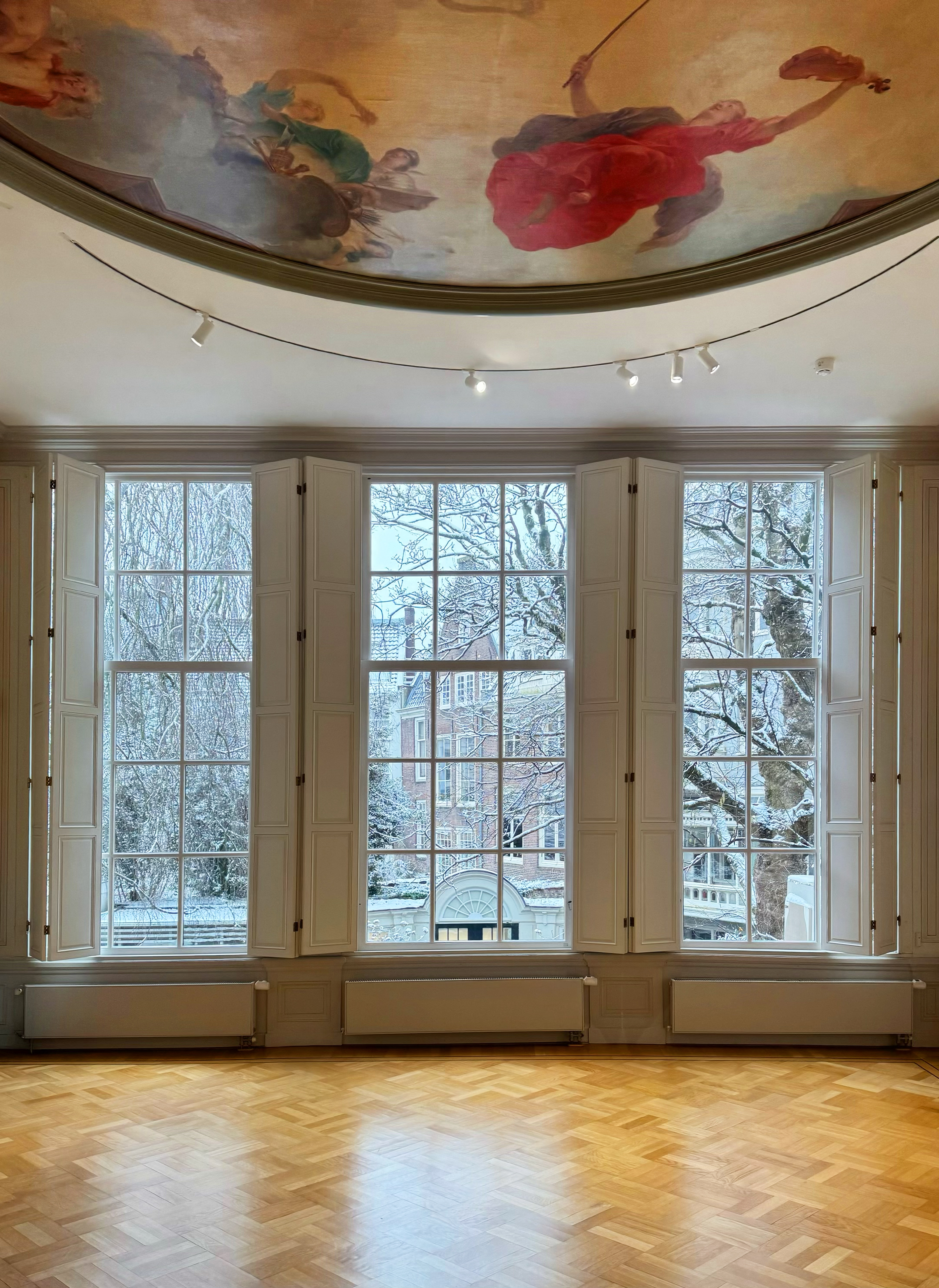
In the garden room hangs a ceiling painting from 1730 by Jacob de Wit, the most sought-after decorator of the eighteenth century. He painted it specifically for this house: Apollo seated among the clouds, Minerva and the nine Muses arranged around him. For decades the panel hung in the Rijksmuseum on loan from the Royal Archaeological Society. In 2004, after restoration, it came home. There is something quietly satisfying about looking up at a tableau of muses while a contemporary exhibition unfolds beneath them — the eighteenth-century allegory of the arts hovering above twenty-first-century prints. Most photography museums chose neutral white cubes. Huis Marseille chose Apollo.
The Red Room
When the museum expanded into the neighboring building at Keizersgracht 399 between 2007 and 2013, the restoration team began stripping decades of paint from a Louis XIV-style room and found something startling underneath. Beneath the cream surface came olive green, earth tones, and finally a deep scarlet pigment — a shade almost unique in the Netherlands for a reception room. In consultation with Amsterdam's Bureau for Monuments and Archaeology, they decided to return it to that original red. The result is unlike anything else in the canal district: an early eighteenth-century chamber walls and ceiling moldings glowing the color of arterial blood, with photographs hung against it. Curators have to think carefully about what holds its own beside a wall like that.
Fourteen Rooms of Looking
The expansion gave Huis Marseille two connected canal houses, five floors each, fourteen exhibition rooms in total. The seventeenth-century layout — front segment, courtyard, back segment, garden — survives almost intact, which means the route through the museum is also a route through a working merchant's house. Daylight pours through original windows. A garden room opens onto a small canal garden with its own historic garden house. There is a photography library and a specialized photobook store. Shows over the years have spanned David Goldblatt, Edward Burtynsky, Viviane Sassen, Stephen Shore, Berenice Abbott, Dana Lixenberg, Deana Lawson — major names in twentieth and twenty-first century photography, hung against marble, stucco, and that red wall.
An Unlikely Marriage
Photography is the youngest art Amsterdam takes seriously, and Huis Marseille is the oldest building in Amsterdam fully devoted to it. The match should feel awkward; instead it works. The light is right because canal houses were built for light. The intimacy is right because these rooms were built for small groups. And the contrast between medium and setting reminds you that every photograph is also a record of a moment in a long, ongoing history of looking. Focquier's house has been looking at the canal since the 1660s. It seems only fair that it now contains rooms full of images looking back.
From the Air
Located at 52.3676 N, 4.8849 E in central Amsterdam's UNESCO-listed canal district (Grachtengordel). The museum sits on the Keizersgracht between Leidsegracht and Spiegelgracht. Nearest airport: Amsterdam Schiphol (EHAM/AMS), 14 km southwest. At low approach altitudes the canal ring's concentric arcs are unmistakable; Huis Marseille lies in the inner ring just east of the Rijksmuseum.