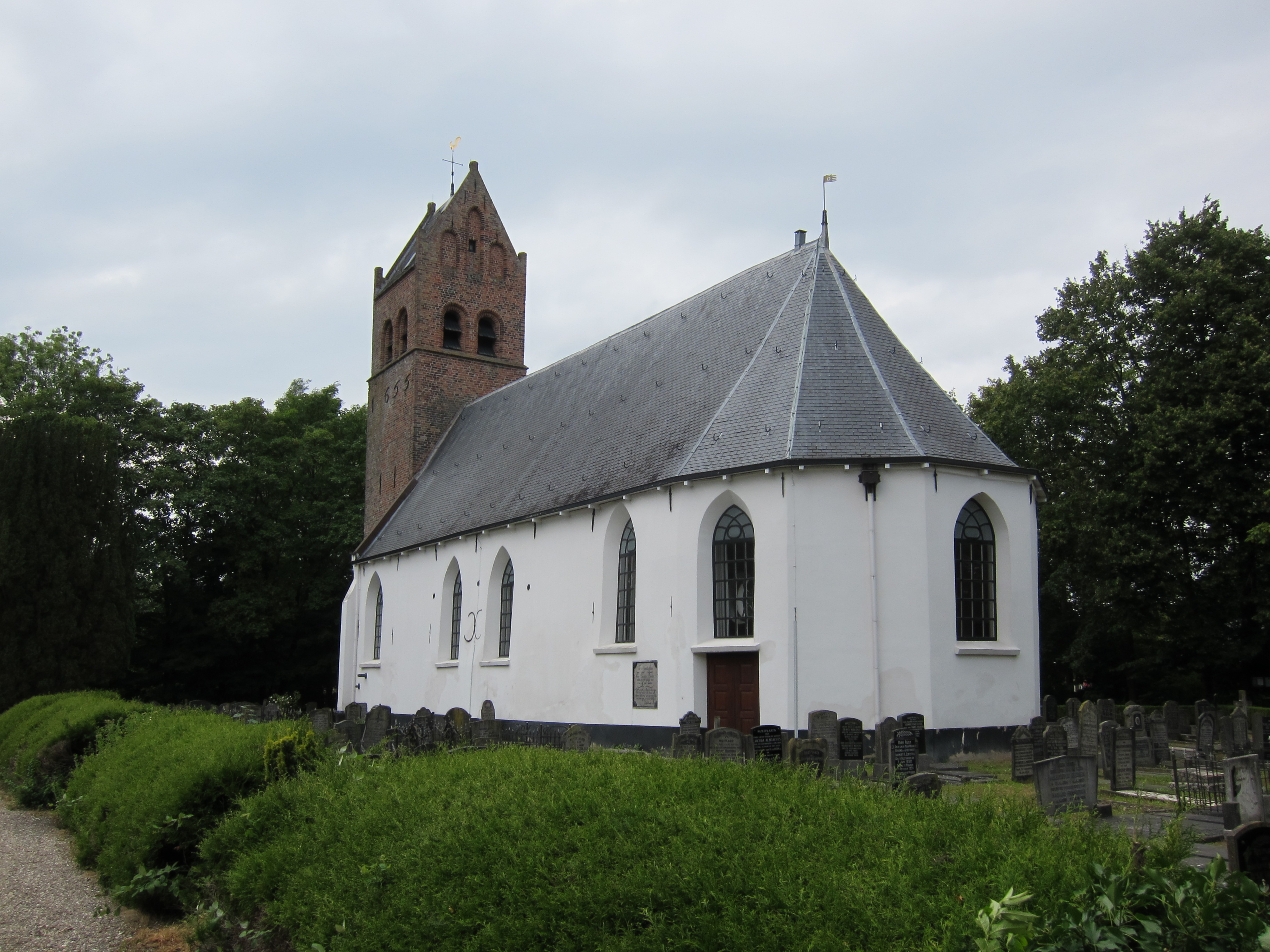
Huizum
The tombstone stands on a pedestal just inside the door of the Dorpskerk, the old village church of Huizum. It bears the names of two people - the parents of the Frisian poet Jan Jacob Slauerhoff - and it was moved there from the cemetery outside when the grave itself was cleared. The church kept the slab in this prominent spot for a specific reason: one of Slauerhoff's longest poems, the thirty-four-stanza In Memoriam Patris, is about his father's burial in that same churchyard. The poem outlived the grave. The grave became part of the poem. Welcome to Huizum, a village so old it was first written about in 1149 and so absorbed into Leeuwarden by now that you might cycle through it without realizing you crossed any kind of border at all.
Built on a Mound
Huizum-Dorp - the old village core - sits on a terp, one of the artificial earthen mounds that Frisians piled up before the year 1000 to keep their feet dry when the North Sea came inland. The name means something like by the houses, a reference to the stinsen, the stone residences of local nobility, that once clustered here. Over the centuries the spelling drifted: Husma in some records, Hwsmanghae in others, Husum elsewhere. The Frisian habit of writing the same place a hundred different ways was already old by the twelfth century. What endured was the mound itself, rising a meter or two above the surrounding pasture, holding the church and the oldest houses above the floodline that, for most of human history here, was a real and recurring threat.
Three Huizums
There are now three Huizums, though the divisions are administrative rather than visible. Huizum-Dorp is the village, declared a Rijksmonument - a protected national heritage site - in 1967. Huizum-West was laid out between 1914 and 1915 by the architect Willem Cornelis de Groot, and in 2007 the planned workers' housing district was itself given protected status as a model of early twentieth-century social housing. Huizum-Oost fills out the eastern flank. About nine thousand people live in the three together. The mix is unusual: medieval terp village, Edwardian-era planned community, and twentieth-century suburb, all stitched into a single neighborhood of greater Leeuwarden.
The Quiet Annexation
Huizum was once the administrative capital of Leeuwarderadeel, the rural municipality surrounding the city of Leeuwarden. That changed on 1 January 1944, under Nazi German occupation, when the southern half of Leeuwarderadeel was transferred to the city. The decision was administrative, made far from any battlefield, and it took effect while much harder things were happening elsewhere. Even so, the town hall stayed in Huizum until 1965, a small bureaucratic holdout against the absorption that had already happened on paper. By the time the building finally moved, the village had been part of Leeuwarden for two decades.
Slauerhoff Comes Home
Jan Jacob Slauerhoff was born in Leeuwarden in 1898 and spent much of his short life - he died in 1936, just thirty-eight years old - working as a ship's doctor on routes through Asia and the Mediterranean. He wrote restless, sea-haunted poetry that made him one of the most distinctive Dutch voices of the interwar years. His family had roots in Huizum, and the village has held on to that connection. The annual Slauerhoff Lecture is held here. The Dorpskerk holds a bronze bust of the poet's head, cast by Ben van der Geest. Several Slauerhoffs are buried in the village cemetery. The tombstone of the poet's parents stands at the church entrance because the poem about that grave outweighed, in the village's judgment, the grave itself. It is a small literary monument, easy to miss, and the kind of thing that explains why the Netherlands names UNESCO Cities of Literature.
The Suburb You Can Still Read
Cycling through Huizum today, you pass the old church on its slight rise, the patterned brick streets of the de Groot housing block, postwar terraces, and shopping streets that could be anywhere in the Netherlands. The terp is still there under your wheels. The 1149 letter from Wibald, Abbot of Corvey to the Bishop of Utrecht - the document that first names the place in writing - is still in an archive somewhere. The poet's parents are still listed by name at the church door. Suburbs are usually places where history is paved over. Huizum is one of the exceptions: a layered village hiding inside a neighborhood, recognizable if you know what to look for.
From the Air
Located at 53.1914 N, 5.8114 E, immediately south of central Leeuwarden, Friesland. From the air, Huizum appears as a dense band of residential streets between the city's outer ring road and the green farmland south of the Van Harinxmakanaal. The old Dorpskerk and its terp sit slightly raised above the surrounding street grid. The Leeuwarden railway corridor runs along the eastern edge. Nearest airports: Leeuwarden Air Base (ICAO: EHLW), 7 km northwest; Drachten Airfield (ICAO: EHDR), 22 km southeast. Best viewed from 1,500 to 3,000 feet AGL in clear weather.