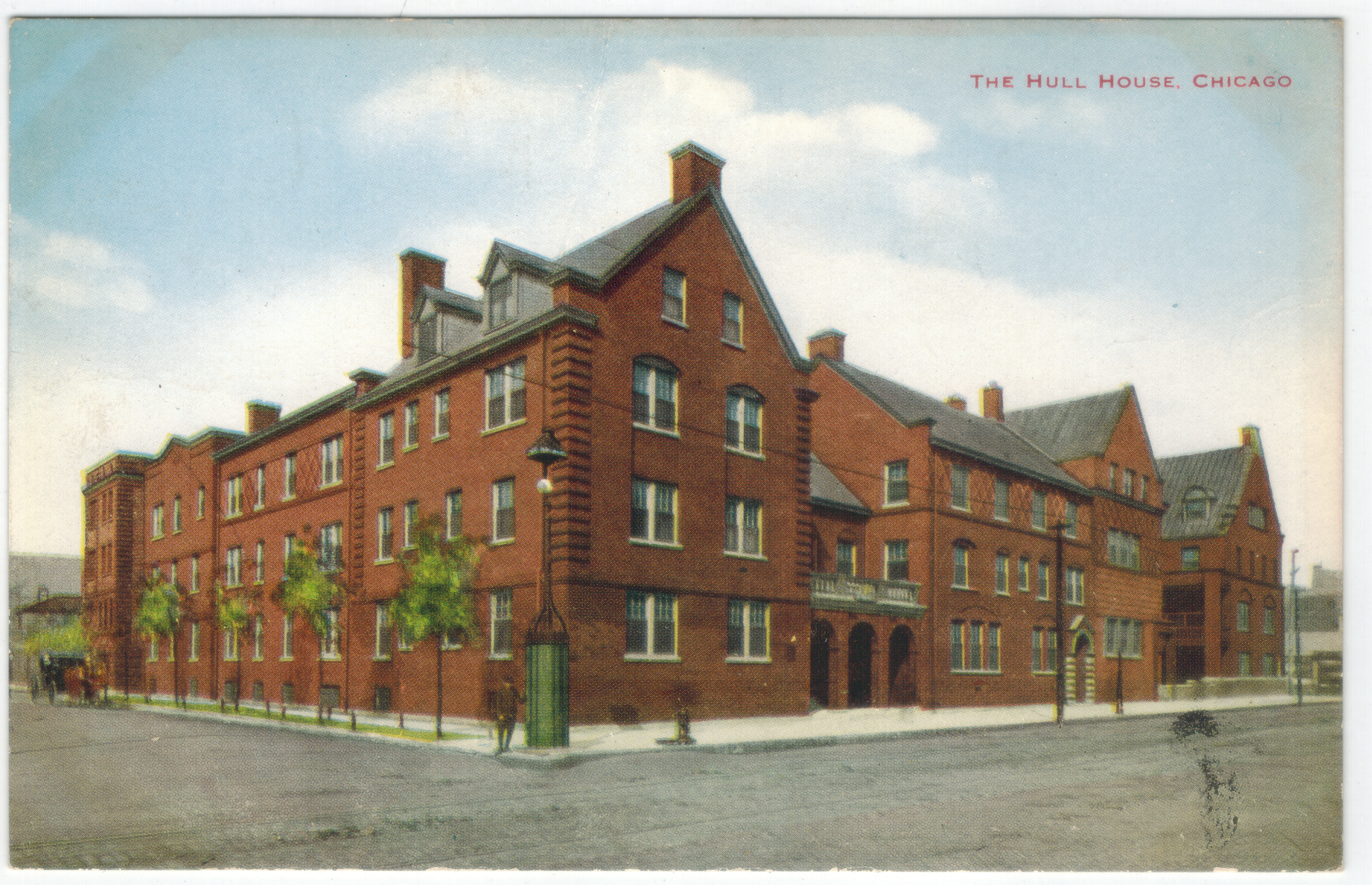
Hull House
The invitation was written in Italian. "Mio Carissimo Amico," it began -- My Dearest Friend -- signed by "Le Signorine, Jane Addams and Ellen Starr." It was 1889, and two college-educated women had just moved into a decaying Italianate mansion at 800 South Halsted Street, surrounded by ten thousand Italian immigrants, with the Germans and Jews to the south, the Greeks forming a delta at Harrison and Halsted, and the Irish farther out. The neighborhood was squalid. The mansion, built in 1856 by real estate magnate Charles Jerald Hull, had once been fashionable. Addams saw something no one else did: not a ruin to demolish, but a bridge to build. Hull House became the most influential settlement house in American history, a place where sociology was invented in practice, where women changed laws they could not yet vote on, and where a young clarinetist named Benny Goodman joined the boys' club band.
The Experiment on Halsted Street
Addams had visited Toynbee Hall in London's East End, where university men lived among the poor and held their clubs and lectures right in the neighborhood. She adapted the model for Chicago, but with a difference: Hull House became "a community of university women." Volunteers -- called "residents" -- held classes in literature, history, art, sewing, and bookbinding. John Dewey lectured there. So did W.E.B. Du Bois and Max Weber. Hull House hosted free concerts, free lectures on current affairs, and clubs for children and adults alike. Addams started ethnic evenings to ease immigrants' homesickness: Italian night, Greek night, German night, Polish night -- rooms packed with food, music, dancing, and the occasional patriotic poem recited with such spirit that everyone was moved.
Changing the Law from a Living Room
Hull House did not stay inside its walls. The residents investigated sweatshops, documented housing conditions, and mapped the neighborhood with a precision that helped invent American urban sociology. Their 1895 publication, "Hull-House Maps and Papers," charted eighteen nationalities across a one-third-square-mile radius and became a landmark of the Chicago School of sociology. From these studies came action: Hull House advocacy led to the nation's first juvenile court, Chicago's first public playground, its first public bathhouse, and its first public gymnasium, all established by 1893. Florence Kelley established a Bureau of Women's Labor there. Alice Hamilton founded one of the first child welfare clinics. Frances Perkins, who would become the first female Secretary of Labor, passed through Hull House. By 1900, nearly one hundred settlement houses modeled on Hull House had opened across the country.
Stage and Kiln
Hull House was not only a laboratory for social reform -- it was a crucible for American culture. Under the direction of Laura Dainty Pelham, the Hull House Players performed the Chicago premieres of plays by Shaw, Ibsen, and Galsworthy, and they are credited with founding the American Little Theatre Movement. Viola Spolin, the mother of American improvisational theater, developed her techniques teaching classes at Hull House. The Hull-House Kilns program, directed by Myrtle Merritt French, promoted hand workmanship as a moral force. Paul Kellogg called the women behind it all "the Great Ladies of Halsted Street." By 1911, Addams had expanded the operation to thirteen buildings, and in 1912, a summer camp -- the Bowen Country Club -- was added for neighborhood children.
Ghost Stories and a Haunted Attic
The mansion came with a reputation. Addams noted upon moving in that the building had "a half-skeptical reputation for a haunted attic." Charles Hull's wife had died in the house in 1860, and the Little Sisters of the Poor had used the building as a home for the aged in the 1870s, where many people died of natural causes. Addams herself spoke to friends about a "woman in white" she once glimpsed in a second-floor bedroom. Rather than being frightened, she was fascinated -- she used the neighborhood's reaction to ghost stories as the basis for her book "The Long Road of Woman's Memory." The Hull House ghost tours remain a stop on Chicago's haunted-history circuit.
What Survives
In the 1960s, the University of Illinois demolished most of Hull House's thirteen buildings to build its Chicago campus. The original 1856 mansion and a community dining hall survived. They are now the Jane Addams Hull-House Museum, a National Historic Landmark designated in 1965, housing over 1,100 artifacts and more than 100 oral histories. The Hull House Association continued providing social services at locations across Chicago until January 2012, when it closed after 122 years, a victim of government funding cuts that left it dependent on public money for 85 percent of its revenue. Addams, who died in 1935, would not have recognized the bureaucracy it became. But the museum endures -- a quiet monument to the idea that a mansion in a slum, staffed by determined women, could reshape a nation.
From the Air
Located at 41.87N, 87.65W on Chicago's Near West Side, now within the University of Illinois Chicago campus. The surviving Hull House mansion is a small Italianate structure amid modern university buildings, difficult to spot from altitude but identifiable by its proximity to the UIC campus and Halsted Street. Chicago O'Hare International Airport (KORD) is 14 nautical miles northwest; Chicago Midway International Airport (KMDW) is 7 nautical miles southwest. Best viewed below 2,000 feet AGL, using the expressway interchange at the UIC campus as a landmark.