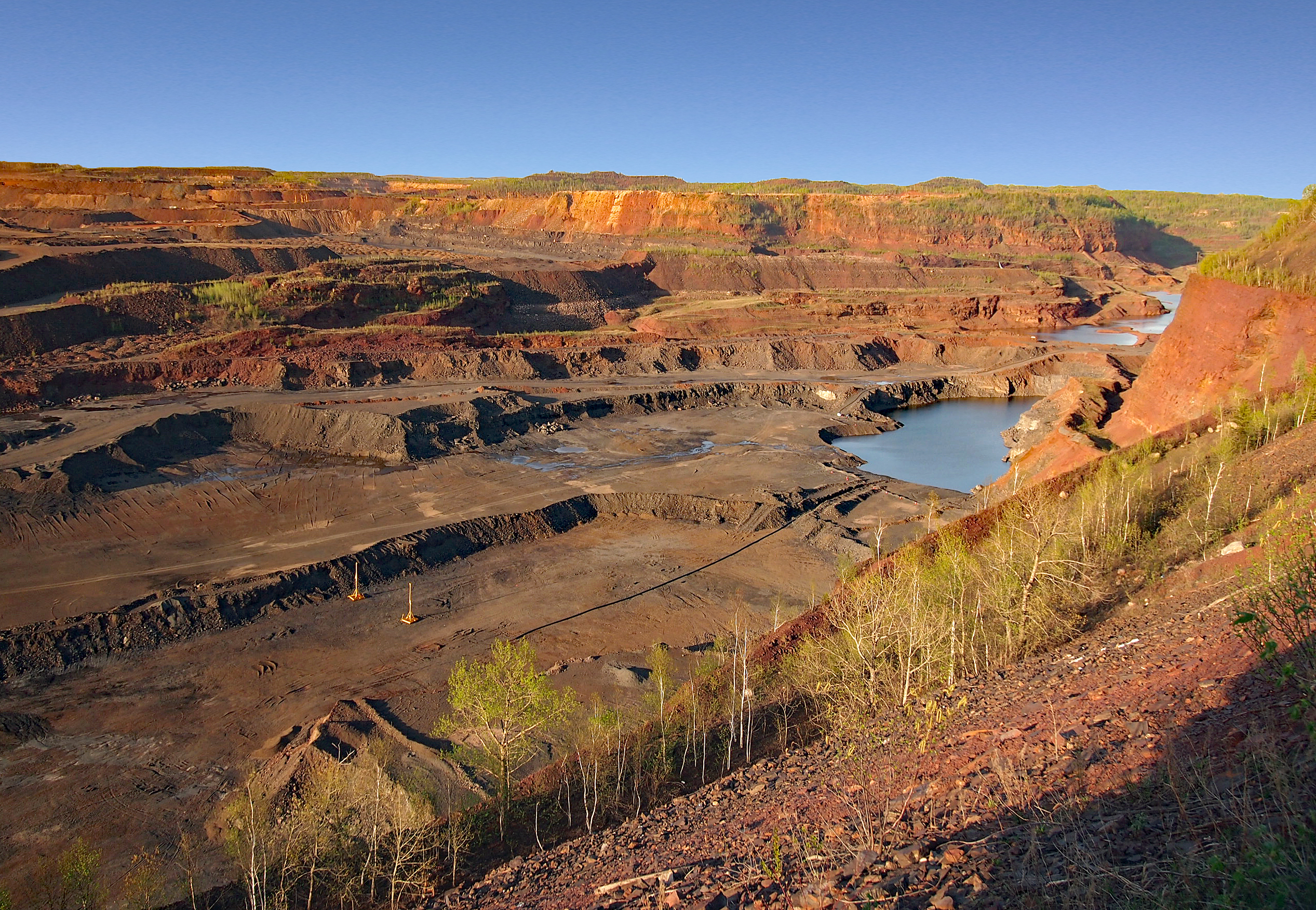
Hull-Rust-Mahoning Open Pit Iron Mine
From the observation platform on the north side of Hibbing, the ground simply vanishes. Red-orange terraces descend in enormous steps toward a floor so far below that the haul trucks crawling along it look like insects. The Hull-Rust-Mahoning Open Pit Iron Mine stretches more than three miles long, up to two miles wide, and over 500 feet deep. It has been devouring the Mesabi Range since 1895, making it one of the world's first mechanized open-pit mines. During its peak production years spanning World War I through World War II, this single pit supplied as much as one-fourth of all the iron ore mined in the United States. That output made Minnesota the nation's top iron producer and helped make the U.S. the world's largest steel manufacturer.
Three Mines Become One
Iron ore was discovered near present-day Hibbing in early 1892, two years after the first Mesabi Range mine opened at Mountain Iron. Three operations sprang up almost simultaneously. The Lake Superior Consolidated Iron Mines developed the underground Burt Mine under William Olcott's management. The Sellers Ore Company sank the underground Sellers Mine. And William C. Agnew directed the stripping and development of the open-pit Mahoning Mine for the Mahoning Ore Company. All three began shipping ore in 1895. As the pits expanded, their boundaries merged, absorbing the Hull and Rust mines along the way. What had been separate operations became a single vast excavation -- a canyon carved not by water but by dynamite, steam shovels, and the insatiable appetite of American industry.
The Mine Eats the Town
By 1910, the pit surrounded Hibbing on three sides. Geologists confirmed what the mining companies already knew: the ore body continued directly beneath the town's streets, homes, and businesses. The population had hit 20,000, but the iron underneath was worth more than everything above it. In 1916, the Oliver Mining Company declared that North Hibbing had to move. In 1918, the town government accepted a proposal to relocate two miles south. What followed was one of the most remarkable episodes in American industrial history. A total of 188 buildings were dragged south on log rollers and wooden rails using horses, tractors, and a steam crawler. Workers riding atop moving buildings lifted electrical lines with long sticks as the structures passed beneath. Buildings too large to move whole were sawed into sections. The Colonial Hotel made the trip intact. The Sellers Hotel did not -- it tumbled off its rollers and shattered.
Arsenal of Democracy
The mine's peak significance coincided with the two world wars, when American steel production became a matter of national survival. Iron ore from the Hull-Rust-Mahoning pit traveled by rail to Duluth, where it was loaded onto Lake Superior freighters bound for steel mills in Pittsburgh, Gary, and Cleveland. One-fourth of all U.S.-mined iron ore came from this single hole in northern Minnesota. The steel forged from Mesabi ore built warships, tanks, bridges, skyscrapers, and the railroad tracks that connected them. After the easily extracted natural ore was depleted, the industry adapted. Since 1976, the Hibbing Taconite Company has operated the mine, processing lower-grade taconite rock into iron-bearing pellets at a rate of 8.2 million tons annually.
From Bethlehem to Cleveland-Cliffs
The mine's corporate lineage reads like a history of American steelmaking. Pickands Mather originally managed Hibbing Taconite on behalf of Bethlehem Steel and the Canadian firm Stelco. ArcelorMittal assumed the managing partner role in August 2019. Then, in September 2020, Cleveland-Cliffs Inc. purchased ArcelorMittal's U.S. operations for approximately $1.4 billion. As of 2021, Cleveland-Cliffs holds 85.3 percent ownership and manages daily operations, with U.S. Steel retaining the remaining 14.7 percent. The pit remains active, its terraces deepening year by year. Designated a National Historic Landmark, the Hull-Rust-Mahoning mine is both a working industrial site and a monument to the era when iron was king and a small Minnesota town was willing to uproot itself entirely to keep the ore flowing.
From the Air
Located at 47.4583°N, 92.9500°W on the northern edge of Hibbing, Minnesota, within the Mesabi Iron Range. The pit is unmistakable from altitude -- a massive terraced excavation over three miles long and up to two miles wide, with distinctive red-orange exposed earth contrasting sharply against the surrounding boreal forest. Range Regional Airport (KHIB) is approximately four nautical miles southeast. Best viewed at 3,000-6,000 feet to appreciate the scale of the terraces and the active mining equipment. The mine observation platform is on the pit's south rim. Duluth (KDLH) lies about 75 nautical miles southeast. Note the numerous water-filled former mining pits scattered throughout the surrounding landscape.