Humayun's Tomb
A wife's grief built this. After Mughal Emperor Humayun died in January 1556 from a fall down his library stairs, his first wife and chief consort, Empress Bega Begum, dedicated the rest of her life to a single purpose: constructing a mausoleum so magnificent it would honor his memory for centuries. She selected Persian architects Mirak Mirza Ghiyas and his son Sayyid Muhammad from Herat, oversaw the project after returning from the Hajj pilgrimage, and spent 1.5 million rupees -- an enormous sum -- on a tomb that would take from 1565 to 1572 to complete. The result did not merely honor one emperor. It invented a new architectural language.
A Garden Meant for Paradise
Bega Begum chose a site on the banks of the Yamuna River, near the dargah of Nizamuddin Auliya, the revered Sufi saint of Delhi. The tomb sits at the center of a 30-acre Charbagh, a Persian-style garden divided into four quadrants by water channels -- the first garden of this type and scale ever built in South Asia. The symbolism was deliberate: in Islamic tradition, paradise is a garden with rivers flowing beneath it. Water moved through the channels by gravity alone, engineered to a grade of one centimeter every 40 meters, feeding fountains without any mechanical assistance. The garden was both landscape and theology, a physical rendering of the afterlife that the empress hoped her husband now inhabited.
The Architecture of What Came Next
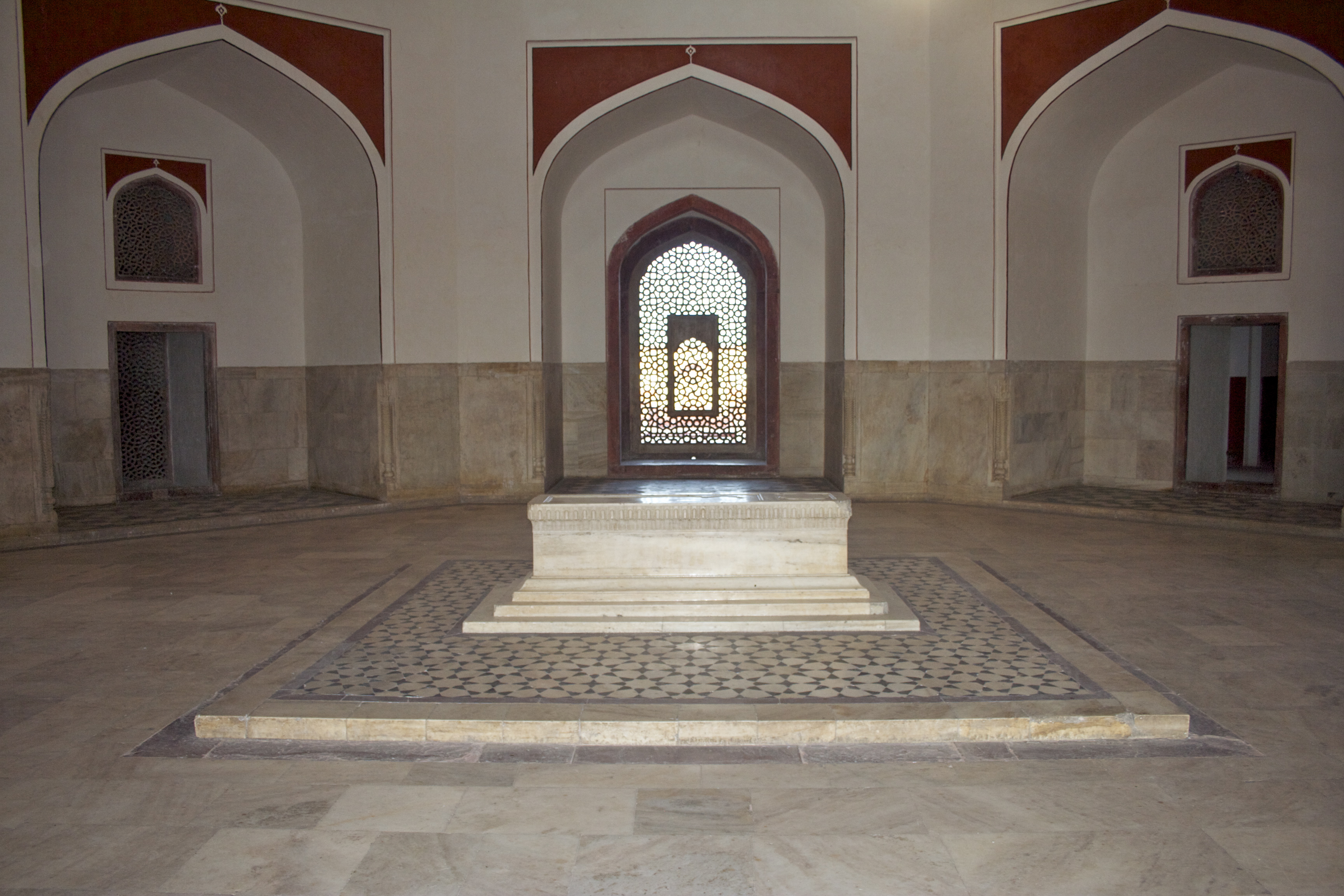
The tomb's design was modeled on the Gur-e Amir, the mausoleum of Timur in Samarkand, but Ghiyas and his son transformed the reference into something distinctly new. The structure was the first in India to use red sandstone at such a scale, accented with white marble in a combination that would become the signature of Mughal architecture. A white double dome rises above an octagonal plan, surrounded by chhatris -- small domed pavilions -- at the corners. Inside, the floor plan is deceptively complex: eight two-storied vaulted chambers radiate from a central double-height domed room. The emperor's cenotaph sits aligned on the north-south axis, his face turned toward Mecca. His actual burial chamber lies underground, accessible through a separate passage that remains mostly closed to visitors. A mihrab design carved into the marble lattice allows light to enter the chamber from the direction of Mecca -- a symbolic elevation of the emperor's status closer to the divine.
Refuge and Ruin
History kept returning to the tomb uninvited. In September 1857, the last Mughal emperor, Bahadur Shah Zafar, fled the Red Fort during the Indian Rebellion and took refuge here with three princes. Captain William Hodson of the British cavalry found them, promised safe passage, then seized and executed the princes at the Delhi Gate. During the Partition of 1947, the tomb and the nearby Purana Qila became refugee camps for Muslims migrating to Pakistan. Thousands sheltered among the monuments for nearly five years, and the damage was severe: gardens were trampled, water channels blocked, and cenotaphs had to be encased in brick to protect them from vandalism during raids by mobs. By the late twentieth century, slum encroachments surrounded the complex, heavy vehicles parked illegally at the entrance, and the sacred pool at the nearby dargah of Nizamuddin Auliya had become, as one account described it, a messy cesspool.
Bringing the Water Back
The turning point came in 1993, when UNESCO designated the tomb a World Heritage Site. The Aga Khan Trust for Culture, working with the Archaeological Survey of India, began a painstaking restoration that started with research in 1997 and reached its first major completion in 2003. Twelve hectares of lawns were replanted. Over 2,500 trees and plants -- mango, lemon, neem, hibiscus, jasmine -- went into the ground. The water channels were re-laid to the original Mughal gradient, and for the first time in centuries, water flowed through the garden and dormant fountains came alive again. In 2009, workers spent months using hand tools to remove a 40-centimeter layer of cement concrete from the roof, accumulated since the 1920s, that was pressing over a thousand tons of dead weight onto the structure. A rainwater harvesting system using 128 recharge pits was installed, and old wells discovered during excavation were desilted and revitalized.
A Monument Surrounded
Other monuments cluster around Humayun's Tomb like footnotes to a longer story. The tomb of Isa Khan Niyazi, an Afghan noble who fought against the Mughals, predates the main tomb by twenty years and sits in its own octagonal garden. The Nila Gumbad, the Blue Dome, was built by the son of a Mughal courtier for a servant who died in battle -- octagonal outside, square within, its ceiling decorated with painted plaster. The Barber's Tomb stands within the main Charbagh, its occupant's identity still debated despite inscriptions dating to 1590. From the air, the tomb's symmetry is unmistakable: the white dome centered precisely within the green geometry of the garden, the whole complex a statement of order imposed on the sprawl of Delhi. Bega Begum, who is buried here alongside her husband, would recognize what she built. The water runs again.
From the Air
Humayun's Tomb is located at 28.5933N, 77.2506E in Nizamuddin East, Delhi, approximately 5 km southeast of the Red Fort. The white dome centered within the green Charbagh garden is a distinctive visual landmark from the air, especially given the contrast with surrounding dense urban development. Purana Qila (Old Fort) lies just to the northwest. Nearest airport is Indira Gandhi International Airport (VIDP), approximately 14 km southwest. Best viewed at 2,000-4,000 feet AGL for the garden layout; the dome and surrounding chhatris are visible from higher altitudes in clear conditions.