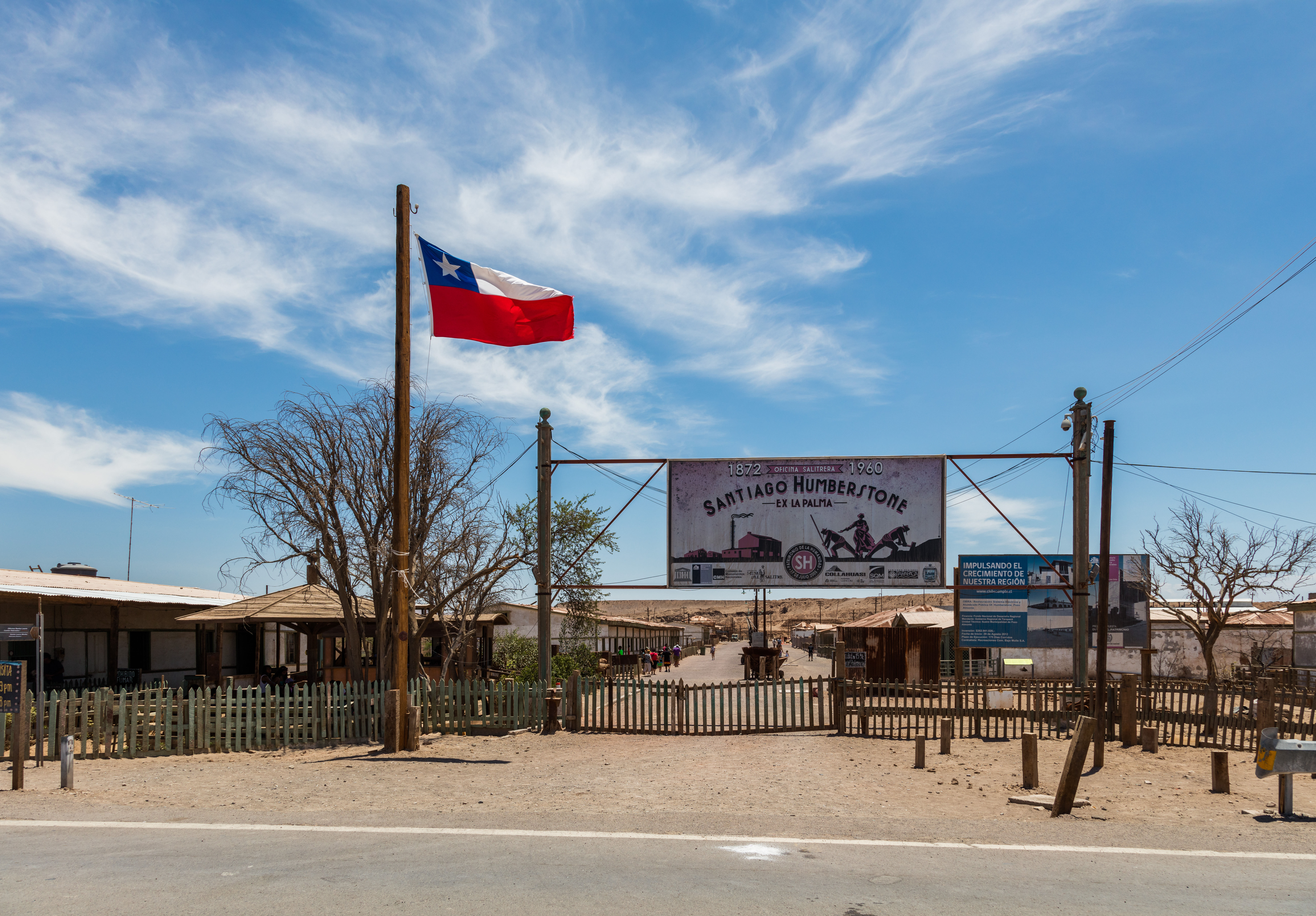
Humberstone and Santa Laura Saltpeter Works
There is a swimming pool in the Atacama Desert. It is made of steel, because there is no fresh water for hundreds of kilometers in any direction, and the pampinos -- the saltpeter workers -- needed something that would not leak into sand that has not seen rain in recorded memory. The pool sits in the ghost town of Humberstone, 48 kilometers east of Iquique, alongside a theater, a church, a company store, tennis courts, and row upon row of workers' dwellings. All of it is empty. All of it is preserved by the same aridity that made the nitrate deposits possible in the first place.
The Industry That Fed the World
Sodium nitrate -- saltpeter -- was the nitrogen source that made modern agriculture possible before Fritz Haber synthesized ammonia from air in 1909. Chile held a global monopoly. The Norte Grande, seized from Bolivia and Peru in the War of the Pacific, contained the richest deposits, and dozens of oficinas salitreras -- saltpeter works -- sprang up across the desert pampa in the late nineteenth century. Humberstone, originally called La Palma, and neighboring Santa Laura were among the largest. Workers extracted caliche ore from the desert surface, crushed it, dissolved it in enormous cooking pots called cachuchos, and crystallized the nitrate for export through the port of Iquique. The work was grueling, the desert merciless, and the company-town system left workers dependent on their employers for everything from housing to groceries.
A Company Town's Two Faces
Walking through Humberstone today reveals a sharp social geography. The administrative buildings and owner residences are spacious, well-appointed structures built from imported Oregon pine -- the same wood shipped from the Pacific Northwest to build much of coastal Chile. The workers' dwellings are small and utilitarian, arranged in strict rows. Housing was allocated by rank within the company: professionals, employees, married workers, single workers, each in their designated quarter. Yet the town also provided amenities that the surrounding desert could not: drinking water, electricity, sewerage, a theater that hosted performances for the entire community, a church, and that improbable steel swimming pool. The pulperia -- the company store -- was the economic center, the place where wages paid in company tokens circulated back to the company.
Santa Laura's Iron Skeleton
Where Humberstone preserves domestic life, Santa Laura preserves the industrial process itself. Its enormous chimney is visible from great distances across the flat pampa, a landmark in a landscape that offers few. The processing plant, called la maquina, is a cathedral of Oregon pine and iron where the cachuchos once bubbled with dissolved caliche. The crushing plant, the power house, the administration building, and the main square complete a picture of industrial-era extraction laid bare. Together, the two sites tell the full story -- how the nitrate was mined, processed, and shipped, and how the people who did that work lived, worshipped, and entertained themselves between shifts in one of the most inhospitable environments on the planet.
Ghost Town, Heritage Site
The synthetic nitrogen process killed the Chilean saltpeter industry. Humberstone and Santa Laura became ghost towns by the mid-twentieth century and were declared national monuments in 1970. The designation did not prevent decades of looting and weathering -- the Atacama's dryness preserves wood and iron, but wind and occasional earthquakes take their toll. In 2001, Humberstone found an unlikely second life as a film set for the Chilean soap opera Pampa Ilusion. Former pampinos organized Saltpeter Week celebrations that became rallying points for preservation. The Saltpeter Museum Corporation formed and successfully petitioned UNESCO, which designated both sites as a World Heritage Site in 2005 -- simultaneously placing them on the List of World Heritage in Danger due to the fragility of the buildings. Significant restoration work by the Corporation and the Tarapaca Regional Government earned their removal from the danger list in 2019.
What the Desert Keeps
The Atacama is the driest place on Earth, and it is an extraordinary preservative. School desks sit in empty classrooms. A clock hangs on a wall in Humberstone. Mining carts rest on tracks that lead nowhere. The doctor's office, the kiosk, the kitchen in a worker's residence -- all remain, emptied of people but full of the details that make the past tangible. A visit to Humberstone and Santa Laura is not a museum experience in the conventional sense. There are no velvet ropes, no climate-controlled galleries. The desert itself is the display case, and what it holds is an entire way of life, frozen at the moment it was abandoned.
From the Air
Located at 20.21S, 69.79W in the Atacama Desert, 48 km east of Iquique. No airstrip at the site; the nearest airport is Diego Aracena (SCDA) near Iquique. From the air, the twin sites are visible as geometric anomalies in the otherwise featureless desert pampa -- Santa Laura's tall chimney is the most prominent landmark. The straight road from Iquique (Ruta 16) is clearly visible from altitude. Best viewed at mid-altitude where the contrast between the abandoned structures and surrounding desert is most striking.