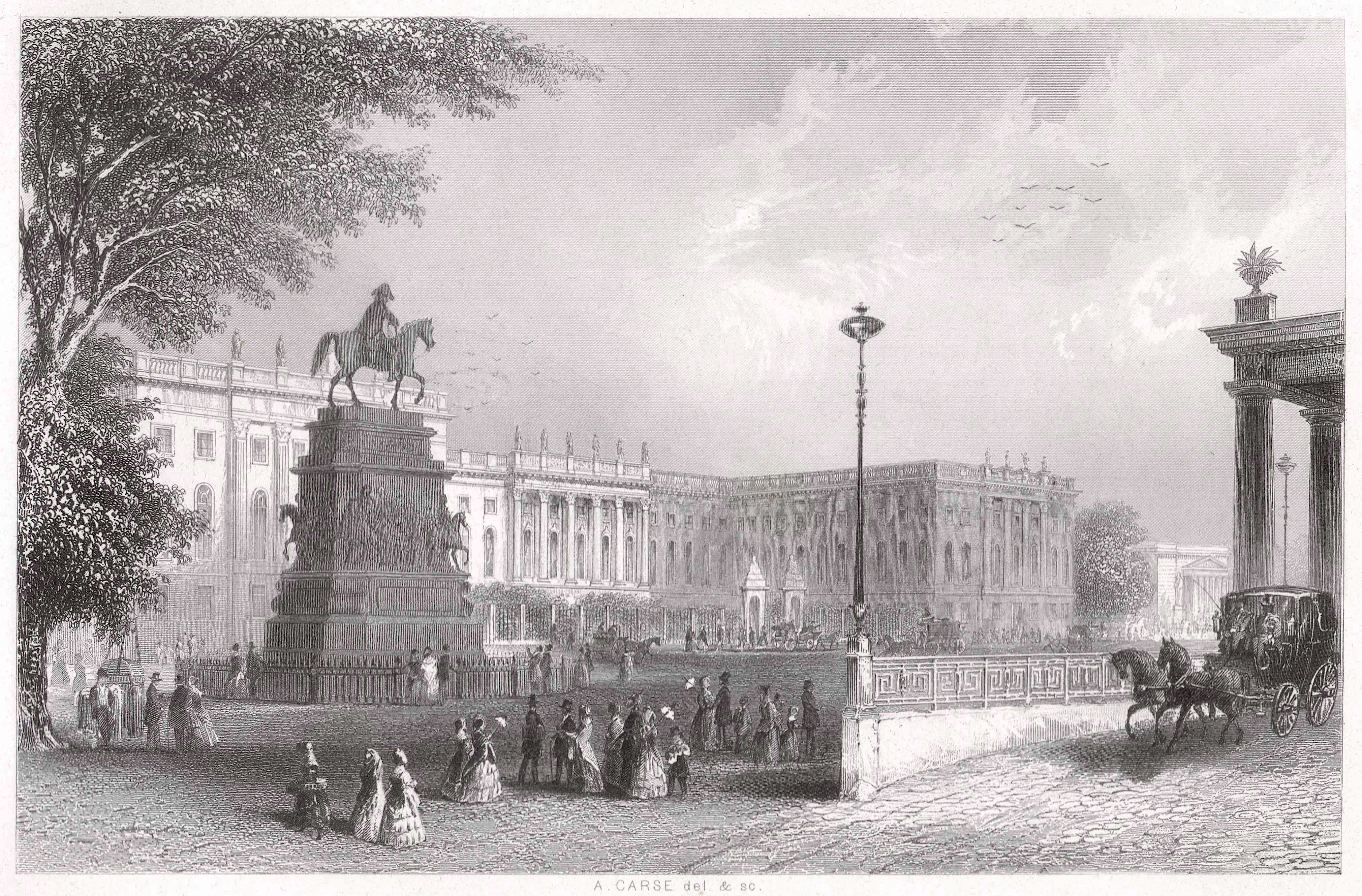
Humboldt University of Berlin
Walk down Unter den Linden today, past the row of lime trees the boulevard is named for, and you reach a calm neoclassical palace set back behind a small lawn. The statues of two brothers — Wilhelm and Alexander von Humboldt — sit out front. This is the institution Wilhelm imagined in 1809: a university where teaching and research lived in the same scholar, where the sciences and humanities answered to no master but inquiry itself. Hegel taught here. Einstein taught here. Bonhoeffer studied here. Fifty-seven Nobel laureates have been affiliated. And on a May evening in 1933, students from this university piled tens of thousands of books on the square across the street and set them on fire.
The Humboldtian Idea
Wilhelm von Humboldt — Prussian linguist, philosopher, and reformer — convinced King Friedrich Wilhelm III to charter a new university in Berlin in August 1809. The country was reeling from defeat by Napoleon, half its territory gone under the Treaties of Tilsit. Humboldt's argument was that Prussia could not rebuild itself militarily without first rebuilding itself intellectually. The university opened in 1810 inside a palace once owned by Prince Henry, Frederick the Great's younger brother. The first lectures were given in winter; the widow's staff had only just moved out. From the start the model was different: students chose their own paths, professors pursued their own questions, and what emerged from the meeting between them was the curriculum. American universities studied the model. Johns Hopkins copied it. The phrase "research university" comes from here.
A Century of Discovery
The 19th-century roster reads like a syllabus. Hegel taught philosophy, Schopenhauer arrived to compete with him and lost his audience. The Brothers Grimm assembled their dictionary in the library. Karl Marx and Friedrich Engels both studied here, separately. Heinrich Heine wrote poetry. Robert Koch identified the tuberculosis bacillus, Rudolf Virchow built modern pathology, Hermann von Helmholtz unified physics with physiology. By the early 20th century the natural sciences faculty was widely considered the strongest in the world. Albert Einstein joined in 1914 and developed general relativity in his Berlin years. Max Planck was already on faculty when his quantum theory rewrote physics. Fritz Haber pulled nitrogen from the air, feeding millions; Otto Hahn split the atom in 1938. Fifty-seven Nobel laureates passed through, depending on how broadly you count.
The Books on the Square
On 10 May 1933, three months after Hitler took power, students from the German Student Association marched from the university library across Unter den Linden to the square then called Opernplatz. They had collected roughly 20,000 books they considered un-German — works by Heine, Marx, Freud, Einstein, Brecht, Hemingway, Helen Keller. They built a pyre. Joseph Goebbels gave the speech. The fire was bright enough to see for blocks. Today an artwork by Micha Ullman, embedded flush in the pavement of what is now Bebelplatz, looks down through a glass plate into a white room of empty bookshelves with space for exactly 20,000 volumes. A line from Heine, written more than a century earlier, is engraved nearby: "Where they burn books, they will in the end also burn people."
The University the Nazis Made
Within a year of the fire, the Law for the Restoration of the Professional Civil Service had cost the university roughly 250 Jewish professors and staff their jobs. Doctorates were stripped. Nearly a third of all faculty were dismissed. Students who had questioned the regime disappeared. Einstein, abroad when Hitler came to power, never returned. Dietrich Bonhoeffer — the theologian who had studied here — joined the resistance, was arrested, and was executed in April 1945. The university Wilhelm Humboldt had imagined as a sanctuary for free inquiry had, in twelve years, become a recruiting ground for the regime that murdered its own scholars.
Divided, Restored, Continuing
The university reopened in 1946 in the Soviet sector, soon to become East Berlin. Repression returned in different uniform: the Soviet military arrested students for organising, sentenced some to 25-year forced-labour terms, and disappeared others. Liberal and social-democratic faculty fled west, founding the Free University of Berlin in 1948 with American support. The two institutions have shared the Charité medical school since reunification. In 1949 the eastern campus took the name Humboldt-Universität, honouring both brothers — Wilhelm the founder and Alexander the explorer-naturalist. Today around 35,000 students study across nine faculties. The library where the books once stood is rebuilt. The names of the burned authors are taught in the curriculum. The university Wilhelm Humboldt invented turned out to be more fragile, and more durable, than he could have imagined.
From the Air
The main campus stands at 52.52°N, 13.39°E on Unter den Linden in Berlin's Mitte district, between the Brandenburg Gate to the west and Museum Island to the east. From the air look for the long tree-lined boulevard running east-west and the cluster of historic buildings between it and the Spree. Berlin Brandenburg (EDDB) lies about 25 km southeast. Berlin's central airspace is restricted around government and historic buildings, which sit within walking distance of the campus. The TV Tower at Alexanderplatz, 368 m tall, lies just east and serves as the dominant visual reference.