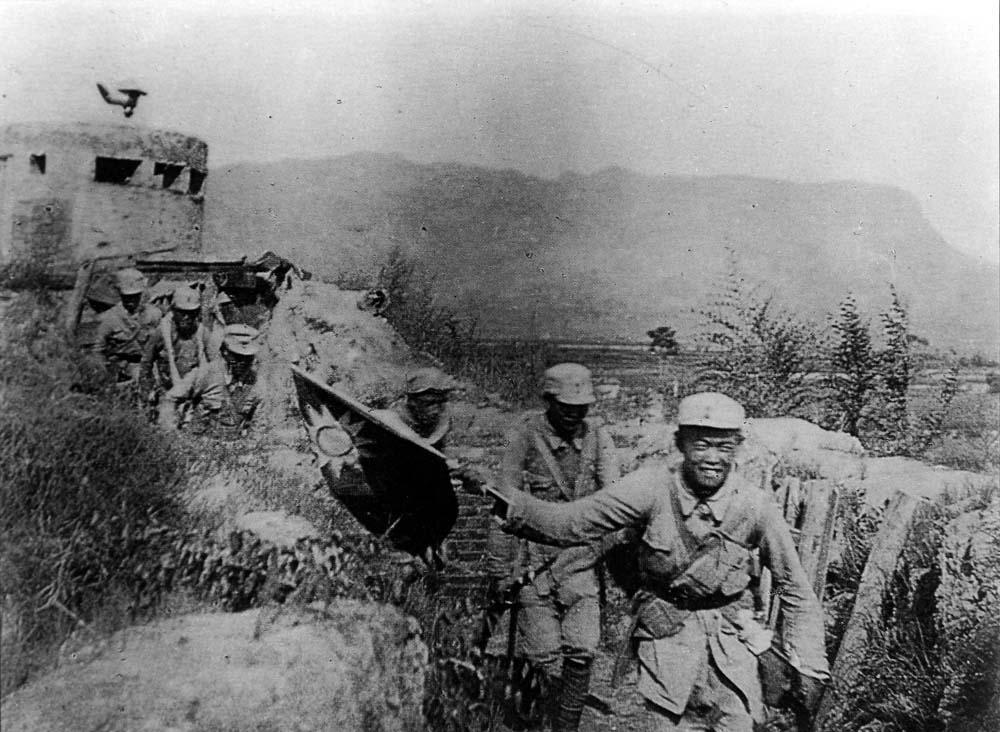
Hundred Regiments Offensive
The plan called for 22 regiments. What showed up was 105. On the night of August 20, 1940, gunfire and explosions erupted simultaneously along thousands of kilometers of Japanese-held railways across North China. Signal flares arced through darkness that had been, moments earlier, quiet. The Eighth Route Army, led by Peng Dehuai and operating behind enemy lines, had launched the largest Communist offensive of the Second Sino-Japanese War. The campaign was supposed to be a targeted sabotage operation against the Shijiazhuang-Taiyuan Railway. Instead, enthusiasm among frontline units transformed it into something far larger -- and far more consequential -- than anyone in the command chain had authorized.
The Prison Cage
By the summer of 1940, Japan's strategy in North China had evolved from conquest into containment. The 'prison cage policy' used railways, roads, and chains of fortified blockhouses to divide the landscape into sealed compartments, isolating Communist base areas from one another and slowly strangling their capacity to operate. Between 1939 and 1940, the Japanese conducted 109 large-scale 'mopping-up' operations, each involving over 1,000 troops, deploying more than 500,000 soldiers in total. The anti-Japanese base regions were being suffocated. Meanwhile, the broader war picture was bleak. The Kuomintang had suffered successive battlefield defeats, calls for peace with Japan were growing louder, and the Wang Jingwei faction had defected outright to form a puppet government. A pervasive atmosphere of pessimism gripped the nation. Something dramatic was needed.
Hidden in the Millet
Preparation was meticulous and clandestine. Reconnaissance teams, disguised and protected by local villagers, mapped Japanese strongholds, troop dispositions, and terrain near the Shijiazhuang-Taiyuan railway. Blacksmiths forged crowbars and pickaxes for ripping up rails. Soldiers trained in demolition techniques, including heating steel rails until they could be bent beyond use. Over 10,000 militia members were mobilized in central Shanxi alone to handle transportation, medical support, and coordination. The Eighth Route Army headquarters insisted on absolute secrecy: the campaign's objective was revealed only to brigade-level commanders, and troops moved to their positions concealed by the tall summer millet that blanketed the North China Plain in August. The original battle order mandated attacks on the Zheng-Tai Railway line. When units along other rail corridors saw the opportunity, they joined without waiting for orders.
Twenty Days of Destruction
The first phase, from August 20 to September 10, achieved its primary objective: the total incapacitation of the Zheng-Tai Railway. Forces from the Jin-Cha-Ji Military Region seized Niangzi Pass and destroyed railway bridges. At the Jingxing coal mine, soldiers collaborated with miners to dismantle the entire mining infrastructure, shutting down operations for more than six months. The 14th Regiment held the heights of Shinaoshan for six days, subsisting on black beans, corn husks, and vegetable soup while repelling repeated Japanese assaults and killing over 400 enemy soldiers. At Daluopo Village on August 21, the 8th Company of the 25th Regiment was ambushed and fought hand-to-hand, killing over 40 Japanese soldiers, including a platoon leader. The company earned the honorary title 'Bayonet Combat Hero Company' -- shattering the belief that Eighth Route Army troops could not match Japanese soldiers in close combat.
Burn All, Kill All, Loot All
The Japanese response was devastating. After the second phase of attacks targeted strongholds along transportation corridors, the Japanese army mobilized tens of thousands of troops for retaliatory 'sweep' operations across the anti-Japanese base areas. These sweeps implemented the Three Alls Policy -- burn all, kill all, loot all -- with systematic brutality. In the Taihang, Taiyue, and northwest Shanxi regions, Japanese forces destroyed villages, crops, and infrastructure in an effort to eliminate the basic conditions for human survival. The Eighth Route Army shifted to counter-sweep guerrilla tactics, but the cost was severe. At the Battle of Guanjianao, commander Peng Dehuai directed operations from just 500 meters from enemy positions. The 25th and 38th Regiments, serving as main attack forces, lost 500 killed and 1,570 wounded in that engagement alone. The offensive's final phase ground on until January 1941.
Victory, Controversy, and Memory
The Hundred Regiments Offensive incapacitated Japanese transportation infrastructure across North China and forced Japan to shift resources from its planned southward expansion to anti-Communist operations in the north. But it also revealed Communist military strength to the Japanese, who had estimated Communist regular forces at 88,000 -- the actual number was between 200,000 and 400,000. Mao Zedong, who had long disagreed with Peng about how directly to confront the Japanese, later used the offensive against Peng politically. During the Cultural Revolution, Red Guards denounced Peng for launching the campaign without Mao's explicit approval. Marshal Nie Rongzhen eventually defended Peng, noting that the headquarters had reported its plans through normal channels. A memorial erected in 1987 on Shinao Mountain in Yangquan, Shanxi, now commemorates the campaign. The consensus in China after the Cultural Revolution has been to recognize the offensive as a pivotal moment in the war of resistance.
From the Air
The Hundred Regiments Offensive spanned a vast area of North China, centered on the Shijiazhuang-Taiyuan Railway corridor. The memorial is located at Shinao Mountain near Yangquan, Shanxi Province. The article coordinates (37.45°N, 116.30°E) place it in the North China Plain region of Hebei. Key landmarks include the railway corridors between Shijiazhuang (ICAO: ZBSJ) and Taiyuan (ICAO: ZBYN), and the Taihang Mountain range that separates Hebei from Shanxi. The terrain transitions from flat plains to rugged mountains -- the same geography that shaped the campaign's tactics. Best viewed at 10,000-15,000 feet AGL to appreciate the scale of the railway network that was the campaign's target.