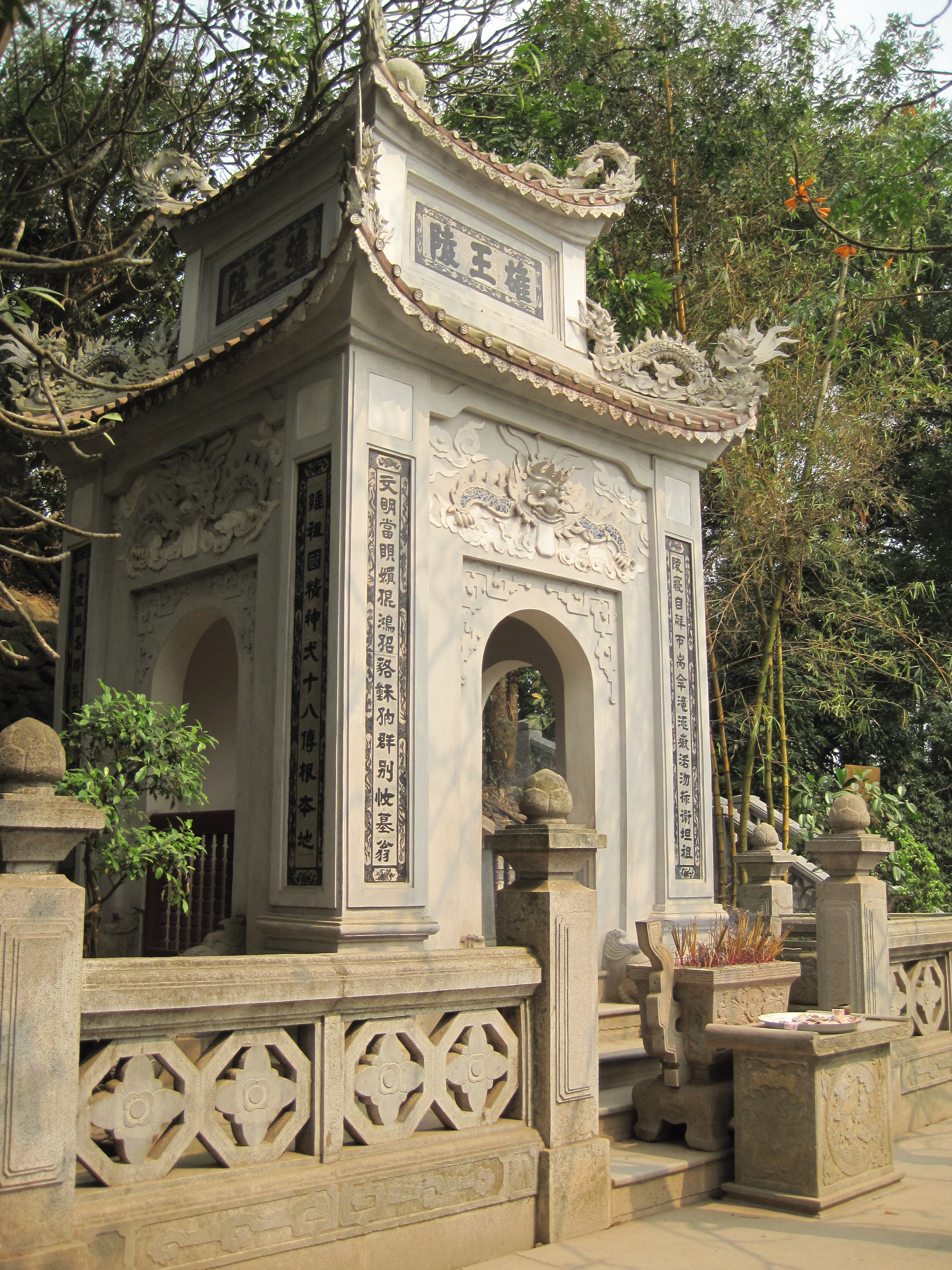
Hung Temple
The king's horse stopped and refused to go further. According to legend, Hung Vuong I had searched 99 places for the seat of his kingdom before reaching the village of Hy Cuong, where his mount planted its hooves and whinnied. The king climbed the nearest peak -- Mount Nghia Linh -- surveyed the land in all four directions, and declared it the site of his capital. Whether or not a horse ever made that decision, the mountain in Phu Tho province has been sacred ground for as long as the Vietnamese have told stories about where they came from.
Children of the Dragon and the Fairy
The temples on Nghia Linh are dedicated to the Hung Kings, the mythological first rulers of Vietnam and the founding dynasty of Van Lang -- the primordial Vietnamese kingdom. According to the creation story, the dragon lord Lac Long Quan married the mountain fairy Au Co, who gave birth to a sac containing one hundred eggs. Fifty children followed their father to the sea; fifty followed their mother to the highlands. The eldest became Hung Vuong I, the first king. Styled sequentially from Hung Vuong I through Hung Vuong XVIII, the dynasty represents not a verifiable historical succession but something arguably more powerful: a national origin myth that has survived every occupation, every war, and every political transformation Vietnam has undergone. The Hung Temple complex is where that myth has its physical home -- a cluster of shrines ascending the mountain, each honoring the kings who, real or legendary, gave the Vietnamese a story about themselves.
Bronze Drums and Ancient Capital
The kingdom of Van Lang is associated with the Dong Son culture, one of Southeast Asia's most significant Bronze Age civilizations, renowned for its elaborately decorated bronze drums. These drums -- some over two thousand years old -- depict scenes of warfare, ritual, and daily life, and have been found across Vietnam and as far as Indonesia. Popular belief holds that the Hung Temple marks the site of Phong Chau, Van Lang's capital. While archaeological evidence for that specific claim remains debated, the connection between the temple complex and the broader Dong Son world is unmistakable. The region around Phu Tho province sits in the midlands where the Red River descends from the mountains into the delta -- a transitional landscape of hills and river valleys that would have been a natural center of power for an early agrarian civilization. Whether Phong Chau stood exactly here or somewhere nearby, the Hung Temple has absorbed that association over centuries until geography and myth have become inseparable.
The Festival That Unites a Nation
Every year on the tenth day of the third lunar month, Vietnam observes Gio To Hung Vuong -- the anniversary of the Hung Kings' deaths, celebrated as a collective national holiday. The festival draws millions of pilgrims and visitors to the temple complex on Mount Nghia Linh. Processions wind up the mountain paths between shrines wreathed in incense smoke. Offerings are made. Traditional performances fill the grounds. The holiday is a public one, and its observance is not merely ceremonial but deeply felt; it functions as a kind of national homecoming, a day when the Vietnamese collectively acknowledge where they believe their civilization began. In 1956, the historian Tran Huy Lieu proposed that the individual anniversaries of each Hung King be consolidated into a single collective celebration. That decision gave the festival its modern form, transforming a regional tradition into something national in scope. UNESCO recognized the Hung Kings worship practices as an intangible cultural heritage of humanity in 2012.
The Eternal Soul of the Nation
The intellectual Pham Quynh made a pilgrimage to the temple complex in the late 1920s, during the French colonial period, and described it as a "symbol of the eternal soul of the nation." His words captured something that successive regimes -- monarchist, colonial, communist -- have all understood: the Hung Temple is not merely a religious site but a political one, a place where Vietnamese identity is performed and renewed. The temples themselves ascend the mountain in stages. Lower temples honor the earliest kings. Higher ones, including a mausoleum for Hung Vuong VI, sit among ancient trees near the summit. The climb is not strenuous but deliberate, each level marking a deeper step into the story. At the top, Mount Nghia Linh offers views across the forested hills of Phu Tho -- a landscape that has changed profoundly since any historical Hung King could have surveyed it, yet one that remains recognizably the midlands, the place where the Vietnamese believe their story began.
From the Air
Located at 21.37N, 105.32E on Mount Nghia Linh in Phu Tho province, northern Vietnam. The temple complex sits atop a forested hill in the midlands where the terrain transitions from the mountainous northwest to the flat Red River Delta. From altitude, the area appears as rolling, green-forested hills with the Red River visible to the east. Noi Bai International Airport (VVNB) in Hanoi is approximately 80 km to the southeast. The city of Viet Tri, the provincial capital of Phu Tho, is visible nearby to the east at the confluence of the Red, Da, and Lo rivers.