Hunterian Museum and Art Gallery
William Hunter spent his life collecting things other people overlooked. An anatomist, physician, and insatiable collector, Hunter scoured Europe for coins and minerals, paintings and manuscripts, insects and ethnographic curiosities, assembling a private cabinet of wonders that rivaled many national museums. When he died in London in 1783, his will specified that this entire collection should be packed up and shipped to the university where he had studied as a young man. The Hunterian, which opened at the University of Glasgow in 1807, is Scotland's oldest museum -- and it began as one man's determination to give his finest things to the place that formed him.
The Collector's Bequest
Hunter's will was precise. His collections were to be 'well and carefully packed up and safely conveyed to Glasgow and delivered to the Principal and Faculty of the College of Glasgow,' to be preserved 'for ever' in whatever manner seemed 'most fit and most conducive to the improvement of the students.' He left funds to construct a purpose-built museum, and his three trustees -- his nephew Matthew Baillie, his lawyer Robert Barclay, and the scholar John Millar -- oversaw the project. Architect William Stark designed the original building on High Street, adjacent to the university's medieval campus. It opened in 1807, twenty-four years after Hunter's death, with his anatomical specimens, coin collections, paintings, and natural history specimens all displayed together in the packed, wunderkammer style typical of the era.
Following the University West
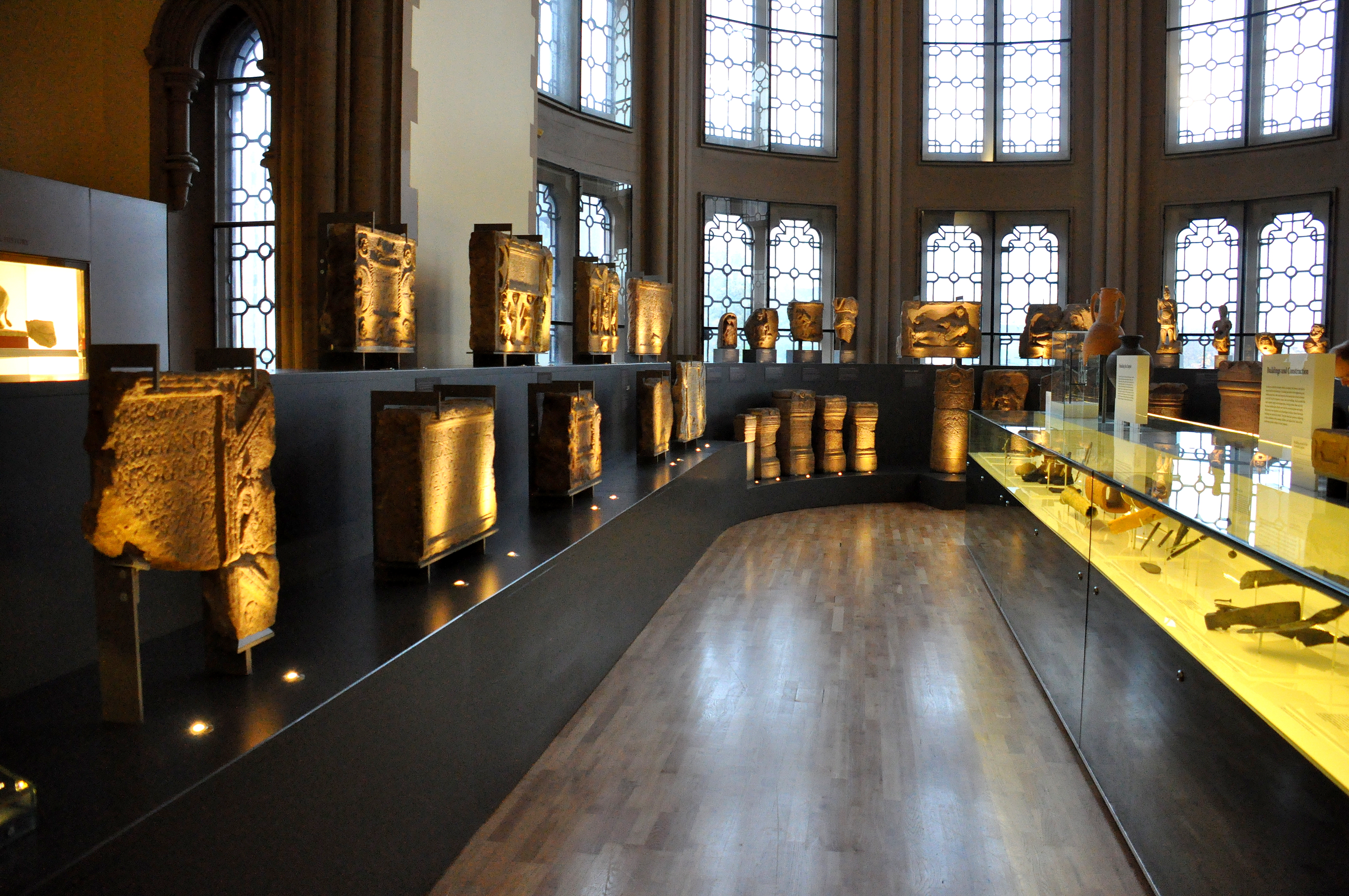
In the 1870s, the University of Glasgow abandoned its cramped High Street campus for a grand new site at Gilmorehill, fleeing the pollution and overcrowding of the old city center. The Hunterian collections followed. They were installed in halls within Sir George Gilbert Scott's soaring neo-Gothic main building, where Roman stonework from the Antonine Wall sat alongside Egyptian antiquities and geological specimens. Over the decades the collection outgrew its new home, and departments dispersed across the campus. The zoological collections moved to the Graham Kerr Building. Hunter's ten thousand printed books and six hundred fifty manuscripts went to the university library. An Egyptian coffin -- that of Lady Shep-en-hor, donated in 1820 -- became one of the museum's earliest and most mysterious acquisitions.
Whistler, Mackintosh, and Paolozzi's Doors
The Hunterian Art Gallery, housed in a modern building designed by William Whitfield as part of the university library complex, holds two collections of international significance. The gallery possesses the largest collection of works by James McNeill Whistler outside the United States, a trove that spans the American-born artist's entire career. Alongside it sits the majority of the surviving watercolors of Charles Rennie Mackintosh, Glasgow's most celebrated architect. The gallery's entrance announces its ambitions: the bas-relief aluminum doors were designed by the sculptor Eduardo Paolozzi, their gleaming surfaces a statement that this is a place where centuries of art converge.
A House Moved One Hundred Metres
When the university expanded across Gilmorehill in the 1960s, rows of Victorian terraced houses on Southpark Avenue were demolished. One of them, Number 78, had been the home of Charles Rennie Mackintosh and his wife, the artist Margaret Macdonald, from 1906 to 1914. The university salvaged the interiors and, in an extraordinary act of preservation, rebuilt the principal rooms inside a new concrete structure approximately one hundred meters from the original site. The Mackintosh House contains the dining room, studio-drawing room, and bedroom, meticulously reassembled with original furniture, fittings, and decorations. Each room demonstrates Mackintosh's concept of the domestic interior as a total work of art -- white walls, geometric furniture, and the interplay of light and dark that became his signature.
Two Brothers, Two Museums
William Hunter's younger brother John became a surgeon and founded his own museum in London -- the Hunterian Museum at the Royal College of Surgeons of England. Both brothers were born in East Kilbride, where a small museum in their childhood home operated until budget cuts forced its closure. The Glasgow Hunterian, meanwhile, continues to expand. In 2016, the Hunterian Collections and Study Centre opened in the transformed Kelvin Hall, a partnership with Glasgow City Council and the National Library of Scotland. From Lord Kelvin's scientific instruments to the Antonine Wall's carved distance slabs, from Whistler's etchings to a 3,400-year-old Egyptian goddess, the museum that one anatomist's will brought into being now holds over a million objects -- each one carrying forward Hunter's conviction that knowledge, once gathered, must be shared.
From the Air
The Hunterian Museum sits at 55.87°N, 4.29°W within the University of Glasgow's Gilmorehill campus in the West End of Glasgow. The university's distinctive neo-Gothic tower by Sir George Gilbert Scott is a prominent landmark visible from the air. The Hunterian Art Gallery and Mackintosh House are in the adjacent library complex. Nearest airport: Glasgow International (EGPF, 6 nm west). Kelvingrove Park lies immediately south, and the River Kelvin runs along the campus's western edge.