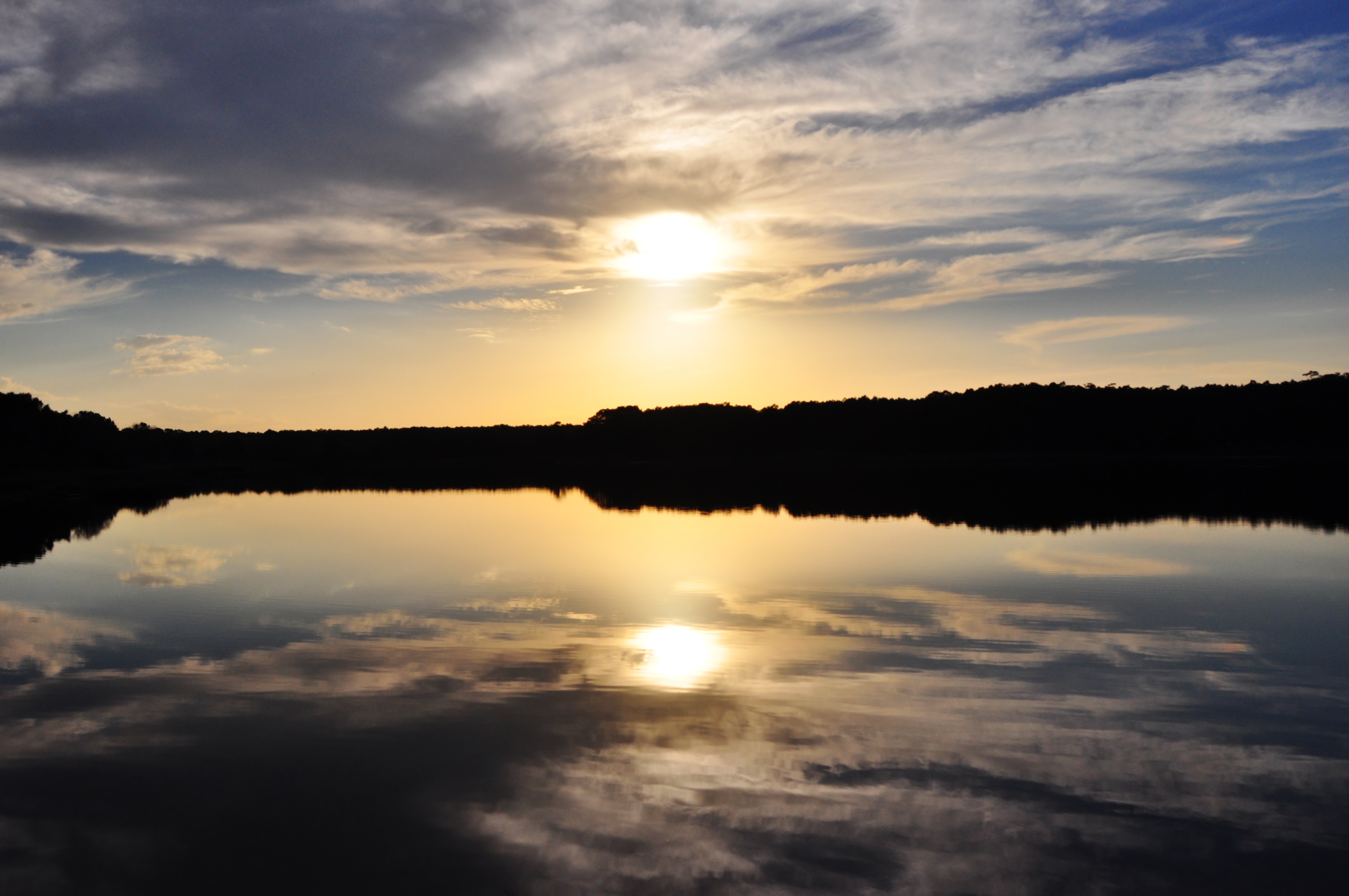
Huntington Beach State Park
Every autumn, enormous flocks of tree swallows gather above the salt marshes of Huntington Beach State Park, swirling in dark clouds before settling on snags silhouetted against the evening sky. Birders who know this 2,500-acre coastal preserve near Murrells Inlet in Georgetown County, South Carolina, simply call it HBSP -- shorthand traded in online forums and field guides as code for one of the Southeast coast's richest birding destinations. But the park holds more than feathers and field lists. On its grounds stands Atalaya Castle, the Moorish-style winter home of Archer and Anna Hyatt Huntington, and across US-17 lies Brookgreen Gardens, the sculpture park they built on former rice plantations. The birds, the beach, and the castle are all tangled together in a single story of wealth, art, and the wild Lowcountry coast.
The Huntingtons' Gift
This land belonged to Archer and Anna Hyatt Huntington, who purchased vast tracts of Waccamaw Neck in the late 1920s for their winter compound and sculpture gardens. After Archer's death, the 2,500-acre Atlantic-facing portion of the property was leased to the state of South Carolina in 1960 to become a public park, taking his name. Anna Huntington, one of the twentieth century's most celebrated American sculptors, lived until 1973. Atalaya Castle, the couple's Depression-era winter home built between 1931 and 1933, was listed on the National Register of Historic Places in 1984 and designated, together with Brookgreen Gardens, as a National Historic Landmark in 1992. Today the Friends of Huntington Beach State Park lead scheduled tours of the castle and operate the Atalaya Visitor Center.
A Birder's Calendar
The park's mix of saltwater and freshwater marshes, beach, jetty, and maritime forest creates a patchwork of habitats that draws different species through the seasons. Winter brings ducks and waders to the marshes -- including the striking roseate spoonbill, its pink plumage unmistakable against the brown cordgrass. Out on the jetty, birders scan for ocean species: gannets plunge-diving offshore, loons riding the swells, scoters in dark rafts, and occasionally alcids like razorbills and murres that venture south from their northern range. The massive tree swallow flocks are a signature spectacle, tens of thousands of birds staging before fall migration. Local birders know these marshes as reliably productive year-round.
Rebuilding After Lightning
In the early morning hours of July 20, 2016, a lightning strike set fire to the park's Nature Center, destroying the building and killing every animal on display inside, including the live baby alligator and the saltwater touch tank inhabitants that had delighted children for years. The loss was immediate and total. Rebuilding began in 2019, and a new Nature Center opened in September 2020, once again offering natural history exhibits, live animals, and free programs led by park naturalists. The building sits beside the salt marsh, north of the causeway entry road, with the park's marsh boardwalk extending into the wetlands just outside its doors.
Beach, Jetty, and Boardwalk
Huntington Beach State Park remains one of the Grand Strand's least crowded beaches -- a long stretch of sand that draws fewer visitors than the commercial strips of Myrtle Beach to the north. A rock jetty extends into the Atlantic, offering fishing and a perch for scanning the ocean horizon. Hiking trails and nature boardwalks thread through maritime forest and marsh, and a public campground puts visitors within earshot of the surf. The park's appeal is its plainness: no amusement rides, no high-rise condos, just a wide beach backed by marshland and the silhouette of a Moorish tower rising above the dunes.
From the Air
Huntington Beach State Park is at 33.51N, 79.06W on the Atlantic coast of South Carolina, just south of Murrells Inlet. From the air, the park is recognizable as a large undeveloped coastal tract between the commercial development of the Grand Strand to the north and the Waccamaw River marshes to the west. The distinctive square footprint of Atalaya Castle is visible near the beach. Brookgreen Gardens lies directly across US-17 to the west. A rock jetty extends into the ocean at the park's southern end. Nearest airports: Myrtle Beach International (KMYR) approximately 16nm northeast, Georgetown County Airport (KGGE) about 16nm south. Best viewed at 1,500-3,000 feet AGL on clear days.