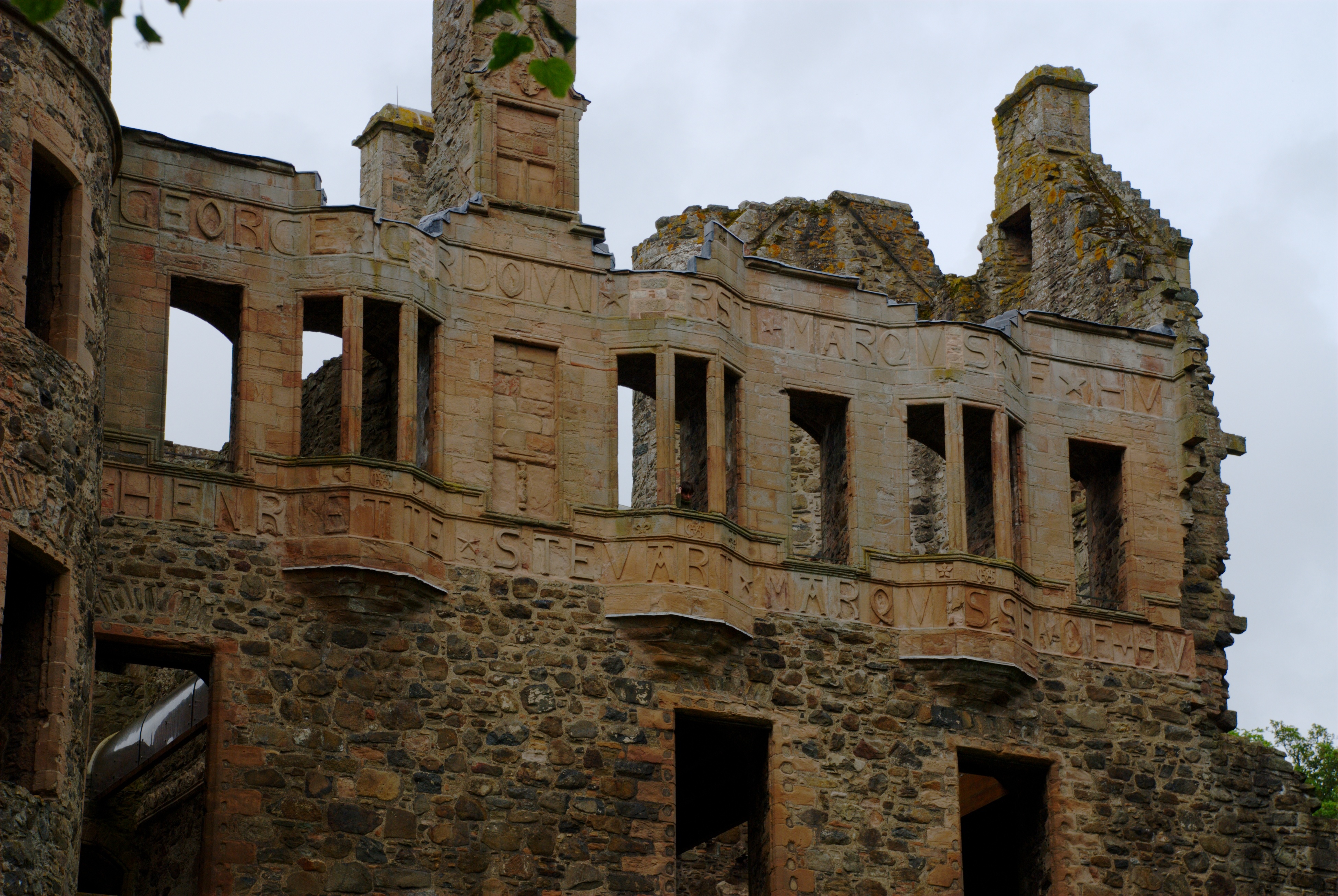
Huntly Castle
The names are carved into the facade in letters a foot high: GEORGE GORDON and HENRIETTA STEWART. The 1st Marquess of Huntly and his wife wanted everyone who approached their castle to know exactly who lived there and, by implication, who controlled the northeast of Scotland. That the King had twice ordered the castle demolished - and that Gordon had twice rebuilt it - made the inscription less a greeting than a provocation. Huntly Castle is the story of a family that refused to be brought to heel, told in stone, fire, and sheer stubbornness.
Four Castles on One Site
The site at Huntly has hosted at least four successive fortifications, each destroyed and replaced by the next. The first was a twelfth-century motte and bailey, a Norman-style earthwork castle built by the lords of Strathbogie. The Gordons acquired the estate in 1376 and built a stone tower house that became the seat of one of the most powerful families in Scotland. This tower was burned during a feud in 1452. Its replacement was burned by Mary Queen of Scots' forces in 1562 when the 4th Earl of Huntly defied the crown. The current ruins date primarily from the late sixteenth and early seventeenth centuries, when the 1st Marquess rebuilt the castle for the final time, adding the ornate heraldic facade that remains its most striking feature.
Playing Cards with Kings
The Gordons' relationship with the Scottish crown was one of mutual dependence and mutual suspicion. James IV played cards at Huntly Castle in 1505, a gesture of royal favour that acknowledged the Gordons' power in the northeast without exactly trusting it. When Mary Queen of Scots toured the north in 1562, the 4th Earl rode out to meet her with a force large enough to suggest either loyalty or threat. Mary chose to interpret it as threat. She took the castle, and the Earl died shortly after - not in battle but, according to contemporary accounts, from a stroke brought on by the shock of his capture. His body was embalmed and brought to Edinburgh, where it was tried for treason posthumously. The 5th Earl met his end even more absurdly, dying in 1576 while playing football outside the castle walls.
Demolished Twice, Built Thrice
James VI ordered Huntly Castle demolished in 1589 after the 6th Earl's involvement in Catholic plotting against the Protestant crown. The Earl submitted, was pardoned, and rebuilt. In 1594, after the Earl's participation in the Battle of Glenlivet - a Catholic victory that terrified the Protestant establishment - James ordered the castle destroyed again. Again the Earl submitted, again he was pardoned, and again he rebuilt, this time on a grander scale than before. Elevated to Marquess in 1599, George Gordon added the ornate south facade that survives today: an elaborate composition of oriel windows, heraldic panels, and inscribed stonework that is one of the finest examples of Renaissance architectural decoration in Scotland. The carved names and armorial bearings were a statement: the Gordons were still here, still building, and still unbroken.
The Ornamental Facade
The south front of Huntly Castle is remarkable for its concentration of decorative stonework. Above the main entrance, a sequence of heraldic panels displays the arms of the Gordon family, the royal arms of Scotland, and religious imagery that reflects the family's Catholic faith at a time when Catholicism was politically dangerous. The oriel windows - projecting bay windows supported on corbels - are among the finest in Scotland, their stone tracery intact despite centuries of exposure. The inscription naming George Gordon and Henrietta Stewart runs across the facade, flanked by carved roundels and decorative bands that draw on French and Flemish models. The whole composition reads as a manifesto in stone: dynastic pride, religious conviction, and architectural ambition fused into a single facade that was designed to be seen, read, and understood.
A Ruin with Authority
Huntly Castle fell out of use in the eighteenth century as the Gordon family moved to more comfortable houses. The roof was stripped, the floors collapsed, and the building settled into the picturesque ruin that stands today, cared for by Historic Environment Scotland. What survives is substantial: the full height of the main block, the vaulted basement, the oriel windows, and the heraldic facade. The setting is parkland on the banks of the River Deveron, where the town of Huntly has grown up around the castle grounds. The medieval motte is still visible as an earthwork mound to the northwest of the standing ruins. Walking through the castle, you move through five centuries of ambition - from the raw defensive needs of the earliest fortification to the ornamental swagger of the Marquess's facade, each layer a response to the one before and a challenge to whatever came next.
From the Air
Huntly Castle is located at approximately 57.455°N, 2.781°W in the town of Huntly, Aberdeenshire, at the confluence of the River Deveron and the Bogie Water. The castle ruins are visible from the air within parkland on the east side of the town. The medieval motte is identifiable as a raised earthwork. Nearest airport is Aberdeen Airport (EGPD), approximately 39 miles southeast. The A96 road passes through Huntly. Best viewed at 1,500-2,000 feet, where the castle's relationship to the river confluence is apparent.