Huntsville: Where Rocket City Built the Machines That Reached the Moon
In 1950, a sleepy Alabama cotton town received an unusual shipment: Wernher von Braun and his team of German rocket scientists, transferred from Fort Bliss to Redstone Arsenal. Within a decade, Huntsville had transformed from agricultural backwater to 'Rocket City,' the place where America's space program took shape. Von Braun's team designed the Redstone rocket that carried Alan Shepard on America's first manned spaceflight, then the Saturn V that lifted astronauts to the Moon. The Marshall Space Flight Center, opened in 1960, has shaped every major NASA program since. Today Huntsville is Alabama's largest city, its economy still built on rockets and missiles - Boeing, Lockheed Martin, Northrop Grumman, and dozens of contractors clustered around Cummings Research Park, the nation's second-largest research park. The U.S. Space & Rocket Center displays the actual hardware: a Saturn V lying on its side, spacecraft that carried astronauts to orbit, rockets that changed history.
U.S. Space & Rocket Center
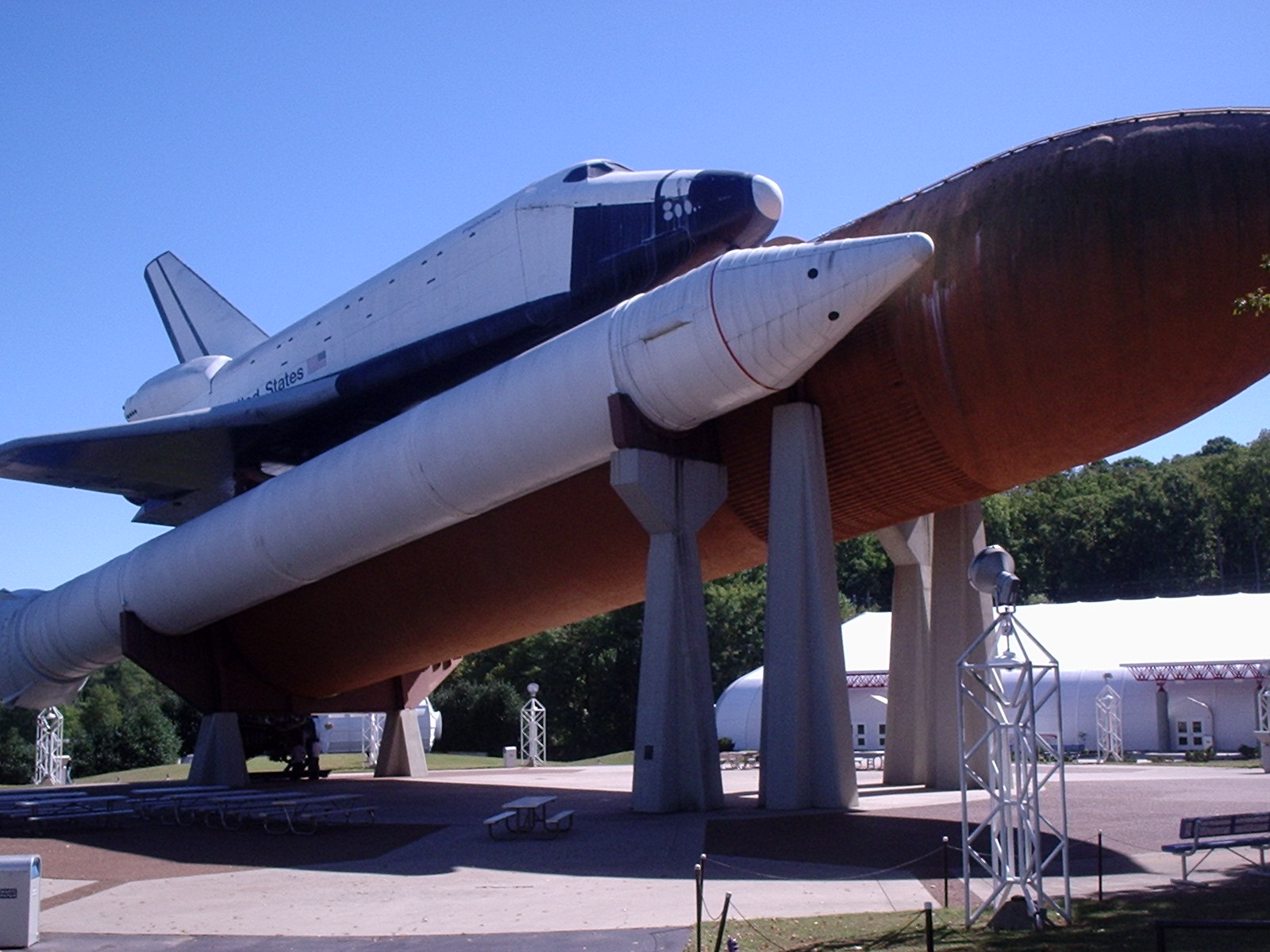
The Saturn V rocket displayed at the U.S. Space & Rocket Center is real - a flight-ready vehicle that never flew, now lying on its side in the Davidson Center where visitors can walk beneath its F-1 engines and comprehend the scale of what it took to reach the Moon. The museum holds spacecraft, rocket engines, lunar samples, and the history of America's space program from Mercury through the International Space Station. Space Camp, operating since 1982, trains students in simulated missions and astronaut training exercises - over a million people have graduated. The Rocket Park displays missiles and rockets upright against the Alabama sky: Redstone, Jupiter, Saturn I, Patriot. This is not a museum of replicas but of actual hardware, machines that were built to fly and that changed what humanity could accomplish.
Marshall Space Flight Center
Marshall Space Flight Center, NASA's propulsion development facility, has designed and tested the engines and vehicles for every major American space program. Von Braun directed Marshall from 1960 to 1970, overseeing Saturn V development. The center designed the Space Shuttle's main engines; it manages the Space Launch System that will carry Artemis astronauts to the Moon. Marshall engineers developed Skylab, the Hubble Space Telescope's scientific instruments, and systems for the International Space Station. The center sits within Redstone Arsenal, restricted military land that also hosts the Army's missile command. Huntsville's aerospace workforce - 30,000 engineers and technicians - serves both military and civilian space programs, the line between them often blurred.
Von Braun's Legacy
Wernher von Braun remains Huntsville's most complicated figure. The German engineer who built the V-2 rockets that terrorized London used concentration camp labor; he joined the Nazi Party and the SS. After the war, Operation Paperclip brought him and his team to America, their wartime records overlooked in the Cold War race for rocket technology. Von Braun became the public face of American spaceflight - appearing on Disney television programs, advocating for Mars missions, leading the Saturn V development that realized Kennedy's moon challenge. He lived in Huntsville for twenty years; streets, buildings, and the civic center bear his name. The city celebrates his achievements while largely overlooking the moral complexities. Von Braun died in 1977; his legacy in Huntsville is everywhere.
Beyond Rockets
Huntsville existed for 145 years before the rockets arrived. The city was founded in 1805; antebellum mansions in the Twickenham Historic District date to the 1810s and 1820s. Alabama's first constitutional convention met here in 1819; Huntsville briefly served as state capital. The cotton economy built graceful Federal and Greek Revival homes that survived the Civil War. Big Spring International Park, downtown, marks where John Hunt settled by a spring in 1805 - now surrounded by restaurants and the Von Braun Center. Monte Sano State Park rises above the city, offering hiking trails and views across the Tennessee Valley. Huntsville's downtown has revived with breweries and restaurants, though the city remains sprawling and car-dependent like most of the South.
Tennessee Valley Position
Huntsville International Airport (HSV) offers connections to major hubs. I-65 passes twenty miles west; I-565 connects downtown to the interstate. The city sits in the Tennessee Valley, the Tennessee River visible to the south where it bends through northern Alabama. Decatur and Athens are nearby; Chattanooga is ninety minutes east; Nashville two hours north. From altitude, Huntsville appears as development spreading across the valley floor - Redstone Arsenal's restricted expanse visible to the southwest, Monte Sano's forested plateau rising to the east. What appears from the air as a modest Southern city is Rocket City, where German engineers built American rockets, where the Saturn V took shape, and where the aerospace industry still builds machines to carry humanity beyond Earth.
From the Air
Located at 34.73°N, 86.59°W in the Tennessee Valley of northern Alabama. From altitude, Huntsville appears as development across the valley floor - Redstone Arsenal's large restricted area visible to the southwest, Monte Sano State Park rising to the east. What appears from the air as a mid-sized Southern city is Rocket City, where Wernher von Braun's team built the Saturn V that carried astronauts to the Moon, and where NASA's Marshall Space Flight Center continues to develop the rockets carrying humanity to space.