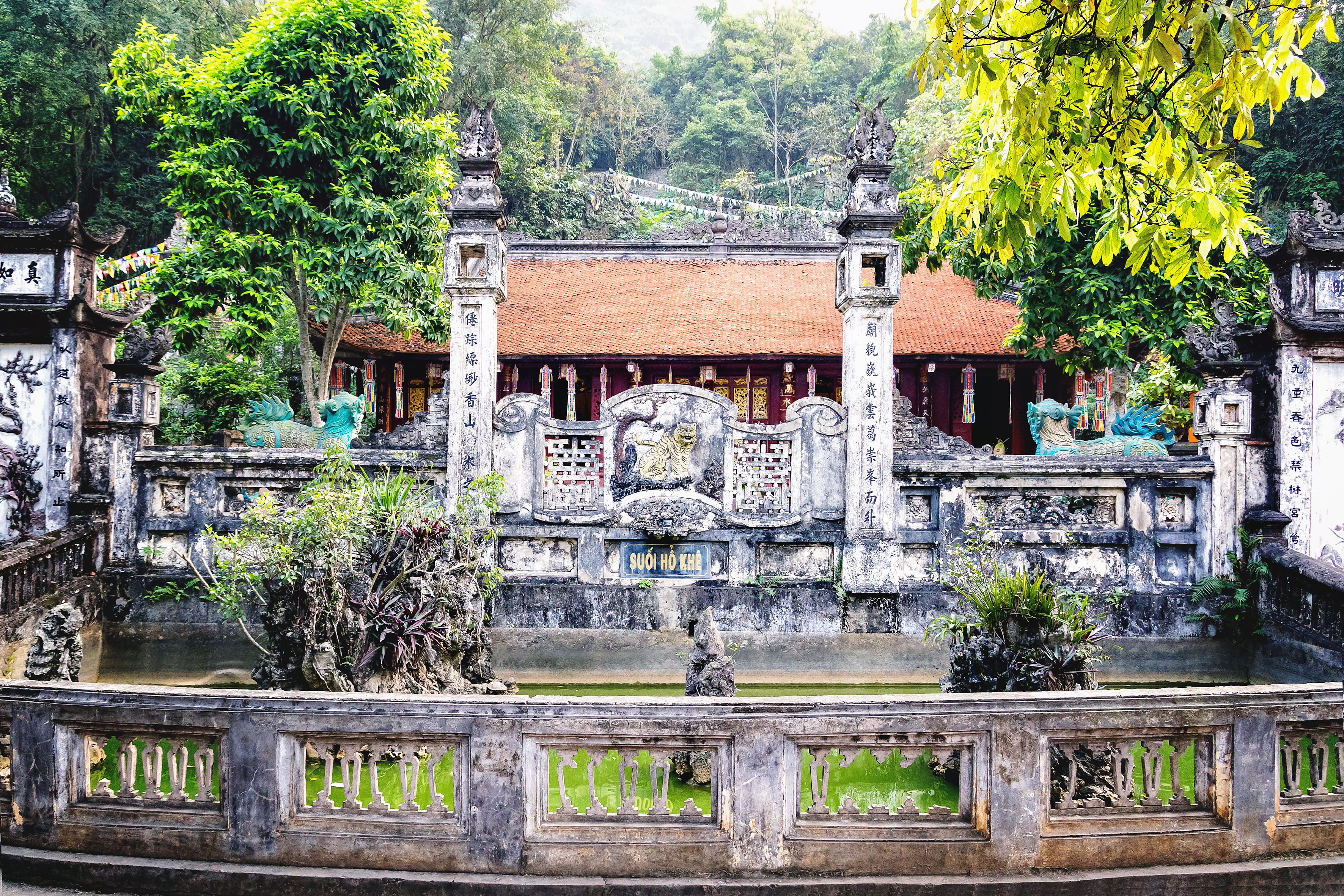
Hương Temple
The journey begins not on foot but by water. Flat-bottomed boats glide up the Yen River through a corridor of limestone karsts, paddled by rowers who use their feet on the oars, hands free for the long haul. The destination is invisible from the river - tucked into the mountains ahead is one of Vietnam's most sacred Buddhist complexes, a labyrinth of temples, shrines, and grottoes collectively known as Chua Huong, the Perfume Temple. The name comes not from incense but from the mountains themselves: Huong Tich, the "Fragrant Traces," where legend says the scent of rare aquilaria wood once drifted down the slopes.
A Cave Where Bodhisattva Rested
At the heart of the complex lies Huong Tich Cave, where the Inner Temple - Chua Trong - occupies a natural cathedral of stalactites and shadow. According to Vietnamese Buddhist tradition, the Bodhisattva Quan Am traveled south and stayed at this very grotto to help save human souls. A stone inside Phat Tich Temple is said to bear her preserved footprint. The first structure here was likely a modest shrine built during the reign of Emperor Le Thanh Tong in the 15th century, though legend pushes the site's spiritual discovery back over two thousand years, to a meditating monk who named it after a Tibetan mountain where the Buddha practiced asceticism. A stele dates the construction of a terrace, stone steps, and the Kim Dung shrine to 1686, during the reign of Le Hy Tong. The original bronze statues of Buddha and Quan Am, cast in 1767, were replaced with the current figures in 1793.
Heaven's Kitchen and the Outer Temples
Before reaching the cave, pilgrims pass through a succession of temples that climb the mountainside like stations of devotion. Den Trinh comes first - the Presentation Temple, where travelers announce their arrival to the resident spirits. Beyond it stands Thien Tru, the "Heaven Kitchen" Temple, also called Chua Ngoai, the Outer Temple. Its compound shelters the Vien Cong Bao Stupa, a brick tower entombing Master Tran Dao Vien Quang, who led the temple's reconstruction centuries ago. The complex sprawls further into the karst landscape: Thien Son Temple, Thuyet Kinh Grotto, Phat Tich Temple, and Cua Vong Temple each occupy their own pocket in the limestone. A modern gondola now carries visitors above the forest canopy, but most pilgrims still choose the stone steps, treating the climb itself as part of the spiritual practice.
The Spring Pilgrimage
Each year after Tet, the Lunar New Year, the Huong Temple Festival draws enormous crowds from across Vietnam. The pilgrimage season runs from the first to the third lunar month, and during peak weeks the Yen River becomes a procession of hundreds of boats moving in slow single file through the mist-wrapped karsts. This is not a quiet contemplation - it is a joyful, noisy, communal act of devotion, with families packing food, incense, and offerings for the journey. The festival is one of Vietnam's longest-running religious gatherings, a tradition that has persisted through centuries of dynastic change, colonial rule, and war. For many Vietnamese, the pilgrimage to Chua Huong is a once-in-a-lifetime act of faith, and the emotional weight of finally arriving at Huong Tich Cave - cool, dark, glittering with stalactites - is unmistakable on the faces of those who have waited years for the trip.
Verses Carved in Memory
Few Vietnamese sacred sites have inspired as much poetry as Chua Huong. The poet Chu Manh Trinh wrote of Huong Son as standing "sky high, in the land of Buddhas," its cave "so deep, glittering in the moonlight." Nguyen Nhuoc Phap composed a beloved poem about a young girl accompanying her father on pilgrimage and finding love along the way - a work so widely known that its opening lines are practically folk memory. The musician Hoang Quy, writing in the early 20th century, captured the sensory saturation of the place: "Huong Temple is filled with incense and aquilaria, smoke spiralling up in the dying sun." These literary layers have made the temple not just a religious site but a touchstone of Vietnamese cultural identity, a place where faith, nature, and art converge in limestone and river mist.
From the Air
Located at 20.62N, 105.75E in the limestone karst region of Huong Son, My Duc District, about 60 km southwest of Hanoi. The Yen River and surrounding karst formations are visible from altitude. Nearest major airport is Noi Bai International (VVNB) in Hanoi. Best viewed at lower altitudes where the river corridor through the karsts is distinguishable. The temple complex itself is nestled inside the mountains and not visible from the air, but the distinctive boat traffic on the Yen River during pilgrimage season is identifiable.