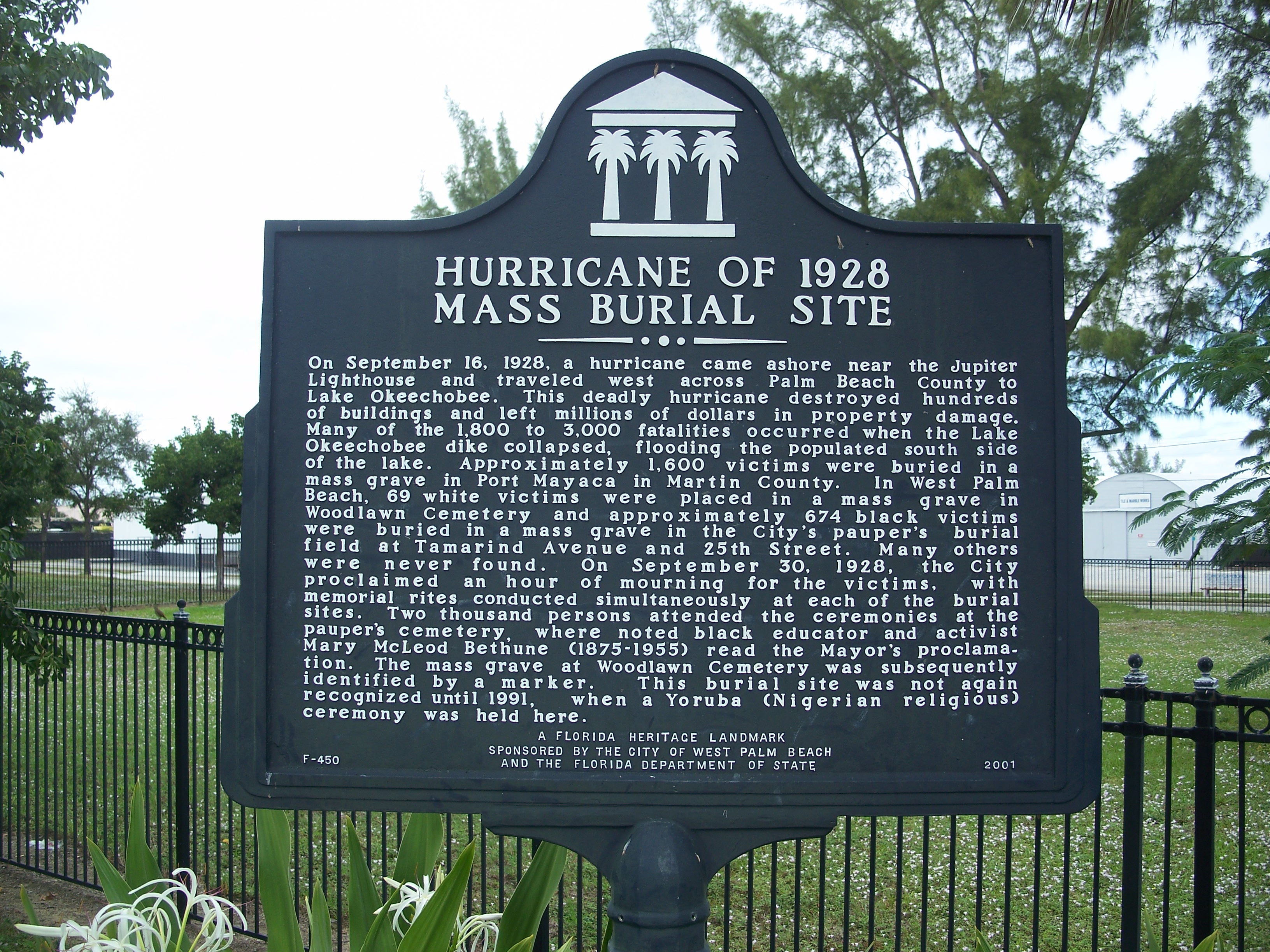
Hurricane of 1928 African-American Mass Burial Site
On October 1, 1928, roughly 3,000 people gathered in West Palm Beach for an hour of mourning proclaimed by Mayor Vincent Oaksmith. They came to grieve the dead of the Okeechobee hurricane, a Category 4 storm that had struck southeastern Florida two weeks earlier, killing at least 2,500 people and devastating the farming communities around Lake Okeechobee. At Woodlawn Cemetery, a memorial was placed for the storm's victims. But at a pauper's cemetery near the corner of 25th Street and Tamarind Avenue, where 674 bodies of African Americans and people of unknown race had been buried in two layers in a mass grave, no marker was placed. Segregation dictated who received dignity in death. Among those who attended the funeral service was Mary McLeod Bethune, the educator and civil rights activist who understood, perhaps better than most, what that silence meant.
The Storm That Drowned the Glades
The 1928 Okeechobee hurricane made landfall near West Palm Beach on September 16 with winds exceeding 140 miles per hour. The storm drove Lake Okeechobee's waters over its low earthen dike, flooding the surrounding agricultural lowlands in a wall of water that swept away entire communities. The victims were disproportionately Black migrant farm workers who labored in the sugar cane and vegetable fields along the lake's southern shore. The death toll -- at least 2,500, with some estimates reaching higher -- made it the deadliest hurricane in Florida history and the second-deadliest natural disaster in United States history at the time. Bodies were scattered across miles of flooded farmland, and the grim task of recovery took weeks.
Separate Even in Death
The treatment of the dead exposed the racial order of 1920s Florida with brutal clarity. White victims were collected and given individual burials at Woodlawn Cemetery in West Palm Beach, with coffins and markers. African American victims received no such care. Their bodies were brought to the pauper's cemetery that had been established in 1913 near 25th Street and Tamarind Avenue, between what are now Interstate 95 and U.S. Route 1. There, 674 bodies were placed in a mass grave, buried in two layers without individual identification. Other mass burial sites were established across the region -- about 1,600 bodies at Port Mayaca, at least 22 at Miami Locks, 28 at Ortona, and 22 at Sebring. In some locations, bodies of Black victims were stacked by roadsides and burned.
Decades of Forgetting
After the burials, the site slipped from public memory. The city of West Palm Beach sold the land, and it changed ownership multiple times through the 1980s. In the 1950s, 25th Street was paved directly over the northern portion of the mass grave, unearthing bodies in the process -- a desecration that drew little public attention. The pauper's cemetery, originally encompassing a larger parcel, was reduced as portions were sold off. For more than sixty years, no marker acknowledged what lay beneath the ground. The 674 people buried there remained as invisible in death as the segregation-era power structure had intended them to be in life.
Reclaiming Sacred Ground
The recovery of memory began in 1991, when the Sankofa Society conducted a well-publicized blessing ceremony at the site, bringing the mass burial back to public awareness. The property's owner at the time refused to sell or donate the land back to the city but halted any construction plans. In 1999, resident Robert Hazard established the Storm of '28 Memorial Park Coalition, a nonprofit organization dedicated to reacquiring the land and building a memorial complex. The coalition's original vision included an educational center and a museum honoring African American pioneers and migrant farm workers, at an estimated cost of $6.1 million. The Sankofa Society proposed a more modest plan: an information wall and a large marble headstone for approximately $43,000. In December 2000, the city of West Palm Beach repurchased the property. On September 12, 2002, the site was added to the National Register of Historic Places, and a state historical marker was installed the following year.
Ground That Speaks
Today the burial site sits enclosed by fencing at the southwest corner of 25th Street and Tamarind Avenue, a small and quiet parcel in an urban neighborhood. The inner fenced area marks the approximate boundaries of the mass grave. It is not a grand memorial. There are no towering monuments or visitor centers. But its presence on the National Register -- and in the consciousness of the community that fought to reclaim it -- transforms this patch of ground into something more than a cemetery. It is evidence. Evidence that 674 human beings lived and worked and died in a storm that did not discriminate, in a society that did. The ground holds their names in silence because no one recorded them, but the ground itself refuses to be silent any longer.
From the Air
Located at 26.74°N, 80.06°W in West Palm Beach, Florida, near the intersection of 25th Street and Tamarind Avenue between I-95 and U.S. Route 1. The site is a small urban parcel not easily distinguished from the air, but its location in the broader West Palm Beach urban grid is identifiable. Best approached at lower altitudes. Nearest airport is Palm Beach International (KPBI), approximately 3 nm to the south. Palm Beach County Park Airport (KLNA) in Lantana is approximately 9 nm south.