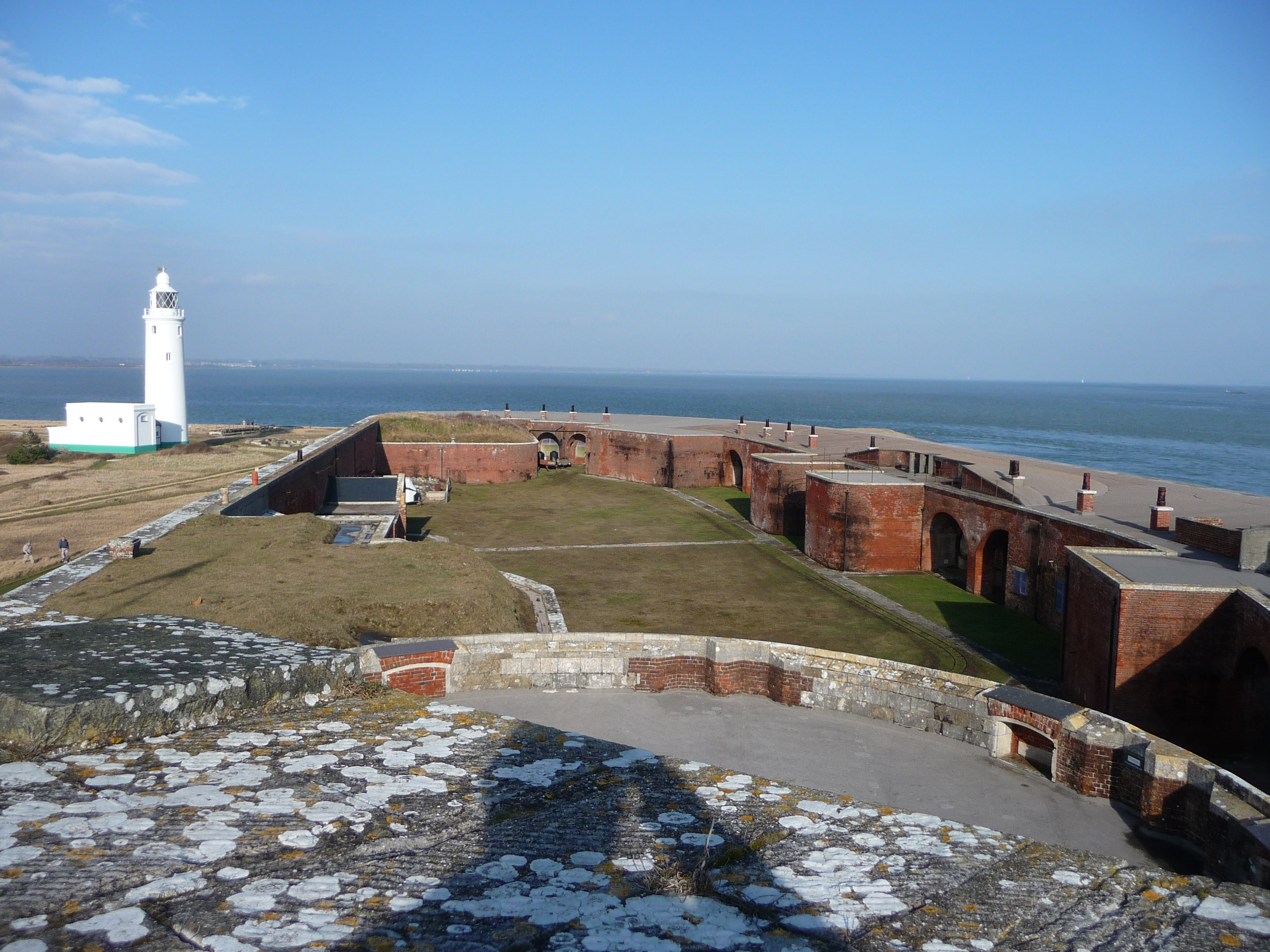
Hurst Castle
Only three-quarters of a mile of water separates Hurst Castle from the Isle of Wight, and that narrow channel has determined the fort's purpose for nearly five hundred years. Built on a finger of shingle reaching into the Solent, Hurst was designed to make that gap lethal for any hostile fleet. Henry VIII ordered its construction in 1541, and every subsequent conflict prompted upgrades, from the Napoleonic Wars to the Second World War. Now the castle faces an adversary no amount of armament can defeat: the sea that gives it strategic value is slowly consuming the spit it stands on.
The Device King's Fort
Henry VIII's break with Rome in 1533 left England dangerously exposed. When France and the Holy Roman Empire declared an alliance against him in 1538, with the Pope's encouragement, Henry issued a "device" ordering the construction of coastal fortifications. Hurst Castle was one of four forts recommended for the Solent, alongside Calshot and installations at East and West Cowes. Work began in 1541 under master mason Thomas Bertie, who became the castle's first captain. Completed by January 1544 at a cost exceeding 3,200 pounds, the result was a stone artillery fort with a central keep and three bastions, surrounded by a moat, capable of holding up to 71 guns. In practice, the garrison and armament were more modest: a 1547 inventory listed 26 artillery pieces, including sakers, culverins, and demi-cannons.
A King's Last Prison
Hurst's most famous chapter lasted only weeks. During the English Civil War, Parliament held the castle from 1642 onward. In late 1648, King Charles I was brought here under guard before being transferred to London for his trial and execution in January 1649. The castle's isolation on its spit made it an ideal holding point, a secure stop on the condemned king's final journey. Centuries of neglect followed this moment of high drama. By the 1770s, reports described guns that could no longer be mounted on crumbling bastions and water seeping through decaying walls. By 1793, every gun was unusable, and smugglers led by a notorious criminal named John Streeter used the spit as a regular rendezvous.
Reinvention Through Fear
War with France repeatedly rescued Hurst from dereliction. The Revolutionary Wars brought repairs in 1794 and new batteries armed with captured French 36-pounder guns. The Napoleonic threat prompted a more ambitious remodeling: the keep was vaulted, reinforced with a central stone pillar, and equipped with 24-pounder guns, effectively transforming it into something resembling the Martello towers being built along the south coast. By the 1850s, the introduction of steam-powered warships created fresh anxiety. Sailing ships had been forced to pass the castle slowly against the tide, making easy targets. Steamships could cruise past at speed. The response was dramatic: between 1861 and 1874, two enormous granite-faced batteries were built flanking the Tudor castle, creating 61 gun positions. The work cost 211,000 pounds and bristled with massive rifled muzzle-loading guns, including ten weapons weighing 38 tons each.
The Born Son of Rebellion
One detail connects Hurst to events far from the Hampshire coast. Thomas Clarke, born at Hurst Castle where his father served in the garrison, grew up to become one of the executed leaders of the 1916 Easter Rising in Dublin. It was an unlikely trajectory from a remote English fort to the General Post Office in Dublin, but Clarke's upbringing in a military family shaped his lifelong preoccupation with resistance. By the time of the First World War, the castle's 1870s guns were thoroughly obsolete. The historian Coad described them wired together "like a collection of elderly blunderbusses," though newer quick-firing weapons provided actual defense. The fort served again in the Second World War before being decommissioned in 1956.
The Sea Closes In
Today Hurst Castle faces a threat none of its builders anticipated. Coastal erosion is steadily eating the shingle spit, and in February 2021, a section of the east wing wall collapsed into the sea. The World Monuments Fund placed the castle on its 2022 Watch list of most endangered sites. English Heritage, which manages the castle jointly with the Friends of Hurst Castle, launched a campaign in 2022 to repair and strengthen the sea walls. Around 40,000 visitors make the journey each year, arriving by ferry or on foot along the spit from Milford on Sea. Four lighthouses have stood at Hurst since the eighteenth century, one of which, the High Lighthouse built in 1867, remains in active service, still marking the passage its Tudor builders first sought to control.
From the Air
Located at 50.706N, 1.551W on the tip of Hurst Spit, Hampshire. The castle and its spit are dramatically visible from the air, extending into the Solent with the Isle of Wight just 0.75 miles across the water. Nearest airports: EGHF (Lee-on-Solent, 18 nm east), EGHI (Southampton, 20 nm northeast). The two long battery wings flanking the Tudor castle are clearly distinguishable. Recommended viewing altitude 1,500-3,000 ft.