Hurum Air Disaster
Twenty-eight children, most of them between 8 and 12 years old, boarded a Douglas DC-3 near Tunis on 20 November 1949. They were Jewish children from poor families, selected through the Youth Aliyah program with their parents' consent, on their way to a new country that had existed for barely a year. Norway was supposed to be a waypoint -- a transit through a sanitarium where they would rest before continuing to Israel. None of them knew that the mountains southwest of Oslo were hidden in fog that afternoon.
A Route Through the Cold
The arrangement was unusual. In 1949, the American Jewish Joint Distribution Committee had signed an agreement with the Norwegian Ministry of Welfare to make 200 places in a tuberculosis sanitarium available for Jewish children from North Africa who were in the process of immigrating to Israel. An earlier group of about 200 children from Morocco had passed through the facility in April 1949 without incident. The Tunisian group was to follow the same path. Two DC-3 aircraft operated by the Dutch charter company Aero Holland departed from an airport near Tunis. The first plane reached its destination safely. The second, registration PH-TFA, stopped at Brussels-Zaventem Airport to repair its radio before setting off for Oslo with 28 children and seven escorts and crew.
Sixty Meters Past the Trees
As the DC-3 descended toward Fornebu Airport, Oslo's main airfield at the time, the pilot encountered dense fog over the mountainous terrain of Hurum, a peninsula jutting into the Oslofjord southwest of the capital. Flying too low, one of the plane's wings clipped a tree. The aircraft traveled another 60 meters before slamming into the mountainside at 4:56 p.m. The impact overturned the fuselage and threw most of the passengers from the wreckage. The fuel tanks ignited, engulfing the forward section in flames. Of the 35 people on board, 34 died -- 27 of them children. The sole survivor was a 12-year-old boy named Itzhak Allal, who later changed his surname to El Al.
A Nation's Response
The Hurum crash was the second-deadliest air disaster in Norwegian history at the time, exceeded only by the 35 deaths in the 1947 Kvitbjorn disaster. Public sympathy was immediate and deep. Hakon Lie, the secretary of the Norwegian Labor Party, launched a fundraising campaign to build a Norwegian village in Israel. The money collected was used to help establish the moshav of Yanuv, a cooperative farming community that became a lasting link between the two nations. In Norway, the response to the tragedy also spurred discussions about aviation safety and the hazards of low-visibility approaches into mountainous terrain -- conversations that would shape Scandinavian aviation policy in the decades to come.
Memorials Across Two Continents
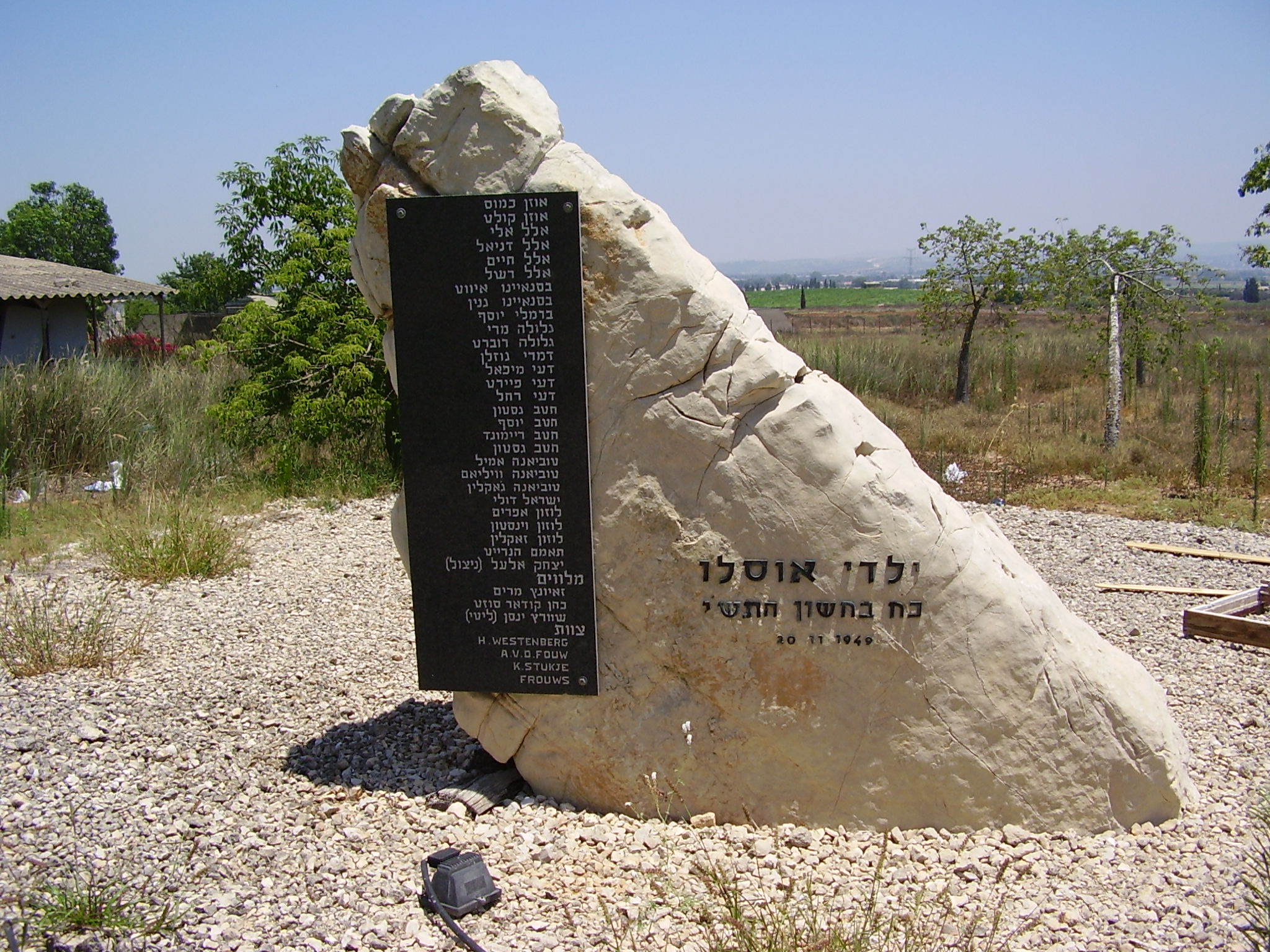
At the crash site on the Hurum mountainside, a memorial stands behind a symbolic fence decorated with Stars of David. Pieces of the wreckage remain at the site, rusting quietly among the trees. In Israel, the village of Yanuv holds its own memorial to the children, funded by friends of Israel within the Norwegian labor movement. Additional memorials exist in Netivot and Netanya, and a kindergarten in Netanya bears the name of the children of Oslo. These scattered markers trace the geography of a journey that began in the Jewish quarters of Tunisian cities, passed through the sanitariums of Norway, and was meant to end in the new state of Israel -- a journey that for 27 children ended instead on a fog-covered hillside above the Oslofjord.
From the Air
Located at 59.62N, 10.58E on the Hurum peninsula, southwest of Oslo on the western side of the Oslofjord. The crash site is in mountainous, forested terrain. The former destination, Fornebu Airport, is now closed. Nearest major airport is Oslo Gardermoen (ENGM), approximately 80 km northeast. The terrain that caused the accident -- forested hills rising from the fjord in conditions of poor visibility -- is still evident from the air. Best observed at 3,000-5,000 ft AGL.