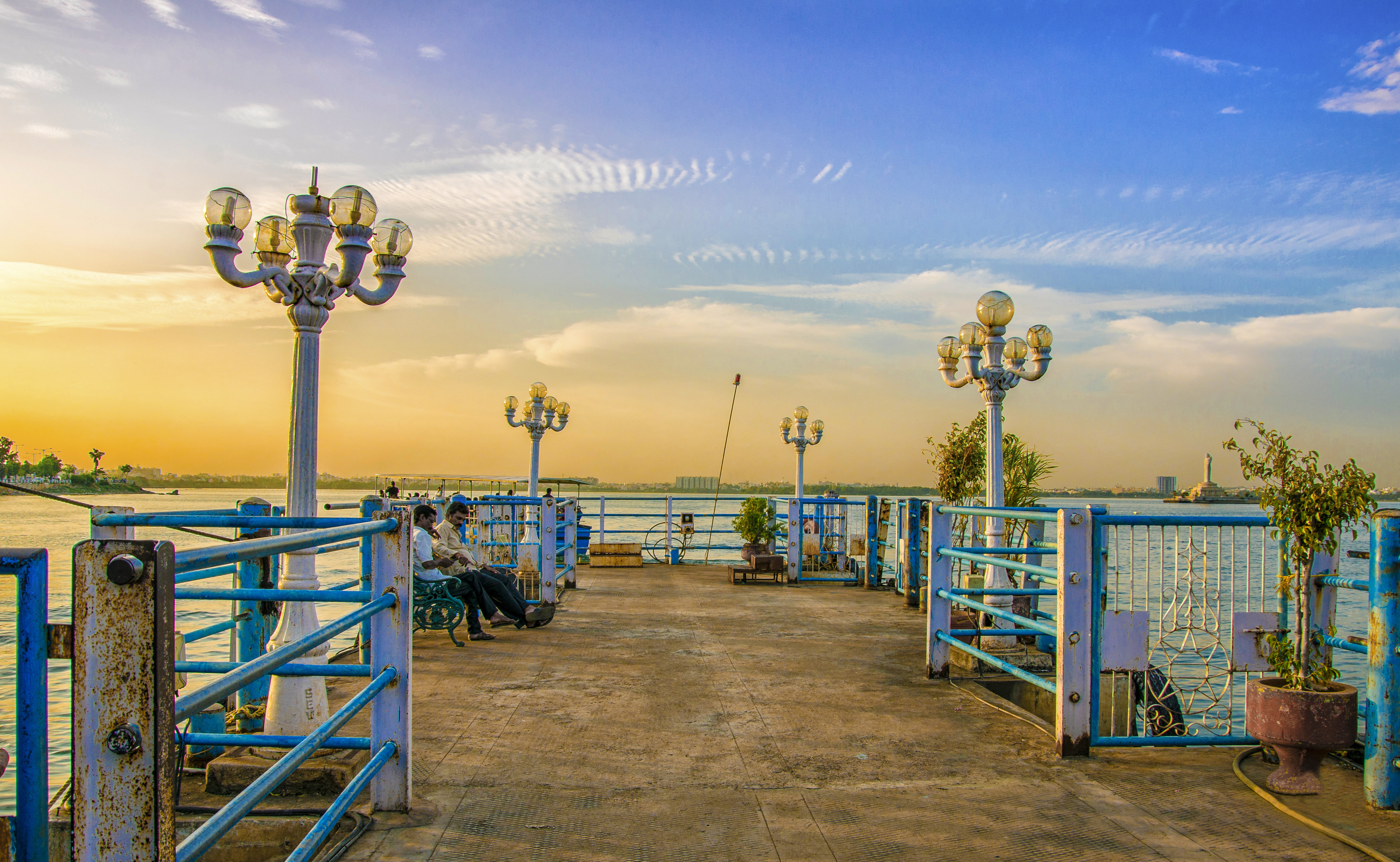
Hussain Sagar
From the air, it looks like a valentine pressed into the sprawl of Hyderabad. Hussain Sagar is a heart-shaped lake spanning 5.7 square kilometers, and the United Nations World Tourism Organisation made that observation official in 2012, declaring it the largest heart-shaped body of water on Earth. But this lake has been the literal heart of Hyderabad since long before anyone thought to measure its outline. Built in 1562 by Ibrahim Quli Qutb Shah across a tributary of the Musi River, Hussain Sagar was the city's primary water supply for centuries, and it still divides the old city center from Secunderabad like a seam holding two halves together.
A Sultan's Gift of Water
The lake takes its name not from its builder but from his architect. Hussain Shah Wali, the Master of Architecture in the Qutb Shahi kingdom, designed the artificial reservoir to capture water from canals fed by the Musi River. For over three centuries, Hussain Sagar was Hyderabad's lifeline, supplying drinking water to the growing twin cities until Himayat Sagar and Osman Sagar were constructed on the Musi itself. On the lake's banks, the 7th Nizam, Mir Osman Ali Khan, built South India's first thermal power station in 1920, supplying electricity to Hyderabad and Secunderabad until 1983. The lake has always been more than scenery. It has been infrastructure, engine, and sustenance.
The Buddha on the Rock
An 18-meter monolithic statue of Gautama Buddha stands on Gibraltar Rock in the center of the lake, rising from a red lotus pedestal. The idea belonged to N. T. Rama Rao, the Telugu film legend turned Chief Minister, who conceived it as part of the Buddha Poornima project in 1985. Two hundred sculptors spent two years chiseling the figure from a single block of white granite weighing 450 tons. Transporting it to Hyderabad in November 1988 proved treacherous, and the statue did not reach its pedestal until 1 December 1992. Today it is the lake's defining image, visible from the Necklace Road promenade that curves along the shoreline, from the hilltop Birla Mandir to the south, and from the sailboats that have raced here since 1971.
A Gallery of Civilization
Walk along Tank Bund road and you pass through two thousand years of Telugu culture rendered in bronze. Thirty-four statues line the causeway, each mounted on a high platform, each representing someone who shaped this region. The sequence begins with Gautamiputra Satakarni, the Satavahana emperor, and moves through the medieval poet Nannayya, the Vijayanagara emperor Krishnadevaraya, Carnatic music composer Thyagaraja, and the 13th-century warrior queen Rudrama Devi. Freedom fighters stand alongside social reformers. Sir Arthur Cotton, the British irrigation engineer who built the barrages that transformed the Godavari delta, shares the promenade with Pingali Venkayya, who designed the flag that would replace British rule. N. T. Rama Rao himself widened and beautified this road in 1987, adding fountains and colored lights, creating the open-air gallery the city promenades through today.
Monuments Along the Shore
The lakefront has accumulated landmarks the way a river accumulates silt. To the south, Birla Mandir crowns Naubath Pahad, a hillock 280 feet above the water, its white marble gleaming against the sky since 1976. To the north, 92-acre Sanjeevaiah Park sprawls in green, an award-winning landscape. In 2023, two enormous additions reshaped the skyline. A 125-foot bronze statue of B. R. Ambedkar was unveiled on the lakeshore, standing atop a circular edifice modeled after India's parliament, bringing the overall height to 175 feet. Nearby, the Telangana Amara Jyothi, a seamless stainless-steel memorial to the state's martyrs, was inaugurated as the largest such structure in the world, five times the size of Chicago's Cloud Gate.
A Heart Under Pressure
Hussain Sagar's beauty is shadowed by an environmental crisis. The lake that once supplied clean drinking water has become, according to a 2008 study, hypereutrophic, choked with untreated sewage and industrial effluents from the twin cities. Siltation has made it shallower, and species that once thrived here have declined or vanished. Despite the commissioning of a sewage treatment plant on the western shore, much of the city's waste still flows in unchecked. Conservation projects have been formulated, and the debate over whether to classify Hussain Sagar as a protected wetland continues between central and state governments. The heart of the world, it turns out, needs open-heart surgery. Whether it arrives in time may determine whether Hussain Sagar remains a living lake or becomes an ornamental pond.
From the Air
Located at 17.42N, 78.47E in central Hyderabad. The heart-shaped lake is unmistakable from altitude, with the white Buddha statue visible on Gibraltar Rock in the center. Tank Bund road bisects the lake's eastern edge. Look for Birla Mandir on the hillock to the south and the tall Ambedkar statue on the western shore. Nearest airport: Rajiv Gandhi International Airport (VOHS), approximately 24 km to the south. Begumpet Airport (VOBG), now used for general aviation, is barely 2 km north of the lake.