HVDC BorWin2
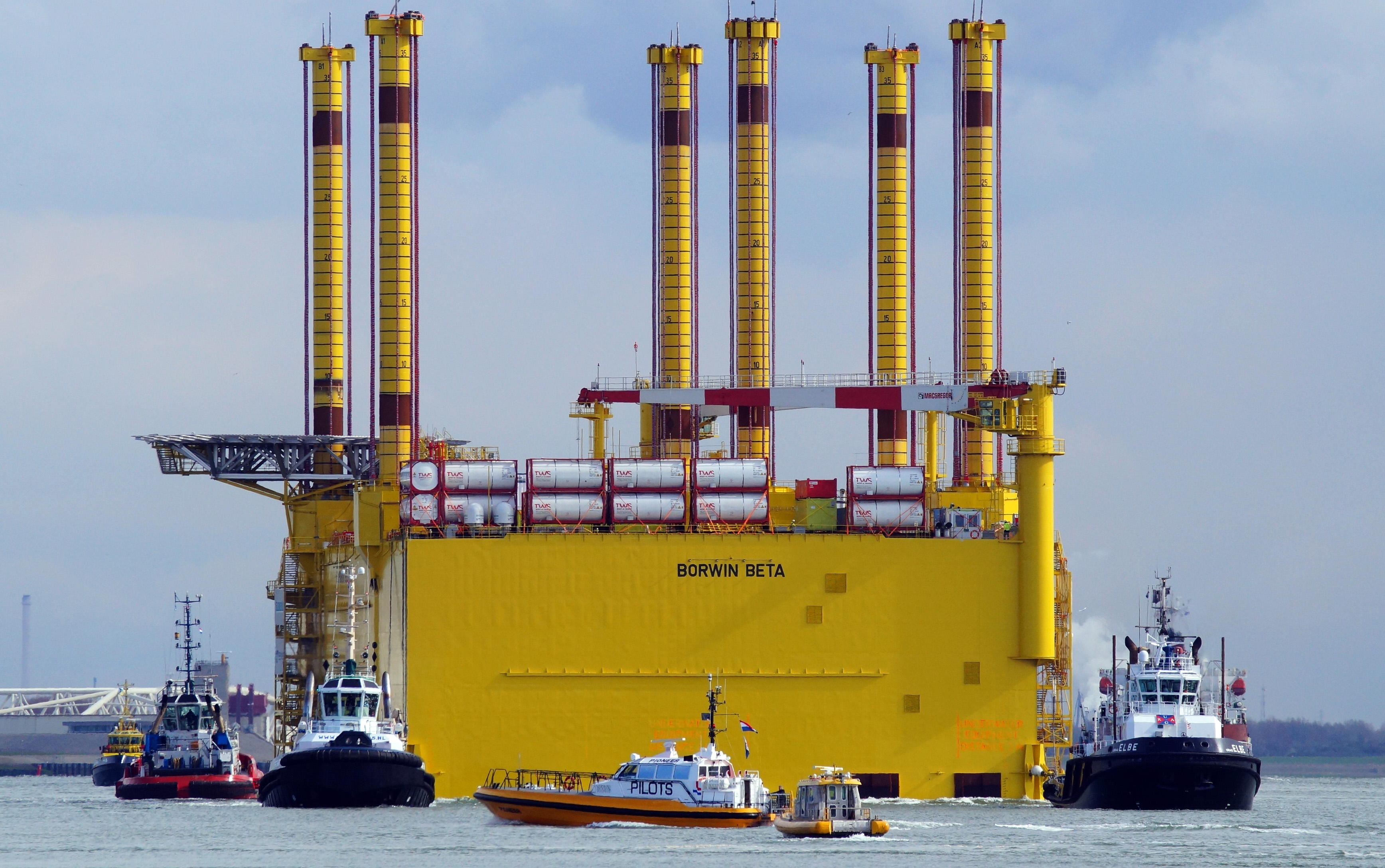
Picture a building the size of a small office block - 72 by 51 meters at the base, 25 meters tall, weighing 12,000 tonnes - sliding across the North Sea on a barge. It reaches a spot 125 kilometers from the German coast and meets the four legs of a submerged jacket. The legs rise. The building lifts itself clear of the waves. That is how BorWin Beta took its position in the German Bight in 2014, and how Germany's second offshore HVDC link beat its older sibling to the finish line.
The Float-Over
BorWin1 had been craned into place by the world's largest heavy-lift vessel. BorWin2 used a different trick. Nordic Yards in Warnemunde, on the German Baltic coast, built the platform topside as a single 12,000-tonne unit with retractable legs designed to grip and lift. A barge ferried it across to a pre-installed jacket foundation. Hydraulic jacks raised the topside out of the water and locked it onto the jacket. There was no heavy crane involved. The technique - borrowed from the oil and gas industry - had never before been used at this scale for a German offshore converter, and it set the template for the larger platforms that followed.
Double the Power
Inside the platform, Siemens converters use 4.5 kV IGBTs and Modular Multi-Level Converter technology to turn alternating current into 800 megawatts of direct current at plus-or-minus 300 kilovolts. That is double the capacity of BorWin1 next door, and roughly enough electricity to power 800,000 German households. A pair of three-phase transformers, each rated 590 MVA, sit on the offshore side, with slightly smaller siblings at the Diele substation 200 kilometers away. The 200-kilometer cable runs under the seabed for most of its length, then continues underground across Lower Saxony, completely invisible to anyone walking above it.
Quietly First
BorWin1 had been wired up and tested first, in 2009, but it kept tripping. Vibration. Harmonics. A platform fire in March 2014. Years of patient work to figure out what was wrong. Meanwhile, BorWin2 came online cleanly. Trial operation started in November 2014. The Siemens-Prysmian consortium formally handed the link to TenneT in January 2015. It was, technically, the first fully operational offshore HVDC link in Germany - the new sibling stepping ahead of the troubled pioneer. The Veja Mate wind farm, with its 67 six-megawatt Siemens turbines, fed it from one side. Two more farms, Deutsche Bucht and Albatros, joined later.
Energiewende's Hardware
Germany's Energiewende - the national turn away from coal and nuclear - depends on links like BorWin2 to drag North Sea power inland to industries and cities. The platforms themselves are unmanned, run remotely, visited only by maintenance crews and the helicopter pilots who shuttle them out. From the air, BorWin Beta looks like a steel hotel marooned in open water, surrounded by 80-meter wind turbine blades scything the sky. From a substation in Diele, it looks like nothing at all - just clean current flowing onto the grid, indistinguishable from any other electron.
From the Air
BorWin Beta sits at 54.36°N, 6.03°E, immediately adjacent to BorWin Alpha (BorWin1) in the German exclusive economic zone of the North Sea. The cluster lies roughly 125 km north of Emden and 110 km north of Borkum. Nearest airports: Emden (EDWE), Wilhelmshaven (EDWI), Heligoland (EDXH), Bremen (EDDW). The two platforms - BorWin1 and BorWin2 - stand close enough to appear as a single complex from cruising altitude. Surrounded by the Veja Mate and BARD Offshore 1 wind arrays; expect active wind-farm airspace restrictions and turbine wake turbulence at low altitudes.