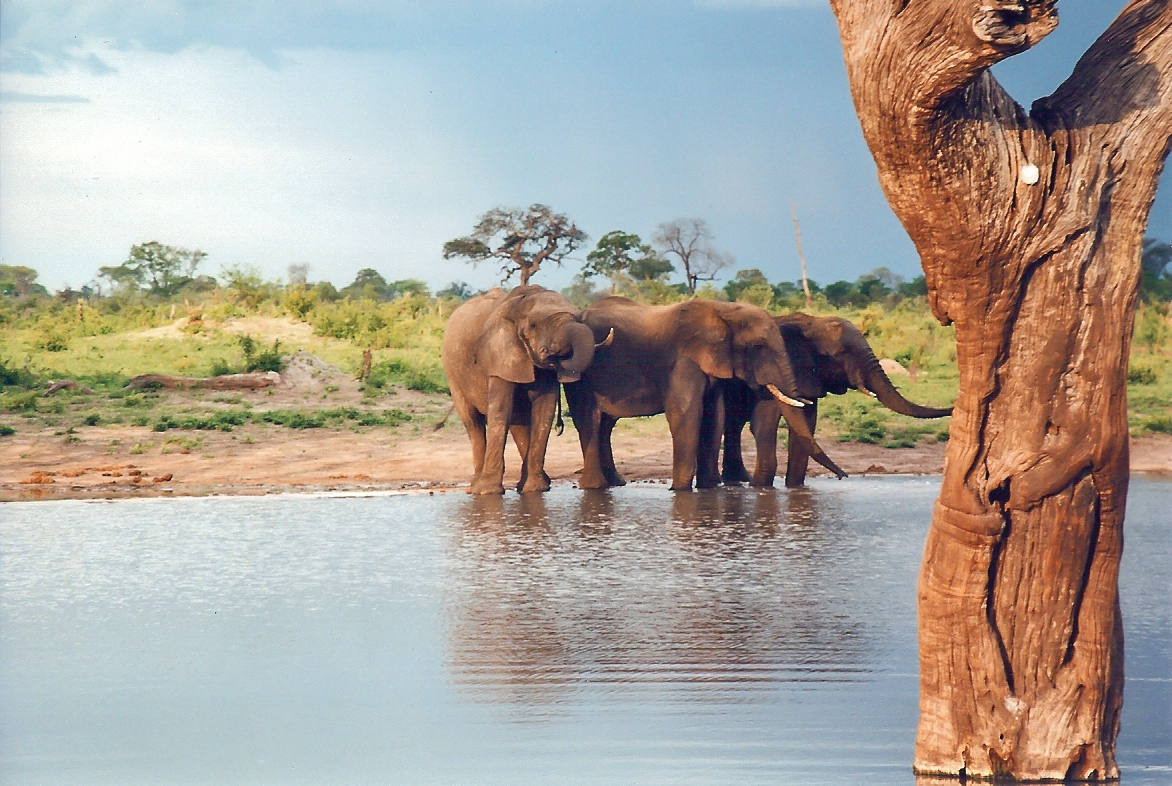
Hwange National Park
In the dry season, everything comes to the water. Elephants shoulder through dust clouds to reach the pumped pans, lions wait in the scrub nearby, and painted dogs trot in precise formation along trails worn smooth by a century of hooves. Hwange National Park covers 14,651 square kilometres of northwestern Zimbabwe -- an area roughly the size of Northern Ireland -- and for much of the year its survival depends on an unlikely lifeline: diesel-powered pumps that push groundwater to the surface. Without them, the great herds would simply leave. With them, Hwange becomes one of the continent's great wildlife theaters, where the simple act of drinking water is never without an audience.
An Arid Stage, Engineered for Life
The land beneath Hwange is Kalahari sand, porous and unforgiving. Rainfall is seasonal and unreliable, arriving between late November and April before vanishing for months. The park was established as a game reserve in 1928 and became a national park in 1961, but its managers understood early that protecting animals meant protecting water. Pans and waterholes were constructed across the park, fed by pumps that run through the dry months. The result is an ecosystem shaped as much by infrastructure as by nature. Most visitor facilities cluster in the north -- Main Camp, Sinamatella, and Robins Camp -- while the south and southwest remain true wilderness, roadless and unvisited. Over 400 kilometres of roads thread through the park, though many require four-wheel drive and some become impassable when the rains come.
The Gathering at the Pans
More than a hundred mammal species and four hundred bird species call Hwange home. Nineteen large herbivore species share the landscape with eight large carnivores, including lions, leopards, cheetahs, spotted and brown hyenas, and African wild dogs -- one of the continent's most endangered predators. The park's elephant population is among the largest in Africa, and watching a herd arrive at a waterhole during the dry season is one of those experiences that recalibrates your sense of scale. The "Big Toms" and "Little Toms" viewing hides, named after farms bequeathed to the park by Harold Robins in 1939, offer some of the finest game viewing on the continent. On moonlit nights, Main Camp runs game drives under skies undiminished by artificial light. Oxford University's Wildlife Conservation and Research Unit -- WildCRU -- maintains active research here, alongside the National Leopard Project and the Painted Dog Project.
Shadows Over the Savannah
Hwange's wildlife has drawn not only researchers and tourists but also poachers, and the park's history carries scars. In 2011, poachers killed nine elephants, five lions, and two buffalo. In 2013, more than a hundred elephants died at a single waterhole after poachers laced it with cyanide -- an act of mass poisoning that made headlines worldwide. In 2015, a protected lion was lured out of the park at night with a dead animal as bait and killed silently with a bow and arrow, an incident that drew international condemnation. These are not isolated events but symptoms of an ongoing war between conservation and the ivory trade, fought on terrain where criminal gangs operate with sophisticated logistics and armed capability. The park's rangers work in dangerous conditions, patrolling vast distances to protect animals that have no idea they are at the centre of a global conflict.
Arriving on the Elephant Express
Getting to Hwange is itself an adventure. The nearest commercial airport is at Victoria Falls, and from there the journey continues by road. But the most memorable approach may be aboard the Elephant Express, a single-car sightseeing train that seats 22 passengers and makes a two-hour, 70-kilometre run along the Bulawayo-Victoria Falls rail mainline. The route skirts the park's northern boundary, and the schedule bends to accommodate freight trains that hold priority on the shared tracks. Overnight trains operated by National Railways of Zimbabwe between Harare, Bulawayo, and Victoria Falls stop in Hwange town, though arrivals tend toward inconvenient hours -- midnight or 4 AM. Inside the park, accommodation ranges from Main Camp's self-catering lodges with electricity to exclusive camps like Bumbusi, Nantwich, and Deka, where groups of ten share cottage-like shelters with no electricity and access roads that challenge even high-clearance vehicles.
From the Air
Located at 18.74S, 26.96E in northwestern Zimbabwe. From altitude, the park appears as a vast stretch of Kalahari sandveld broken by scattered waterholes that glint in the dry season. The northern camps and road network are visible from lower altitudes. Victoria Falls Airport (FVFA) lies approximately 100 km to the northwest and is the nearest airport with scheduled service. The Bulawayo-Victoria Falls railway line marks the park's northern boundary. Hwange town and its airstrip are on the northeast edge. Nearby features include Victoria Falls to the northwest and the Zambezi River marking the Zambia border.