Hwangnyongsa
A dragon changed the plan. In 553 AD, King Jinheung of Silla intended to build a new palace on a plain encircled by mountains near his royal compound at Banwolseong. But when a dragon was reportedly seen at the site, the king took it as a sign and commissioned a temple instead. That temple, Hwangnyongsa -- the Imperial Dragon Temple -- would take nearly a century to complete and would stand for six more centuries after that, its nine-story wooden pagoda rising 80 meters above the Gyeongju skyline as the tallest structure in East Asia. Today, nothing remains above ground but the foundation stones. They are enormous.
A Martyr's Foundation
Hwangnyongsa owes its existence to a political gamble that ended in blood. Buddhism arrived in Silla to fierce resistance from the aristocratic class, who saw the foreign religion as a threat to their power. The king's Grand Secretary, Ichadon, devised a scheme: he forged the royal seal to issue an order demanding the people adopt Buddhism, knowing the nobles would discover the forgery and demand his execution. When they did, Ichadon volunteered himself as the scapegoat, telling the king that his death would prove the Buddha's power. According to legend, when Ichadon was beheaded, his blood ran white and flowers fell from the sky. The nobles converted. Whether the miracles were staged or simply narrated after the fact, the result was concrete: state-sponsored Buddhism took root in Silla, and Hwangnyongsa became its most ambitious expression.
The Tower That Touched the Sky
Construction began in 553 and was not fully completed until 644 -- a span that bridged the reigns of multiple kings. The famous nine-story pagoda, commissioned by Queen Seondeok after the main temple complex was already finished, was the crowning achievement. Built entirely of wood using interlocking joinery with no iron nails, it reportedly stood 263 feet tall, with a foundation area of over 6,000 square feet supported by eight pillars on each side and sixty foundation stones. The pagoda was designed not merely as a place of worship but as a diplomatic statement, intended to impress foreign dignitaries and project the power of the Silla state. Within the main hall stood a five-meter-tall statue of the Sakyamuni Buddha, cast from gold that legend said had traveled by boat from the court of the Indian emperor Ashoka, passing through countries that had each failed to cast it before it arrived in Silla.
Center of a Kingdom's Faith
For centuries, Hwangnyongsa served as the spiritual heart of state-sponsored Buddhism during the Silla and Unified Silla eras. Monks prayed here for the welfare of the nation, asking for the divine protection of the Buddha on behalf of the kingdom. The temple complex was arranged in the "three Halls-one Pagoda" style, with the towering pagoda at the center flanked by three main halls. Its location near the Half-Moon Palace placed it at the intersection of political and spiritual authority -- close enough to the royal compound that the pagoda would have been visible from the throne room, a daily reminder that earthly and celestial power were meant to reinforce each other. The temple's influence extended across the Silla world, its architectural style showing traces of Goguryeo influence that suggest artistic exchange between Korea's rival kingdoms even during periods of conflict.
Fire and Absence
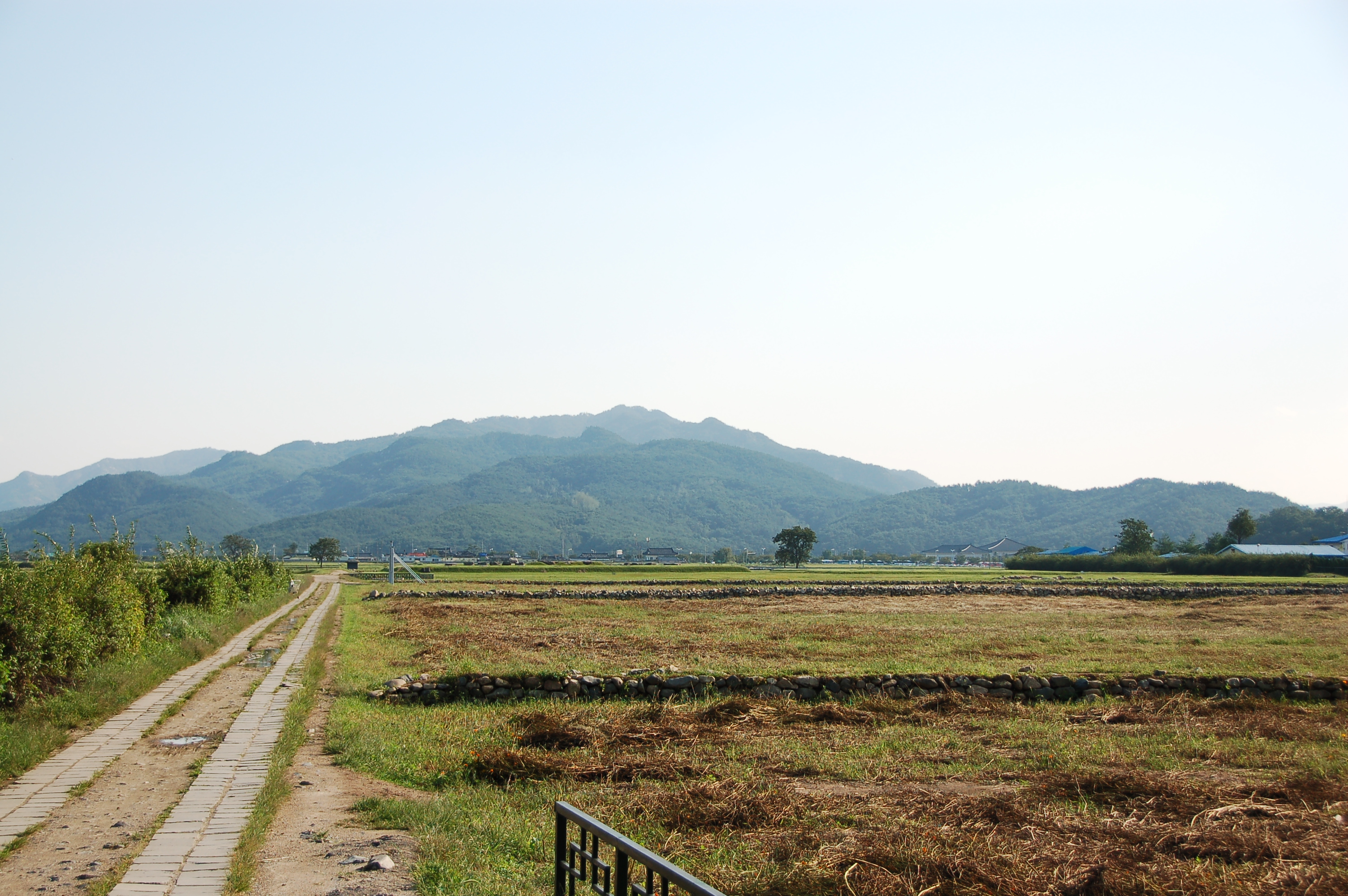
In 1238, Mongol armies swept through the Korean Peninsula, and Hwangnyongsa burned. The pagoda that had dominated Gyeongju's skyline for nearly six centuries was reduced to ash and memory. No wooden architecture from the Silla period survives anywhere today, making Hwangnyongsa's destruction not just a local loss but the erasure of an entire architectural tradition. The site lay largely untouched until 1972, when excavations revealed the full layout of the temple complex and recovered over 40,000 artifacts -- roof tiles, ceramic fragments, ornamental pieces that had survived beneath the soil. The foundation stones remain where they were placed nearly 1,500 years ago, their sheer size the most eloquent testimony to what once stood above them. Walking among them, visitors can trace the footprint of the pagoda and the halls, measuring absence by the scale of what was built to last but did not.
From the Air
Hwangnyongsa temple site is located at 35.79N, 129.23E within Gyeongju National Park in southeastern South Korea. The site is a flat open area near Toham Mountain, approximately 150 yards from Bunhwangsa Temple. From the air, the exposed foundation stones are visible as a large rectangular clearing. Nearest airports are Ulsan (RKPU) about 55km south and Gimhae International (RKPK) about 100km southwest. The site sits in the Gyeongju basin, surrounded by low mountains.