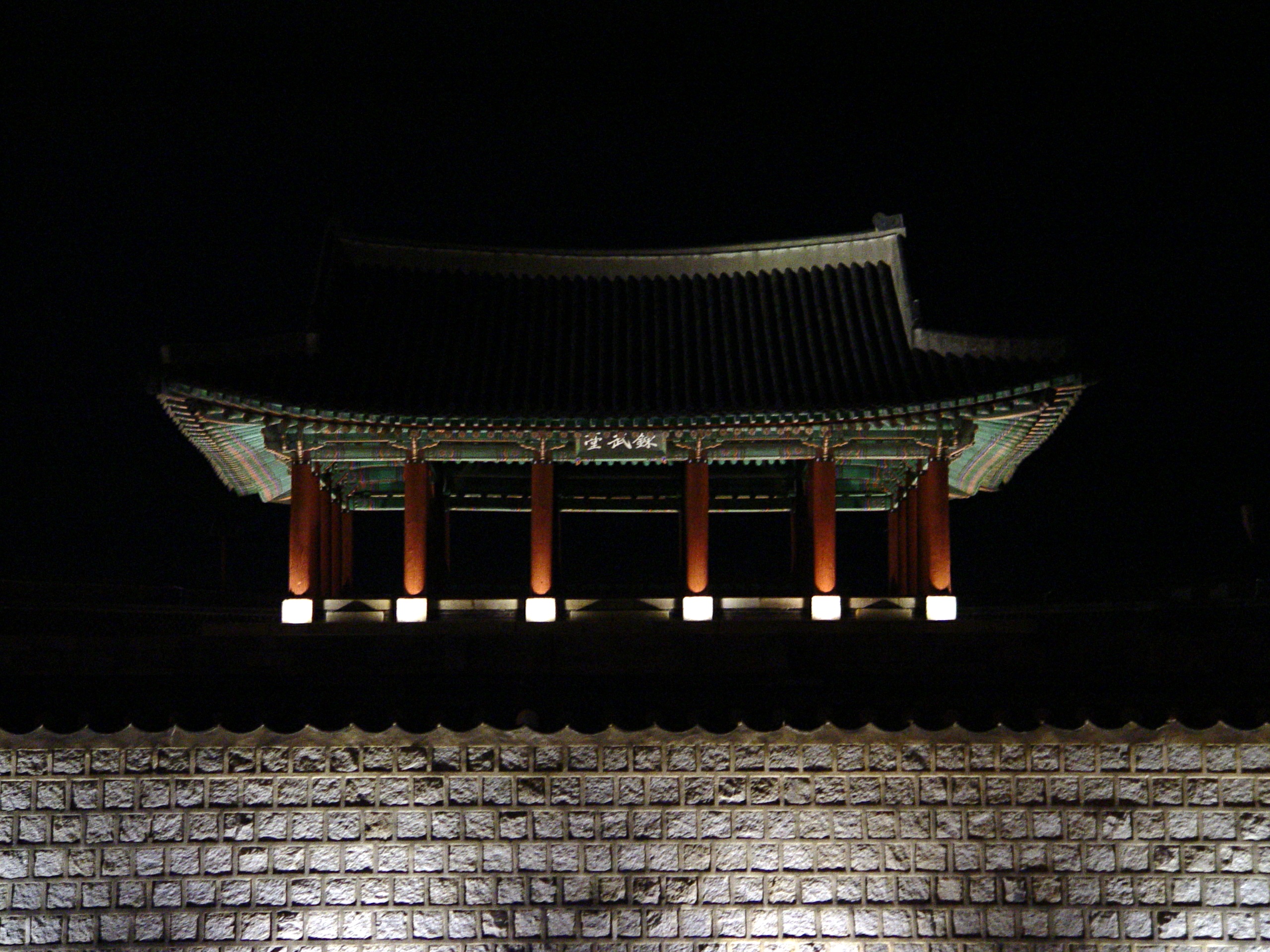
Hwaseong Fortress
The story begins with a rice chest. In the mid-18th century, Prince Sado of the Joseon dynasty was executed by his own father, King Yeongjo, who ordered him locked alive inside a heavy wooden container after the prince refused a command to take his own life. Decades later, Sado's son ascended the throne as King Jeongjo and set about building something no one could ignore. Between 1794 and 1796, he constructed Hwaseong Fortress -- a 5.74-kilometer wall encircling the city of Suwon, thirty kilometers south of Seoul -- to house his father's remains and, perhaps, to prepare for something larger: moving the capital away from the court politics that had destroyed his family.
Practical Learning in Stone and Brick
Jeongjo entrusted the fortress design to Chong Yagyong, a young architect who would become a leader of the Silhak movement -- a Korean intellectual tradition that championed practical learning over Neo-Confucian orthodoxy. Silhak's influence is visible in every aspect of Hwaseong. Where earlier Korean fortifications relied on simple walls with separate mountain refuges for wartime evacuation, Chong integrated the wall, the defensive fortress, and the town center into a single structure. He borrowed fortress designs from both Korean and Chinese traditions and incorporated contemporary Western-influenced engineering, including the use of brick alongside traditional stone and the deployment of efficient pulleys and cranes during construction. The fortress took 700,000 man-hours to build at a cost of 870,000 nyang and 1,500 sacks of rice. In a break from the Joseon tradition of corvee labor, the workers were paid -- another sign of Silhak's reformist influence reaching all the way down to the men carrying stones.
A Wall That Thinks
Hwaseong's perimeter is not just a wall but an integrated defensive system of remarkable sophistication. Forty-eight structures line its 5.74 kilometers: four main gates, five secret gates for covert offensive sorties, five gun towers with internal levels for varying angles of fire, two crossbow platforms, three observation towers, and a beacon tower with five chimneys whose smoke signals conveyed escalating degrees of threat. One chimney lit meant peace. Five meant fighting had begun. The arrow-launching platforms featured crenellated parapets and battlements, while gun towers hid firearms on multiple internal floors. The north gate, Janganmun, is the largest gate structure in Korea -- deliberately so, as visitors arriving from Seoul would enter through it, and Jeongjo wanted them to feel they were entering a capital worthy of the name. The wall varies in height, rising higher on flat terrain where natural elevation provides no advantage and lower along hilltops where the landscape itself serves as a barrier.
The Blueprint That Saved Everything
In 1801, shortly after Jeongjo's death, court officials published a ten-volume white paper called the Hwaseong Seongyeok Uigwe -- the Records of Hwaseong Fortress Construction. The document recorded everything: blueprints, royal orders, worker wages organized by trade, quantities of every material used, and detailed descriptions of each structure. It was bureaucracy as preservation. When the Korean War devastated Hwaseong in the 1950s, destroying or damaging many of the fortress structures, these 200-year-old records made faithful reconstruction possible. The 1970s restoration effort followed the Uigwe so closely that UNESCO granted Hwaseong World Heritage status in 1997 -- a rare honor for a largely reconstructed site, justified precisely because the original documentation was so complete that the rebuilt fortress could be considered an accurate representation of the 18th-century original.
Walking the Walls Today
The entire circuit of Hwaseong can be walked easily, and what strikes most visitors is how the fortress has absorbed the city rather than being absorbed by it. The Suwoncheon stream flows through the center of the enclosed area, passing under two floodgates -- Hwahongmun to the north with its seven arches and the reconstructed Namsumun to the south with nine. The original Namsumun was swept away by flooding in 1846, rebuilt, then destroyed again in 1922 during the Japanese occupation, and finally reconstructed in 2012. Modern roads now pass through gaps in the wall where four structures were never rebuilt, and the south gate, Paldalmun, stands isolated in a traffic roundabout like an island in a flood of cars. Inside, Haenggung palace -- Jeongjo's intended residence -- anchors the complex. The fortress that a grieving son built to honor a father killed by a grandfather has outlasted all of them, its walls now sheltering not a court but a modern city of over a million people.
From the Air
Located at 37.29N, 127.01E, surrounding the center of Suwon, approximately 30 km south of Seoul, South Korea. The 5.74-km fortress wall is clearly traceable from altitude, encircling the old city center with its distinctive gates and watchtowers. Suwon Air Base (RKSW) is located nearby. Seoul Air Base (RKSM) and Osan Air Base (RKSO) are also within range. The Suwoncheon stream flowing through the fortress provides a useful visual reference. Recommended viewing altitude: 3,000-6,000 feet to appreciate the full wall circuit.