Hyōgo Prefectural Museum of Art
Tadao Ando donated the building. Not the design fees, not a sketch for the lobby wall -- the entire structure. When the legendary architect offered to design and fund the Hyōgo Prefectural Museum of Art as a gift to his earthquake-shattered home region, he was making a statement about what architecture owes the places it inhabits. Opened in 2002 in Kobe's Nada-ku ward, this museum of concrete and glass sits on the waterfront like a quiet promise, seven years after the Great Hanshin-Awaji Earthquake killed over 6,400 people and leveled entire neighborhoods. The building does not memorialize the disaster. It answers it.
Concrete and Light
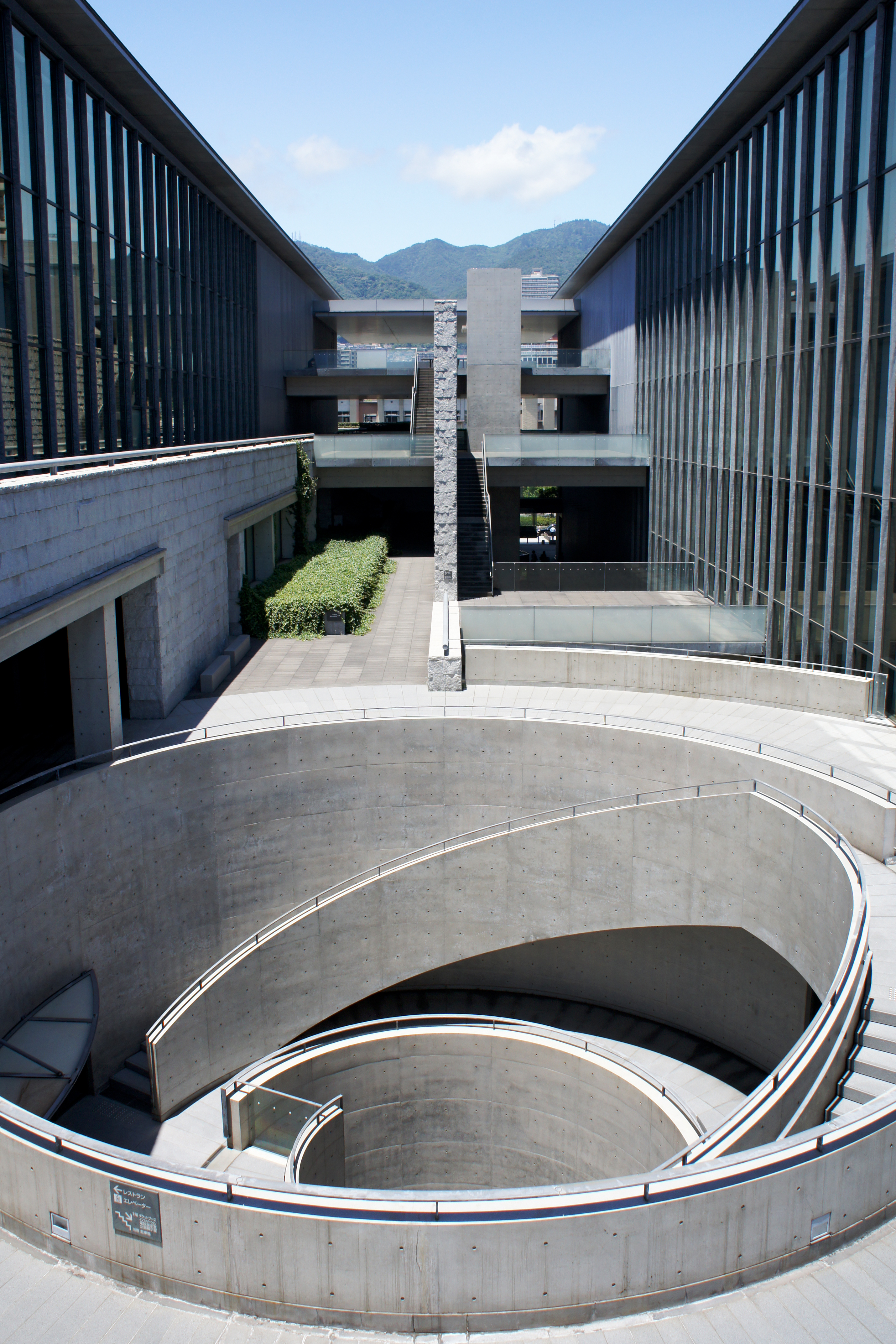
Ando's design language here is deliberately austere. Three long glass boxes run parallel to the shoreline, each encasing a block of his signature exposed concrete. The materials are spare -- concrete, stone, steel, glass -- and every surface is polished to severity. But the austerity carries intention. Ando chose a vocabulary of strength and durability to contrast with the fragility the earthquake exposed. At the building's heart, a central light well houses a spiraling staircase that draws natural illumination down through multiple levels, transforming a utilitarian circulation path into something close to sculpture. Generous windows frame the Kobe waterfront, and roof eaves extend outward into terraces that reach toward the bay. The museum connects the Rokko mountains behind it to the sea in front -- a passage that the earthquake had broken.
Between Mountain and Sea
The museum was never meant to stand alone. Ando designed it as an integral piece alongside the Kobe Waterfront Plaza, creating a continuous civic space where art and everyday life overlap. The plaza serves double duty: recreational gathering place on calm days, designated refuge zone and fire barrier in emergencies. That pragmatism runs through the entire project. Kobe needed cultural institutions to restore civic identity, but it also needed infrastructure that acknowledged the reality of life on seismically active ground. The museum sits on white polished granite, and one gallery wing separates from the others to create an interior passage -- a deliberate corridor connecting the mountains to the waterfront, framing views that remind visitors the city exists between two immense forces of nature.
What Hangs on the Walls
The permanent collection spans Japanese and foreign sculpture, printmaking, and painting, with particular strength in works connected to Hyōgo Prefecture. Western-style oil paintings hang alongside Nihonga -- traditional Japanese-style works using mineral pigments on silk or paper -- reflecting the tension between imported and indigenous artistic traditions that has driven Japanese art since the Meiji era. Dedicated galleries honor two significant Japanese modernists: Ryōhei Koiso, known for elegant figurative work influenced by his studies in Paris, and Kanayama Heizō, whose bold compositions bridged Japanese and European sensibilities. The contemporary art wing pushes further forward, and rotating exhibitions bring in international loans. In 2019, Ando added another gift: the Ando Gallery, which he designed and funded, displaying his architectural models, concept sketches, and drawings across two levels.
A City Rebuilt in Art
Kobe before 1995 was a cosmopolitan port city, Japan's gateway to the world since the nineteenth century. The earthquake did not just destroy buildings; it disrupted the collective memory of what Kobe was. Ando's response was to rebuild the city's relationship with the sea -- the defining feature of Kobe's identity that the disaster had made feel threatening rather than welcoming. The museum draws visitors back to the waterfront, back to open space and horizon lines. It is telling that the building succeeds not through grandeur but through restraint. No soaring atrium, no flashy titanium cladding. Just concrete meeting water, light falling through glass, and art hanging in rooms designed to feel permanent. In a city that learned how quickly the permanent can vanish, that quiet confidence is the most radical gesture of all.
From the Air
Located at 34.70°N, 135.22°E on the Kobe waterfront in the Nada-ku ward. The museum's long rectangular profile is visible along the coast, adjacent to the waterfront plaza. Kobe Airport (RJBE) is approximately 8 km to the south across the bay. Osaka Itami Airport (RJOO) lies 25 km to the northeast. Best viewed at 3,000-5,000 ft approaching from the bay side, where the museum's three parallel glass volumes and waterfront terraces are most distinguishable against the Rokko mountain backdrop.