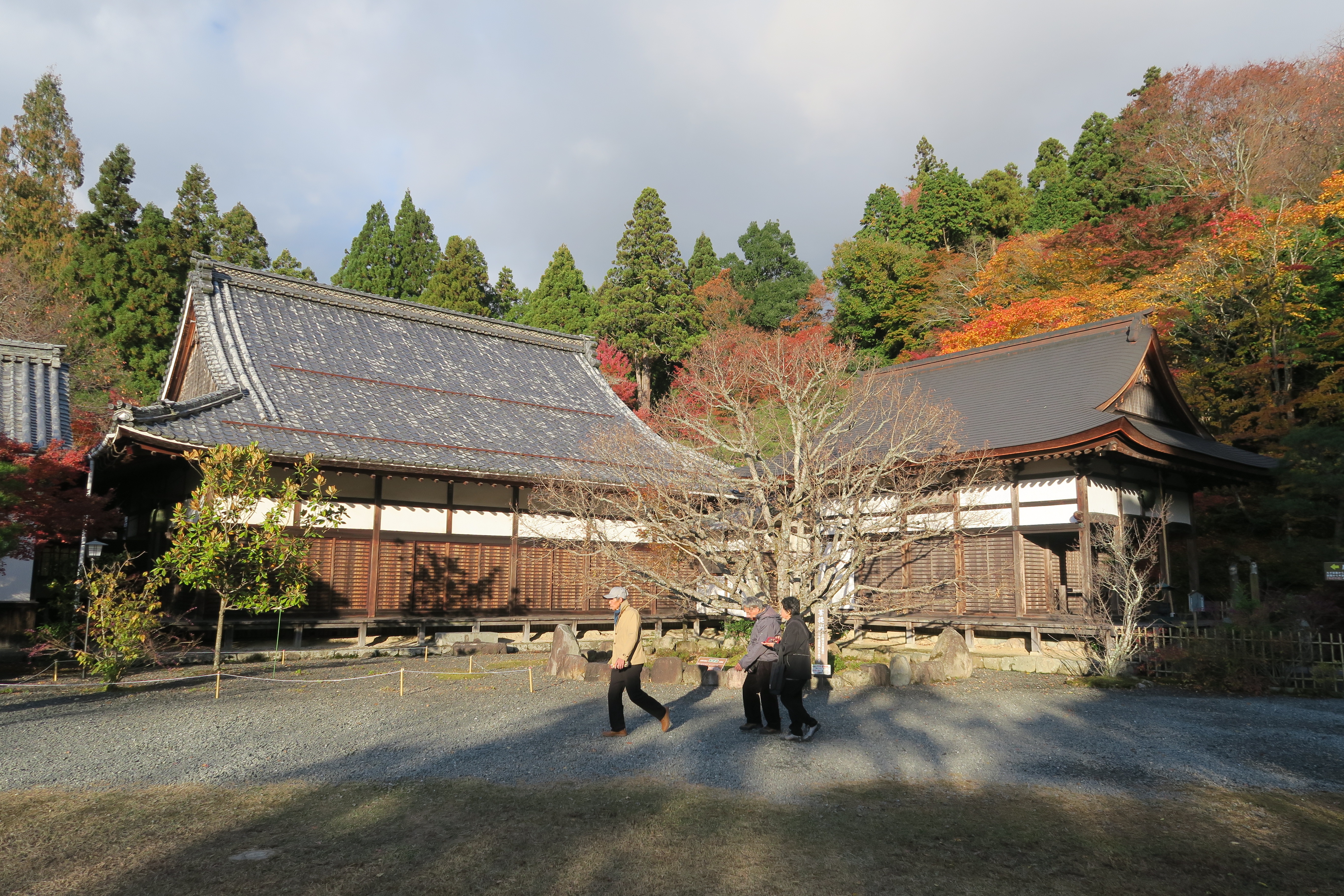
Hyakusai-ji: The Temple That Burned Three Times and Still Stands
A Portuguese Jesuit named Luis Frois visited a Buddhist temple on the forested slopes east of Lake Biwa sometime in the sixteenth century and called it "Heaven on earth." A few years later, Oda Nobunaga burned it to the ground. That sequence -- beauty, destruction, renewal -- is the essential rhythm of Hyakusai-ji, a Tendai Buddhist temple in the city of Higashiomi, Shiga Prefecture, that has been leveled by fire at least three times across its long history and rebuilt every time. Together with Kongorin-ji and Saimyo-ji, it forms the Koto Sanzan -- the Three Great Temples east of Lake Biwa -- and of the three, Hyakusai-ji carries the longest memory and the most dramatic scars. Its founding legend reaches back to the year 606 AD. Its oldest surviving buildings date from the 1600s. Everything in between was consumed by flame.
A Glowing Cedar and a Korean Name
According to temple tradition, Hyakusai-ji was founded in 606 AD by Prince Shotoku, the regent who did more than any single figure to establish Buddhism in Japan. The legend holds that Shotoku's tutor, a monk named Hyeja from the Korean kingdom of Goguryeo, discovered a cedar tree in the Suzuka Mountains glowing with a mysterious light. Shotoku carved an image of the eleven-faced Kannon Bosatsu directly into the living wood of the tree and had a hall built around it. The temple's name, however, honors not Goguryeo but the Korean kingdom of Baekje, because the temple's layout was modeled after Ryuun-ji, a temple in that kingdom. Historians note that the first documented reference to Hyakusai-ji dates from 1089, leaving the connection to Prince Shotoku in the realm of sacred tradition rather than verified history. But the Korean threads woven through the founding story are themselves significant -- a reminder that Japanese Buddhism was shaped by continuous exchange with the Korean peninsula.
A Thousand Chapels on a Mountainside
During the Heian period, Hyakusai-ji came under the influence of the powerful Tendai monastery of Enryaku-ji on nearby Mount Hiei, and formally became a Tendai institution. By the Kamakura period, it had grown into a vast religious complex spread across multiple mountain valleys, with over 1,000 chapels and an army of monk-priests -- a sprawling sacred city that rivaled the great temple establishments of Nara and Kyoto. Then came the fires. In 1498, a severe blaze swept through the complex, destroying ancient buildings, Buddhist statues, and -- critically -- the temple's founding documents and historical records. Just five years later, in 1503, the temple was nearly razed to its foundations during a military conflict between the Omi shugo Rokkaku Takayori and the shugodai Iba Tadataka. These twin catastrophes consumed the physical evidence of Hyakusai-ji's early history, which is why so much of its past remains wrapped in legend.
Heaven on Earth, Then Ashes
The temple recovered from those twin disasters with enough vigor to impress Luis Frois, the sharp-eyed Portuguese Jesuit missionary who chronicled sixteenth-century Japan in remarkable detail. But in 1573, war returned. Oda Nobunaga, locked in conflict with Rokkaku Yoshikata, laid waste to the temple once more. According to temple tradition, when the fires came, monks carried the sacred living tree with its carved Kannon image eight kilometers deep into the mountains to save it from the flames. The main hall was rebuilt in 1584 by the daimyo Hori Hidemasa. With the establishment of the Tokugawa shogunate in 1602, the temple received a stipend of 146 koku for its maintenance, increased by another 100 koku in 1617 under Shogun Tokugawa Hidetada -- formal recognition from the new government that this repeatedly destroyed and repeatedly rebuilt temple was worth preserving.
The Buildings That Survived
From 1634 through 1650, most of Hyakusai-ji's current buildings were reconstructed under Ryosuke, a disciple and younger brother of the archpriest Tenkai, with financial support from the Hikone Domain. Tenkai was one of the most influential Buddhist figures of the early Edo period, serving as a close adviser to the first Tokugawa shoguns, and his brother's involvement lent the reconstruction considerable prestige. The current Hondo -- the main hall -- dates from this period and is designated a National Important Cultural Property. The temple itself was designated a National Historic Site in 2008. These seventeenth-century structures now anchor a temple complex famous as one of Japan's premier autumn foliage destinations. The maple trees that climb the mountain slopes around Hyakusai-ji erupt into deep crimson and gold each November, and the temple's Akamon -- its red gate -- frames the approach like a portal into a landscape that a sixteenth-century Jesuit once called heaven on earth.
From the Air
Located at 35.126°N, 136.292°E on the western flank of the Suzuka Mountains, east of Lake Biwa in Higashiomi, Shiga Prefecture. The temple complex is nestled in forested mountain slopes; look for the break in tree cover where temple roofs and the distinctive red Akamon gate emerge among dense maple groves. Lake Biwa, Japan's largest freshwater lake, is visible to the west. The temple is one of the Koto Sanzan trio -- Kongorin-ji and Saimyo-ji are nearby along the same mountain range. Nearest major airports: Chubu Centrair International (RJGG) approximately 50 nautical miles southeast; Osaka Itami (RJOO) approximately 55 nautical miles southwest. Best viewed at 2,000-4,000 feet AGL. The Suzuka Mountains form a prominent ridgeline to the east.