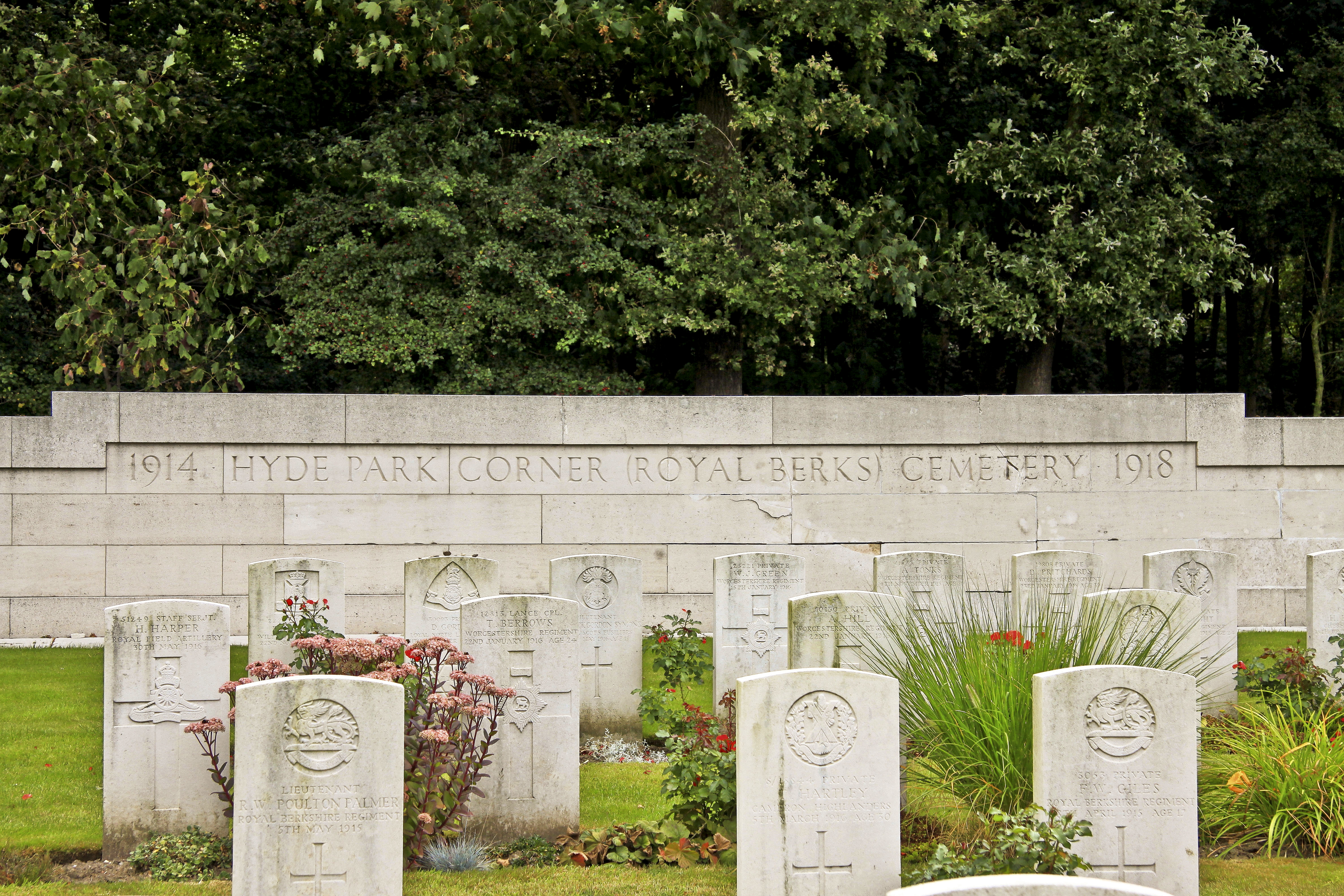
Hyde Park Corner (Royal Berks) Cemetery
Ronald Poulton-Palmer had captained England's rugby team in the last season before the war. He played his final international match — England against France, Stade Colombes, 13 April 1914 — and scored four tries. Just over a year later, on the night of 4 May 1915, he was killed by a sniper while supervising a trench-improvement party near Ploegsteert Wood. He is buried at a small cemetery at the corner of two Flanders roads, in a plot the 1st and 4th Royal Berkshires had begun a month earlier, and which they named — with the homesick wit of men a long way from London — Hyde Park Corner.
A Cemetery That Outgrew Itself
The Royal Berkshires opened the cemetery in April 1915. The wood beside it had become a holding area for units rotating in and out of the Ypres Salient, and burials accumulated faster than the small plot could absorb. Within a year the regiment was burying its dead across the road, in what would become the much larger Berks Cemetery Extension. The original Hyde Park Corner cemetery stayed small — eighty-seven graves, both Allied and German, ringed by a low wall, mostly from the war's early and middle years. It sits directly opposite the great Ploegsteert Memorial, but it does not announce itself. You can walk past it without realising what it is. That, in a way, is the point.
The Rugby Captain
Ronald William Poulton-Palmer was twenty-five when he died, an Oxford Blue, captain of England, heir to a biscuit fortune. His nickname was Ron. The Wikipedia entry calls him a 'well-known rugby union footballer,' which is the way modern English understates a man who in 1914 was the most admired sportsman of his generation. The Times printed long obituaries. The shock he caused had less to do with him than with what he stood for — that there was no exemption for the famous, the beloved, the talented; the trenches took everyone. His grave at Hyde Park Corner is one of the most visited in the cemetery. Schoolchildren still leave rugby balls.
Albert French, Aged Sixteen
Among the graves is that of Albert French, a sixteen-year-old from Wolverton, a railway-works town in Buckinghamshire. He had lied about his age to enlist. He wrote home in pencilled letters about being cold and being homesick and the way the rats came up the trench walls. He was killed in June 1916. Decades later, the discovery of those letters in a family attic became part of a wider reckoning in Britain with the question of the boy soldiers — children, really — who slipped through the recruiting net of 1914 and 1915 and did not come back. In 2006, Ploegsteert was twinned with Wolverton in his memory. Two towns three hundred kilometres apart now share a child.
Shot at Dawn
Rifleman Samuel McBride of the 2nd Battalion Royal Irish Rifles is also buried here. He was executed by firing squad on 7 December 1916, on a charge of desertion, after a court-martial that took less than an hour. He was twenty-one. The British Army shot more than three hundred of its own men during the First World War — most of them, modern scholarship and the long campaign of the Shot at Dawn movement now agree, suffering what was then called shell shock and is today recognised as combat stress reaction. They were not cowards. They were broken. In 2006, the British government issued posthumous conditional pardons to all of them. McBride's headstone at Hyde Park Corner carries no different mark from any other. His regiment is named. His name is named. The rest is silence.
What a Small Cemetery Is For
There are larger cemeteries on the Salient — Tyne Cot, Lijssenthoek, the great rotunda just across the road. Hyde Park Corner is none of these things. Eighty-seven graves do not make a destination. But the cemetery does something the bigger sites cannot. It keeps the war at human scale. You can stand at the gate and see every headstone. You can read every name in twenty minutes. A rugby captain, a sixteen-year-old, a man shot at dawn — three lives, three different kinds of grief, three different reasons for English families to have hated the year their boys did not come home. They share a small patch of Flemish ground because the Berkshires chose this corner in April 1915 and called it after the part of London they were missing. The name held. The men did not move.
From the Air
Located at 50.7375 degrees north, 2.88264 degrees east, in Ploegsteert village in Hainaut, directly opposite Berks Cemetery Extension across the N365. Nearest major airport is Lille (LFQQ) about 25 km south; Brussels (EBBR) about 120 km east. Visible from low altitude as a small walled rectangle at the edge of Ploegsteert Wood — the large Ploegsteert Memorial rotunda across the road is the more conspicuous landmark.