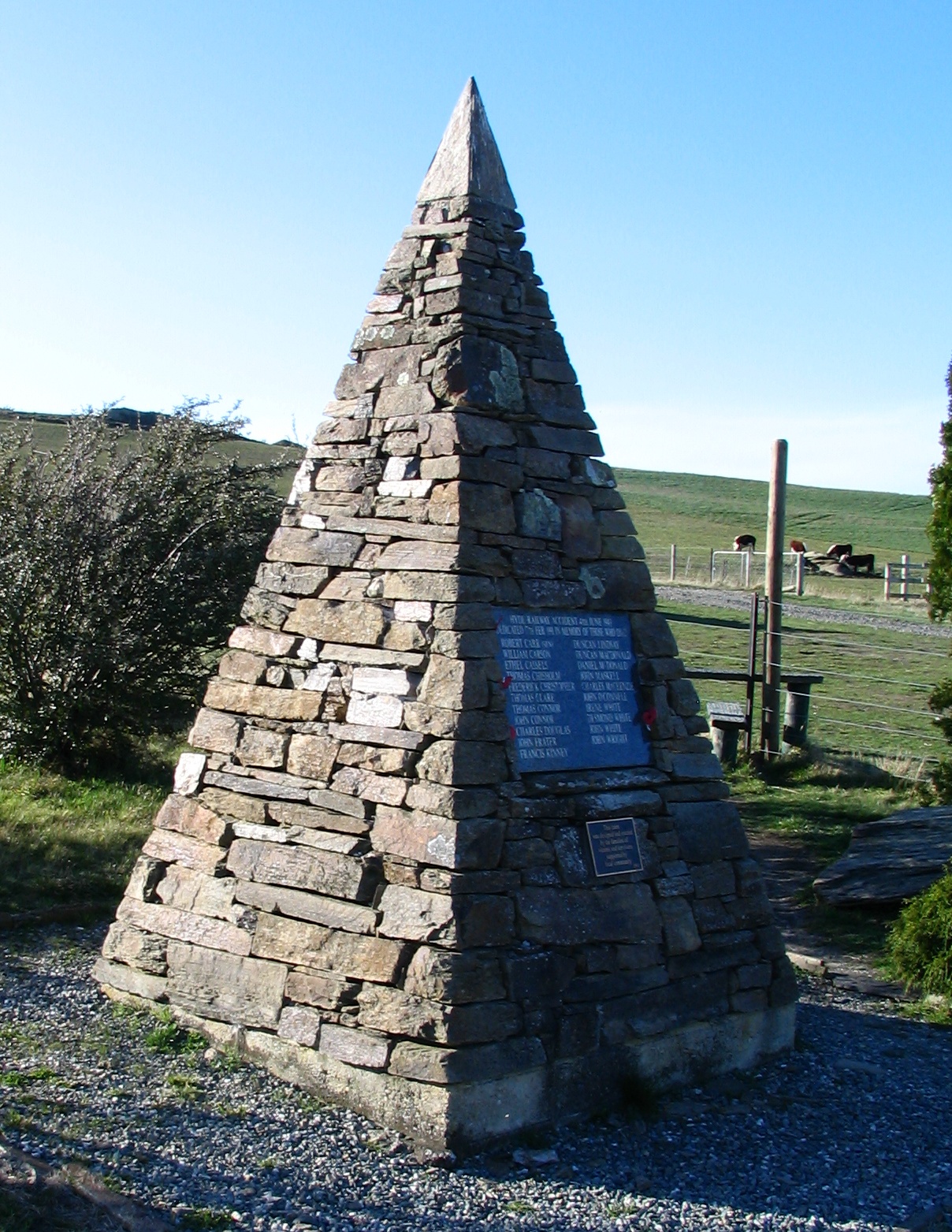
Hyde Railway Disaster
Pat Kinney owned the farmland through which the cutting ran. His son Frank had boarded the express at its last stop in Hyde, joining the 112 other passengers on the afternoon run from Cromwell to Dunedin. At 1:45 p.m. on 4 June 1943, the train entered a 183-meter radius curve in a deep passage of rock known locally as Straw Cutting, between Hyde and the Rock and Pillar Range. It was travelling at more than 70 miles per hour. The speed limit for that curve was 30. Frank Kinney was among the 21 people who did not survive what happened next.
Straw Cutting
The locomotive hit the curve and left the rails, sliding 60 meters before coming to rest against the wall of the cutting. Its boiler burst on impact, extinguishing the firebox fire but scalding the fireman severely. Behind the engine, all seven passenger carriages derailed. The second carriage overturned and came to rest in front of the locomotive. Four others telescoped together, their wooden frames splintering and compressing into one another. The force was extraordinary. The undercarriage of one carriage twisted into the shape of the letter S. One passenger was thrown through a window, struck the rock wall of the cutting, and bounced back in through another window of the same carriage. An attending doctor would later describe the scene as resembling the result of a bomb blast. Bits of the train lay scattered across the surrounding farmland. Only the guards' van and two goods wagons at the rear stayed on the tracks.
Ninety Minutes Away
The disaster unfolded in one of the most remote stretches of the Otago Central Railway. Initial reports reaching Middlemarch suggested an accident with possibly a few injuries, and medical personnel set out without particular urgency. That changed when they crested a rise in the road half a mile from the cutting and saw what lay below. Rescuers worked alongside railway maintenance staff and local farmers, including Pat Kinney himself, who had already reached the wreckage and begun pulling survivors free, not yet knowing that his own son was among the dead. Some passengers remained trapped in the crushed carriages for hours. The rescue effort continued until darkness made further work impossible.
The Driver's Reckoning
A board of inquiry pieced together what had happened. The physical evidence was unambiguous: the train had been traveling at more than twice the permitted speed for the curve. The inquiry found that the driver, 55-year-old John Corcoran, had been drunk. His judgment was markedly impaired, the board concluded, and it charged him with serious dereliction of duty. The train's guard was reprimanded for failing to act when he noticed the train's excessive speed, though he was not criminally prosecuted. Corcoran was tried for manslaughter in the Dunedin Supreme Court, found guilty, and sentenced to three years in prison. Twenty-one lives ended because one man failed in his responsibility to the people who trusted him to bring them safely home.
The People on Board
The express carried 113 passengers that afternoon, people traveling between Central Otago and Dunedin on a wartime winter day. Of the 21 who died, many were from the small communities along the route, places where a loss of that scale meant that nearly everyone knew someone who had been on the train. Forty-seven more were injured, some critically. In a country then at war, where death notices competed for column space with casualty lists from North Africa and the Pacific, the Hyde disaster struck with particular force because it was so close to home and so avoidable. It remains the only significant passenger accident in the entire history of the Otago Central Railway, from the line's construction beginning in 1877 to its closure on 30 April 1990.
Walking the Cutting
The Otago Central Railway closed in 1990, and the route has since been converted into the Otago Central Rail Trail, one of New Zealand's most popular cycling and walking tracks. The trail passes directly through Straw Cutting, where the disaster occurred. The rock walls still stand, narrowing around the same curve that the express failed to negotiate. There is no dramatic memorial at the site, just the quiet, grassed-over corridor of the old railway bed threading through farmland near the Rock and Pillar Range. Walkers and cyclists pass through in minutes, often without knowing what happened here. The landscape has absorbed the catastrophe the way landscapes do, holding the memory in its contours while offering no outward sign of grief. The hills beyond are wide and empty, and the silence in the cutting is the kind that invites you to listen more carefully.
From the Air
The Hyde railway disaster site lies at approximately 45.35S, 170.24E, in the tussock-covered high country between Hyde and the Rock and Pillar Range in Central Otago. The terrain is open, rolling hill country with few trees, making the old railway cutting visible from low altitude as a linear notch in the landscape. The Otago Central Rail Trail follows the former railway route through the area. Nearest airfield is Taieri Airport (NZTI) approximately 50 km to the southeast, and Dunedin Airport (NZDN) about 70 km southeast. At 2,000-3,000 feet the Strath Taieri plain and surrounding ranges are clearly defined.