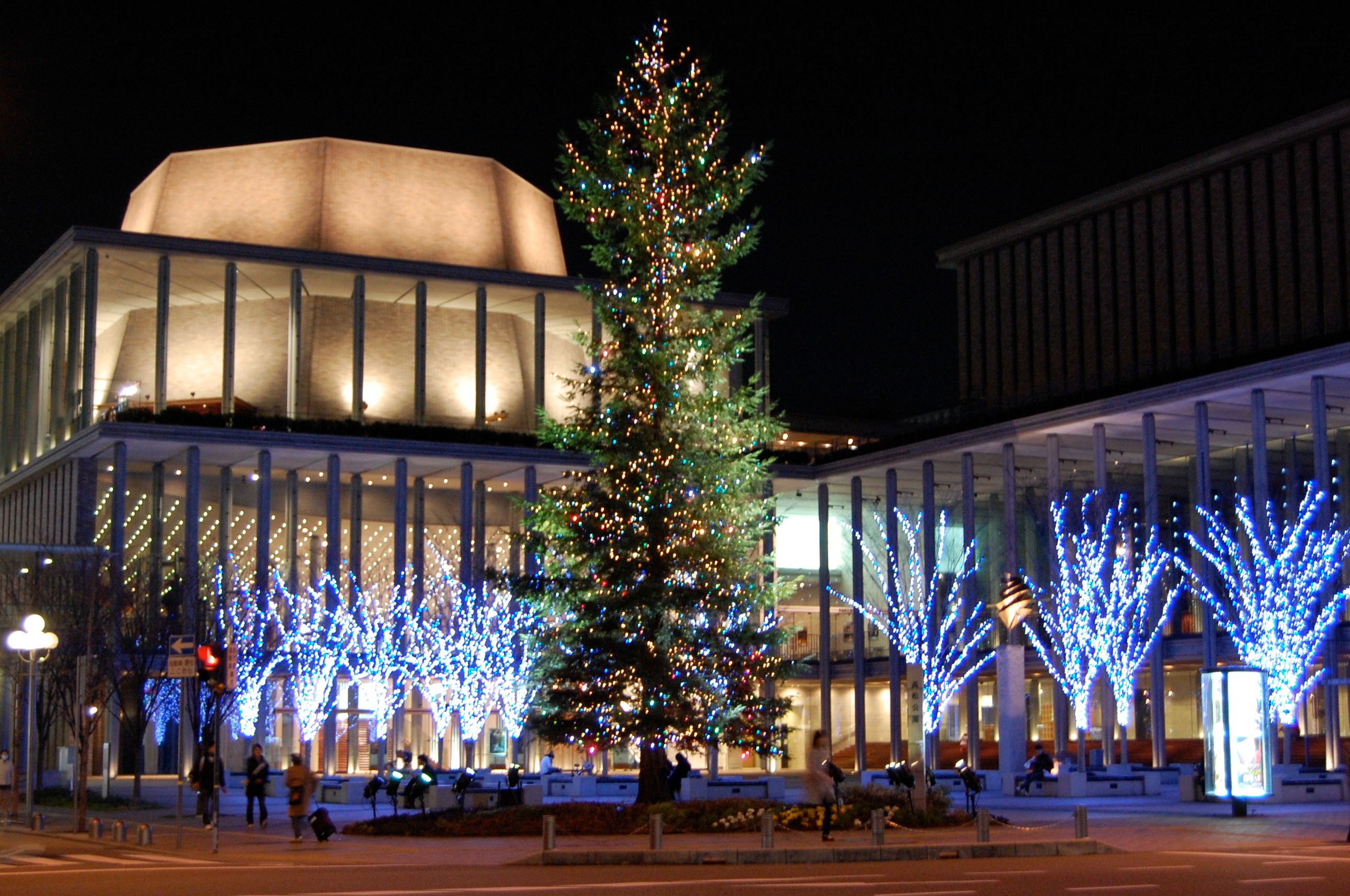
Hyogo Performing Arts Center: A Stage Built from Earthquake Rubble
On January 17, 1995, the Great Hanshin earthquake killed over 6,400 people and reduced entire neighborhoods of Nishinomiya and Kobe to rubble in twenty seconds. Exactly ten years later, a gleaming performing arts center opened next to Nishinomiya-Kitaguchi Station -- not as a monument to what was lost, but as proof of what was rebuilt. The Hyogo Performing Arts Center, with its three interconnected performance halls, rooftop solar garden, and wood-lined interiors tuned for acoustic perfection, was designed to be the cultural heartbeat of a city that had to learn how to breathe again. Its logo, which reads the same from any orientation, carries a deliberate message: rebirth, liveliness, creativity.
Rising from the Tremor
The 1995 Great Hanshin earthquake measured 6.9 on the Richter scale and devastated the Kobe-Osaka corridor. Nishinomiya, positioned between the two cities in Hyogo Prefecture, suffered catastrophic damage to its infrastructure, homes, and public spaces. In the decade that followed, the city rebuilt methodically -- roads, bridges, housing blocks. But civic leaders understood that reconstruction meant more than restoring concrete. A performing arts center was proposed as a symbol of cultural renewal, a place where the community could gather not to mourn but to create. The site chosen sat beside Nishinomiya-Kitaguchi Station, a major rail hub operated by Hankyu Corporation, ensuring the center would be woven into the daily rhythm of commuters and residents alike.
Sound Shaped in Wood
Japan's leading architectural firm Nikken Sekkei designed the complex, and the acoustic engineering was entrusted to Nagata Acoustics, the same firm that shaped the sound of concert halls worldwide. The result earned an Architectural Institute of Japan Design Commendation in 2007. At the center of the complex sits the Grand Hall, seating 2,001 audience members in an interior built almost entirely of wood, optimized for the full dynamic range of orchestral, ballet, and opera performances. Audience members can sit on the inclined floor or in any of four balconies. The rear stage shell detaches to reveal generous fly-space and wings for theatrical productions, while rows of front seats can be removed to expose a hydraulic-powered orchestra pit. Kobe Steel purchased the hall's naming rights in October 2008.
Three Halls, One Piazza
All three of the center's performance spaces connect through a central public lobby -- the piazza -- creating a sense of openness and community even before the music begins. The Recital Hall, an intimate 417-seat arena named for Kobe College after a 2008 naming rights purchase, is built around a flat octagonal stage with stadium-style seating rising on all sides. Acoustic panels lower from the ceiling to adjust reverberation time for everything from chamber music to jazz. The Theater, with 800 cedar-walled seats, places every audience member within twenty meters of the stage, creating a closeness that larger venues cannot replicate. Hankyu Corporation acquired its naming rights in March 2009. Together, the three venues give the center a range that spans full-scale opera to solo recital to experimental drama.
Green Roof, Living Center
The Hyogo Performing Arts Center was designed with environmental consciousness built into its structure. Solar panels line the rooftop alongside a garden watered by recycled rainwater, offsetting the building's carbon footprint in a tangible, visible way. Inside, the center houses not just performance spaces but the full ecosystem of a living cultural institution: offices for the resident Hyogo Performing Arts Center Orchestra, a large rehearsal room engineered to replicate the Grand Hall's acoustics, smaller practice rooms, and two restaurants. Igrek Theatre serves French cuisine to patrons before and after performances, while an artist cafe provides a more casual space for performers and staff. Audio systems by d&b audiotechnik and L'Acoustics ensure that sound quality extends beyond the naturally tuned halls into amplified events.
A City's Second Act
Walk through Nishinomiya today and the scars of 1995 are largely invisible. The Hyogo Performing Arts Center is part of the reason. It draws audiences from across the Kansai region for its opera, ballet, orchestral, and theatrical productions, anchoring the neighborhood around Nishinomiya-Kitaguchi Station as a cultural destination rather than merely a transit point. The HPAC Orchestra, the center's resident ensemble, has built a reputation that extends well beyond Hyogo Prefecture. For a city that lost so much in twenty seconds of shaking ground, the center represents something specific: the decision to rebuild not just what was necessary but what was aspirational. The wood-lined halls, the rooftop garden, the piazza where strangers become an audience together -- these are the sounds of a community that chose to answer destruction with creation.
From the Air
Located at 34.74N, 135.36E in Nishinomiya, Hyogo Prefecture, Japan, adjacent to Nishinomiya-Kitaguchi Station. The center sits in the urban corridor between Osaka and Kobe along the north shore of Osaka Bay. Best viewed at 2,000-4,000 feet AGL from the south, where the building's distinctive modern profile and rooftop garden are visible against the backdrop of the Rokko mountain range. Osaka Itami Airport (RJOO) is approximately 6 nautical miles to the east; Kobe Airport (RJBE) is approximately 12 nautical miles to the southwest on a reclaimed island in Osaka Bay.
Sources
- Hyogo Performing Arts Center - Wikipedia
- AIJ Prize 2007
- Hyogo Performing Arts Center Opens in Japan
- Kobe earthquake of 1995 - Britannica
- Hyogo Performing Arts Center - Wikipedia