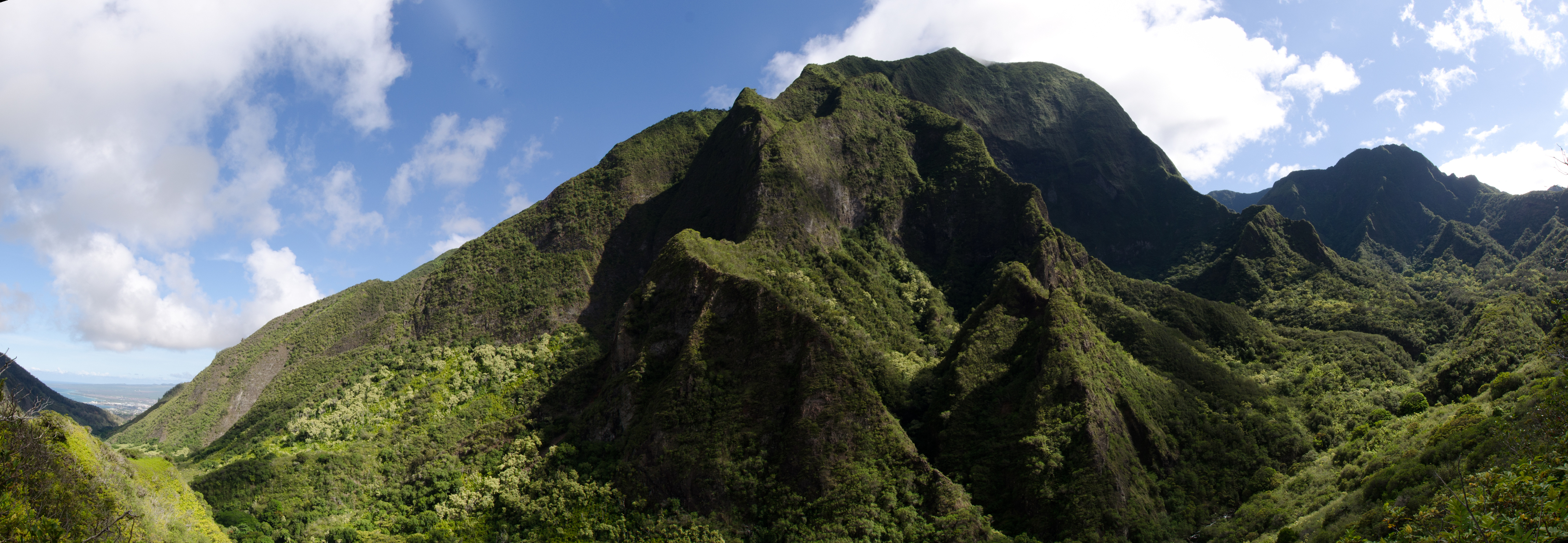
Iao Valley
The stream that runs through Iao Valley once carried so many bodies that it stopped flowing. In 1790, Kamehameha the Great brought his army and newly acquired Western cannons into this narrow valley to face the defenders of Maui, and the slaughter was so complete that the dead dammed the water. The Hawaiians named the battle site Kepaniwai -- "the damming of the waters" -- and the name has not been changed, not out of pride but out of a refusal to look away from what happened here. Today the valley is one of Maui's most visited state parks, its floor thick with tropical vegetation, its walls draped in green, its famous Needle rising from the forest like a monument. But the beauty is layered over blood, and both stories belong to this place.
The Needle and the Cloud Forest
Iao Needle is not actually a needle. It is the end of a sharp ridge, a vegetation-covered remnant of ancient lava that rises 1,200 feet from the valley floor to 2,250 feet above sea level. Viewed end-on from the lookout trail, the ridge narrows to a point that gives it the illusion of being a freestanding spire, an effect that has made it one of the most photographed landmarks in Hawaii. The cliffs surrounding the Needle are part of the West Maui Mountains, the remains of an extinct volcano far older than Haleakala to the east. Below the lookout, Iao Stream runs through dense rainforest, most of it introduced vegetation that has overtaken the valley floor. But above, at the watershed where the valley narrows to its head, a native cloud forest survives. The summit area receives an average of 386 inches of rainfall per year, making it the second wettest location in Hawaii, barely behind the Big Bog on the same mountain and slightly wetter than the famous Mount Waialeale on Kauai.
The Damming of the Waters
Kamehameha I had been consolidating power across the Big Island when he turned his attention to Maui in 1790. He brought with him something the Maui defenders had never faced: cannons, acquired from the American trader Simon Metcalfe and operated by two foreign gunners, John Young and Isaac Davis. The Maui army retreated up Iao Valley, a natural fortress with steep walls and only one way in. It was also a trap. Kamehameha's forces, with their artillery advantage, drove the defenders deeper into the narrowing valley. The carnage was devastating. Bodies piled in the stream until the water could not pass. The battle did not end Kamehameha's wars of unification -- that would take another two decades -- but it broke Maui's capacity to resist independently and demonstrated the decisive advantage of Western weapons in Hawaiian warfare. The valley had been sacred ground before the battle. Maui's rulers had designated it a royal burial place in the late 15th century, and the remains of chiefs were hidden in secret locations throughout the cliffs.
Seven Cultures in a Garden
Established in 1952, the Heritage Gardens at Kepaniwai Park sit just below the state monument and offer a peculiar form of reconciliation. Structures, plantings, and tributes honor each of the major cultures that shaped modern Maui: Hawaiian, American missionary, Chinese, Japanese, Portuguese, Korean, and Filipino. A Japanese tea house stands near a Portuguese bread oven, which sits not far from a Hawaiian thatched shelter. The gardens became overgrown over the decades and were restored in 1994. Nearby, the Hawaii Nature Center operates a small museum focused on conservation education, connecting the valley's natural history to the ecological challenges facing the islands today. The state park itself occupies only 6.2 acres at the end of Iao Valley Road, but the landscape it frames is enormous. The valley was designated a National Natural Landmark in 1972 in recognition of its geological and biological significance. The short walk to the Needle Lookout takes only minutes, but the view it reveals -- the spire rising from green walls, the stream far below, the clouds drifting through the gap above -- compresses millions of years of volcanic activity and erosion into a single unforgettable image.
From the Air
Located at 20.88N, 156.55W in the West Maui Mountains. The valley is a deep, narrow cleft cutting into the extinct volcano that forms western Maui. The Iao Needle is visible as a prominent spire rising from the valley floor. Dense cloud cover frequently fills the upper valley, especially in the afternoon. Nearest airport: Kahului Airport (PHOG, approximately 5 miles east). Best viewed at 3,000-5,000 feet AGL. Approach from the east for the most dramatic view of the valley opening. Expect turbulence and downdrafts near the ridgeline.