Idanre
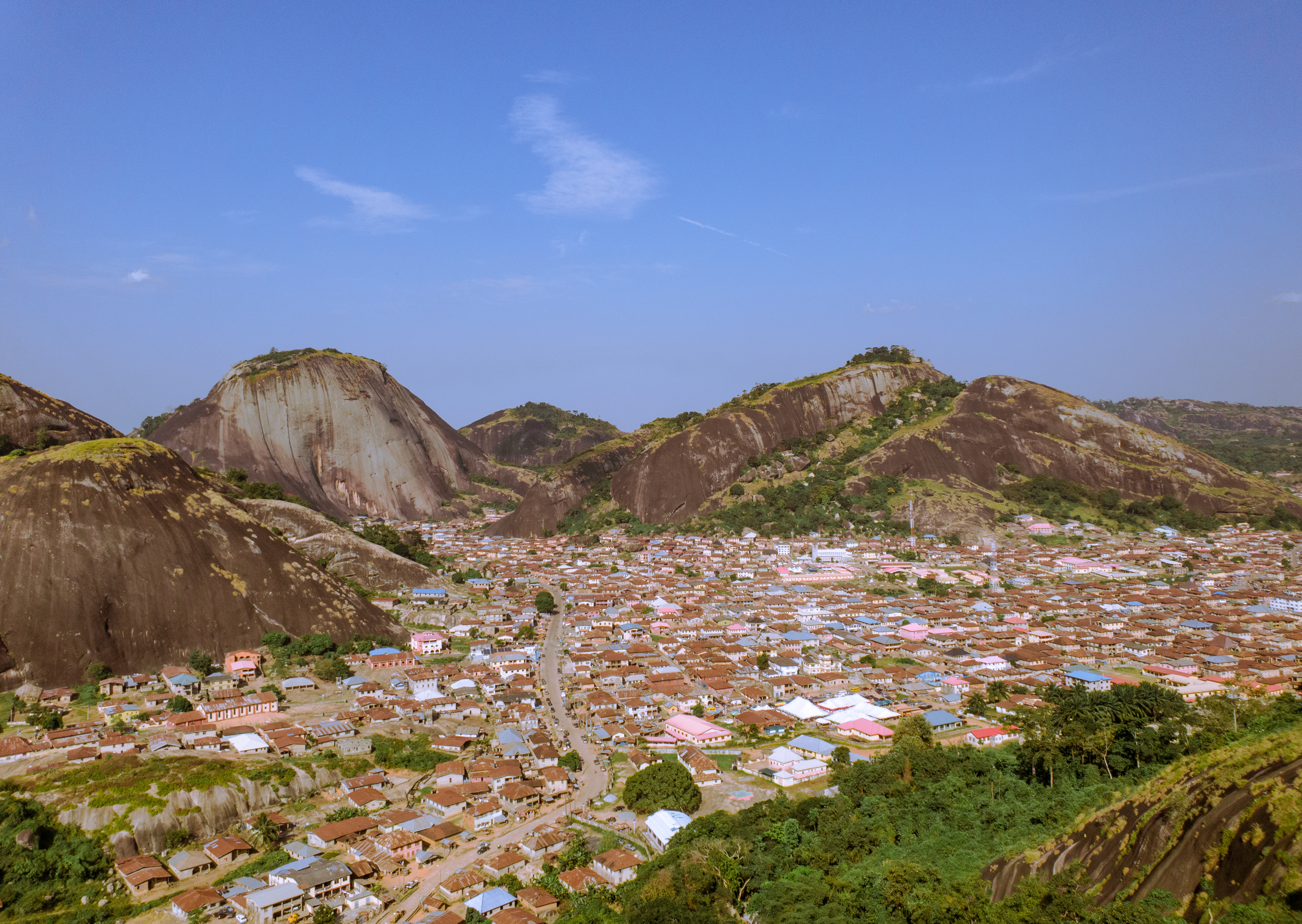
Nigeria's largest cocoa-producing area does not announce itself with factories or industrial signage. Idanre reveals itself through the landscape: massive granite inselbergs rising abruptly from tropical forest, their flanks softened by nine months of annual rainfall that feeds the cocoa trees, yam fields, and oil palms spreading across the valleys below. The town sits about 20 kilometers southeast of Akure, the capital of Ondo State, in a pocket of southwestern Nigeria where the average temperature hovers around 23.6 degrees Celsius and the air carries the humid weight of 2,644 millimeters of rain per year. It is a place shaped entirely by what grows here and what towers above.
Cocoa, Cassava, and the Shape of Daily Life
Idanre is predominantly a Yoruba-speaking town, though the locals communicate among themselves in a distinct dialect that marks them as specifically Idanre rather than generically Yoruba. The population, roughly 129,000 at the 2006 census, is largely engaged in farming and trading -- and farming here means cocoa above all else. The town's position as Nigeria's largest cocoa-producing area is the economic fact that defines it. But the fields also yield yams, cassava, and oil palm, the staple crops of southwestern Nigeria. Two major markets serve the community: Alade market at the town center and Ojota market, where farm produce, household goods, and the commerce of daily life play out in the rhythms common to Yoruba market towns across the region.
Boulders and Belonging
The inselbergs that ring Idanre are not merely scenic. They are the reason the town exists. For nearly a millennium, the people of Idanre lived among these massive boulders, building their homes and their culture into the hills' contours. The most famous of these formations, Idanre Hill, rises 3,000 feet above sea level and shelters cultural sites including a royal palace, shrines, an old court, and burial grounds. The hill is on Nigeria's tentative list for UNESCO World Heritage status. When the population began moving to the lowlands around 1923, the hilltop settlement became a place of festival and memory rather than daily residence. But the connection never severed. Annual celebrations draw lowlanders back up the ancient steps to reenact historical episodes and reaffirm their ties to Yoruba mythology and the wider confederacy of Yoruba peoples.
Getting There and Getting Around
Reaching Idanre requires commitment. The fastest route is by air to Akure and then a taxi ride of about an hour, though the combined cost of flight and cab runs between 70,000 and 150,000 Naira. Shared cabs from motor parks offer a cheaper alternative at 5,000 to 25,000 Naira for a roughly four-hour journey that passes through the landscapes and landmarks of southwestern Nigeria. A train from Lagos to Oshogbo followed by a taxi covers the same ground in nine and a half hours, the scenic but slow option. Once in town, motorcycles -- referred to simply as bikes -- are the dominant mode of transport, the fastest and most common way to navigate Idanre's roads and lanes. Tricycles offer an alternative for those who prefer a slightly less adventurous ride.
Where Rain Defines the Calendar
The climate is everything in Idanre. Situated in the tropical rainforest zone, the town receives rain for nine months of the year, from February through November. May and June are the hottest months, with average highs reaching 30.5 degrees Celsius and lows around 22 degrees at night. The annual rainfall of 2,644 millimeters sustains the dense vegetation that blankets the lowlands and creeps up the lower slopes of the inselbergs. This is the water that feeds the cocoa trees and keeps the farms productive, but it also means that timing a visit matters. The dry months offer easier access to the hills and clearer views of the dramatic rock formations that make Idanre unlike anywhere else in Nigeria.
From the Air
Located at 7.10N, 5.13E in Ondo State, southwestern Nigeria. The town is identifiable from altitude by the dramatic inselbergs -- massive granite outcrops rising from tropical lowland forest. Nearest airport is Akure Airport (DNAK), approximately 20 km to the northwest. The terrain is relatively flat tropical lowland punctuated by the striking vertical rock formations of the Idanre Hills. Expect haze and cloud buildup, especially during the long rainy season from February to November.