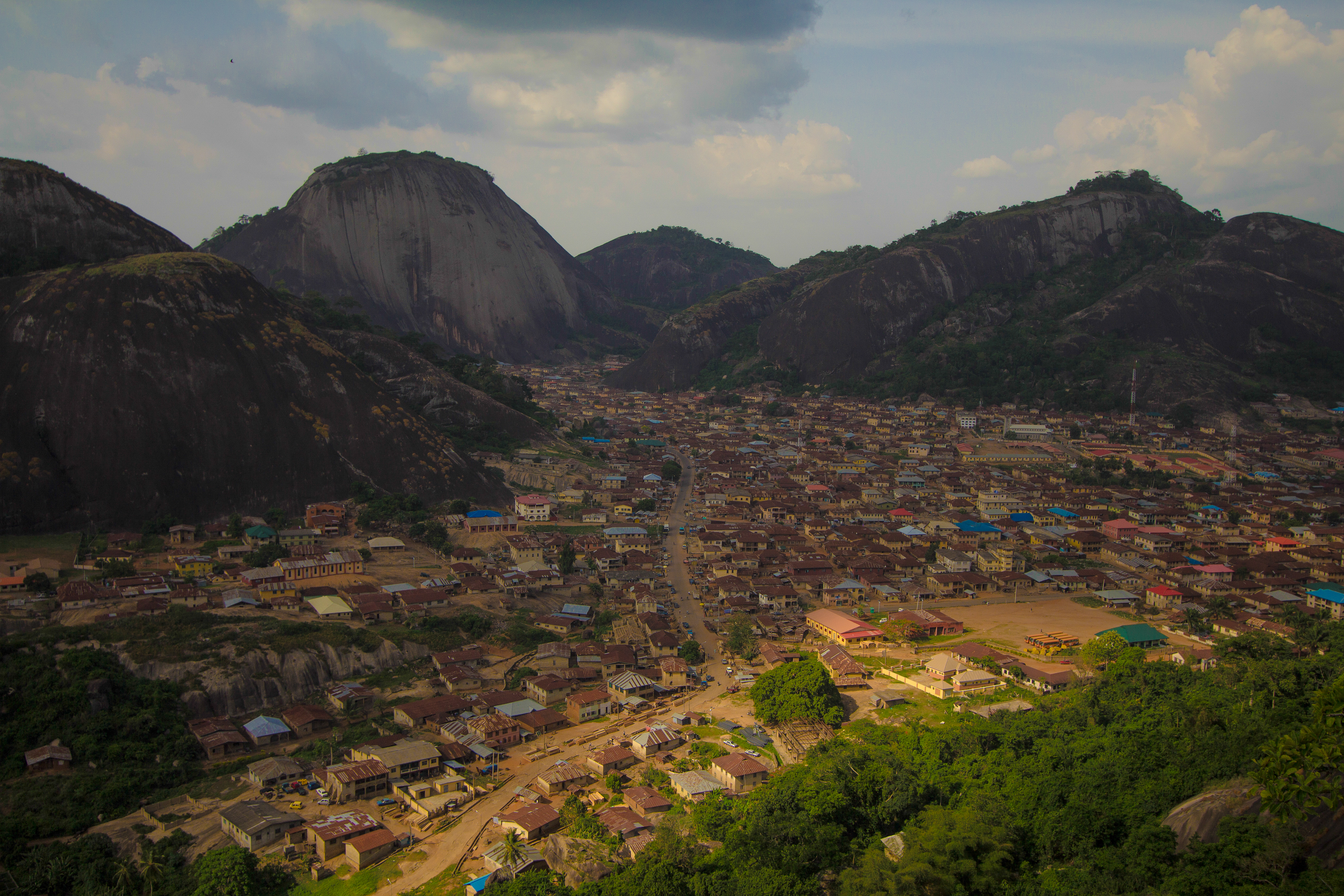
Idanre Hill
Wole Soyinka, Africa's first Nobel laureate in literature, titled one of his most celebrated poetry collections "Idanre and Other Poems." He chose the name for good reason. Oke Idanre -- Idanre Hill -- is the kind of place that demands to be written about: a 3,000-foot granite inselberg erupting from the tropical lowlands of Ondo State, its summit scattered with the ruins of a civilization that lived among these boulders for nearly a thousand years. The Owa's Palace, ancient shrines, a colonial-era court, a belfry, burial grounds, and a footprint attributed to the mythical figure Agboogun all occupy the heights. Nigeria has placed the hill on its tentative list for UNESCO World Heritage status, and the case is strong -- few places on earth combine natural drama, cultural depth, and biological rarity in such concentrated form.
A Millennium Among the Boulders
The people of Idanre did not choose to live on a hilltop for the view. Elevation meant defense, and for centuries the granite summit provided security that the lowlands could not. An entire community -- homes, governance, spiritual life -- adapted to the contours of the rock. The king's palace perched among the boulders. Courts administered justice. Shrines marked the places where the sacred pressed closest to the surface. When emigration to the flatlands began accelerating around 1923, the hilltop settlement started its transition from living town to cultural monument. But it never became merely a ruin. Annual festivals draw people back up the ancient steps -- 660 of them, by one count -- to reenact episodes from Idanre and broader Yoruba history, to reconnect with mythology and confederacy. The topography and vegetation have remained largely undisturbed since the descent, preserved by the difficulty of the terrain and the reverence of those who once called it home.
Nine Wonders on the Summit
Local tradition holds that Idanre Hill contains nine ancient wonders, and the list reads like an inventory of the mythical and the mysterious. "Ibi Akaso" -- the Steps -- are the ancient carved path to the summit. The King's Palace stands as evidence of governance at altitude. Agboogun's Legacy and Agboogun's Footprint tie the hill to a figure from Yoruba oral tradition. Unreadable signs carved into the rock defy interpretation. A "wonderful mat" of unknown origin and purpose adds to the enigma. "Omi Aopara," the thunder water, suggests a spring or waterfall associated with supernatural power. The Orosun Hill and the Arun River complete the count. Whether one approaches these as historical sites, spiritual landmarks, or simply curiosities, they testify to a culture that wove meaning into every feature of its landscape.
A Toad Found Nowhere Else
The biological significance of Idanre Hill is as remarkable as its cultural heritage. Perret's toad, a species first described in 1963, is known from a single locality on earth: this hill. The species' extreme range restriction makes the site critical for amphibian conservation. But the toad is not the only notable resident. Hyraxes -- small, tailless mammals more closely related to elephants than to the rodents they resemble -- inhabit the rocks, though hunting has pushed their population toward extinction. Monkeys have been spotted near Orosun Hills. The surrounding Idanre Forests are one of just six sites in southern Nigeria where forest elephants survive, alongside the Omo Forests in Ogun State, Okomu National Park in Edo State, Cross River National Park, Osse River Park, and Andoni Island. A colony of bats lives on the hill, honored by the community with a unique annual bat festival. Filmmakers regularly use the dramatic landscape as a location, and scientists and field researchers maintain a presence studying the ecosystem.
The Missionaries Climbed, Too
Western contact arrived in 1894, when a team of missionaries led by Reverend Gilbert Carter made the climb. Two years later, in 1896, they built the hill's first primary school -- a clay structure that reportedly still stands. A law court followed in 1906, complete with a small prison where convicts served their sentences at altitude. These colonial additions layered onto a settlement that had existed since antiquity, creating the palimpsest visible today: ancient shrines alongside Victorian-era institutions, Yoruba cosmology sharing space with imported legal systems. The hill absorbed each new influence without losing its essential character. Even now, with the permanent population gone to the lowlands, the summit retains the feeling of a place that belongs to the people who shaped it, not to the outsiders who later arrived and built their own small monuments among the boulders.
From the Air
Located at 7.11N, 5.11E in Ondo State, southwestern Nigeria. Idanre Hill is a dramatic inselberg rising 3,000 feet (914 meters) above sea level, clearly visible from altitude as a massive granite formation surrounded by tropical lowland forest. Nearest airport is Akure Airport (DNAK), approximately 25 km to the northwest. The hill and surrounding inselbergs are prominent terrain features. Exercise caution for mountain weather, especially during the rainy season (February-November) when cloud buildup and haze are common.