Iga Kokubun-ji: The Temple That Vanished Twice
The temple vanished so completely that by the Muromachi period, nobody in Iga knew where it had stood. The ruins were mistaken for a mansion. Other temples across the region claimed to be its successor. It was not until the 1910s that earthworks and foundation stones confirmed the true location of the Iga Kokubun-ji -- a provincial Buddhist temple ordered into existence by Emperor Shomu in 741 AD as part of a nationwide spiritual response to a catastrophic smallpox epidemic. Then, just as the site was finally understood, the Imperial Japanese Navy arrived in 1944 and tore through the archaeological remains to build hangars and bunkers for an airfield. The temple that had already disappeared from history was destroyed a second time.
An Emperor's Prayer Against Plague
Between 735 and 737, a devastating smallpox epidemic swept across Japan. The Shoku Nihongi records that Emperor Shomu, seeking divine protection for a shattered nation, ordered in 741 that a Buddhist monastery and nunnery be established in every province of Japan. These kokubunji were built to a semi-standardized template, serving a dual purpose: spreading Buddhist orthodoxy to the provinces and projecting the power of the Nara period centralized government under the Ritsuryo legal system. The Iga Kokubun-ji was the province's answer to that imperial command. It rose on a plateau at 170 meters elevation, southeast of what is now the city center of Iga, its axis deliberately offset by four degrees and thirty minutes from true north -- for reasons that remain unknown.
The Architecture of Faith
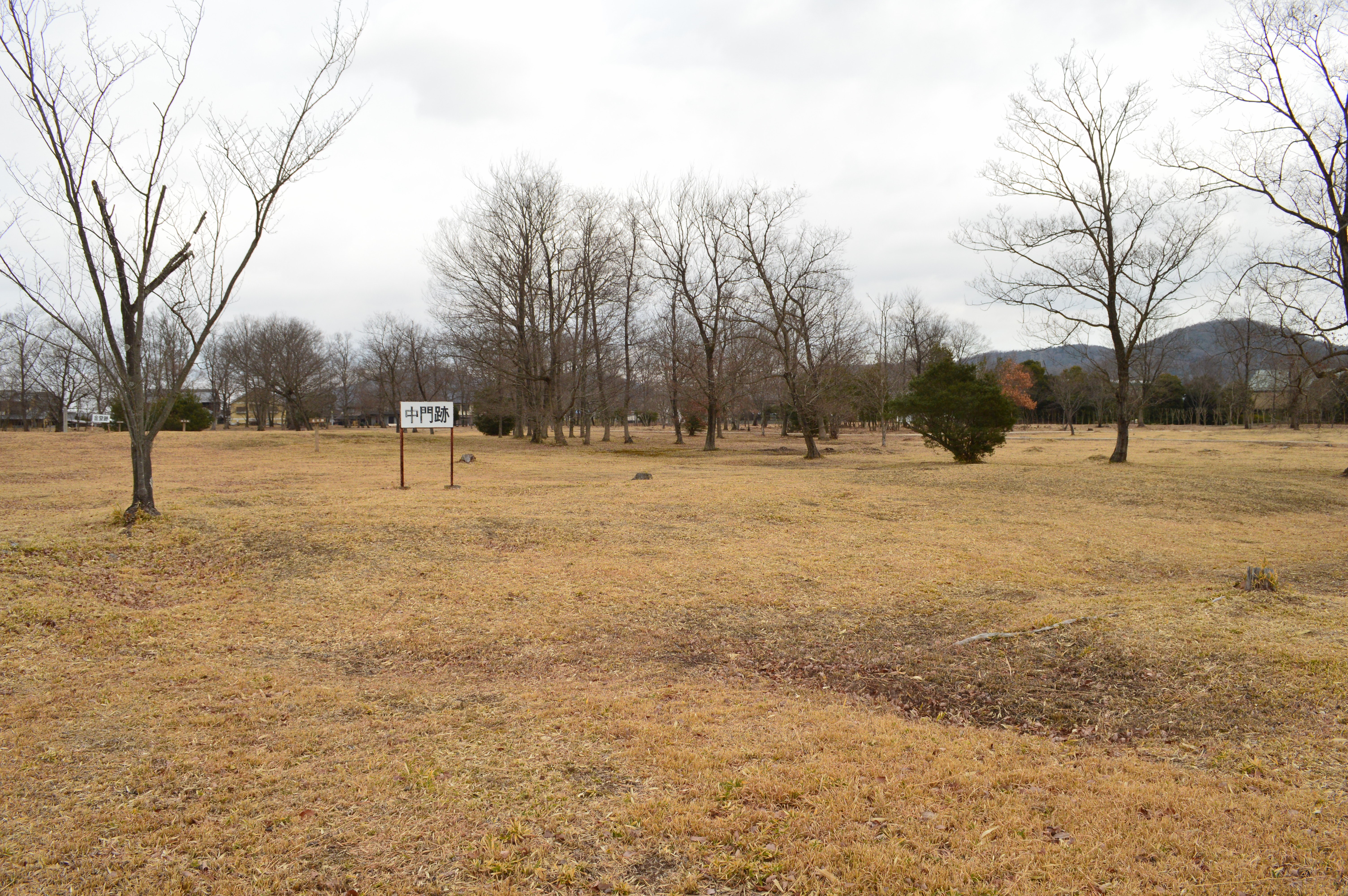
The temple was laid out as a walled compound, 220 meters east-to-west by 240 meters north-to-south. A Middle Gate, Kondo main hall, and Lecture Hall were arranged in a straight line running south to north, with a cloister connecting the Middle Gate to the sides of the Kondo. Both the Kondo and Lecture Hall were substantial structures -- five bays by seven bays, based on the foundation traces that survive. The pagoda foundations have been found outside the cloister to the east, and the platforms for the Kyozo scripture repository and Kuri kitchen behind the Lecture Hall. The South Gate, however, has never been found. About 200 meters to the east, another set of ruins -- the Chorakuzan temple -- is believed to have been the Iga Kokubun-niji, the provincial nunnery that accompanied every kokubunji.
Stolen Stones and Forgotten Names
The Engishiki records mention the temple in an entry dated 927 AD. It appears sporadically in other Heian period documents and into the early Kamakura period, but then it simply drops out of the historical record before the Muromachi period begins. Archaeological evidence supports this timeline -- roof tiles and pottery shards from the Heian and Kamakura periods have been recovered, but nothing later. The disappearance was thorough. Many of the temple's foundation stones were physically carried off and reused in the construction of Iga Ueno Castle. By the Muromachi period, locals referred to the remaining ruins as the 'Choja Mansion,' attributing them to a wealthy landowner rather than a sacred temple. By the Meiji period, the site was officially designated the 'Mita temple ruins' after the surrounding neighborhood, and multiple temples elsewhere in Iga competed to claim the Kokubun-ji's lineage.
Rediscovered and Destroyed Again
The true location of the Iga Kokubun-ji was finally confirmed in the 1910s when earthworks and structural foundations were identified at the plateau site. In 1923, the Japanese government designated it a National Historic Site -- formal recognition that this patch of ground held 1,200 years of Buddhist history. The protection lasted exactly twenty-one years. In September 1944, as the Pacific War pressed Japan to its limits, the National Historic Site designation was officially abolished to permit the Imperial Japanese Navy to build an airfield on the plateau. Semi-underground hangars and bunkers were carved through the archaeological remains, severely damaging the ruins that had survived a millennium of neglect. The temple that history had forgotten was physically torn apart by the nation that had once ordered its construction.
What Remains in the Soil
No comprehensive full-scale excavation has ever been conducted at the Iga Kokubun-ji site. What is known comes from partial surveys and surface discoveries -- the foundation traces, the offset alignment, the pottery shards that date the temple's active period. The companion nunnery ruins at Chorakuzan sit nearby, equally understudied. The kokubunji system that Emperor Shomu envisioned was one of the most ambitious infrastructure projects of ancient Japan, planting Buddhist temples across every province in a network of faith and governance. Most have left at least some visible trace. The Iga Kokubun-ji left foundations that were robbed for a castle, ruins that were mistaken for a mansion, and a National Historic Site that was bulldozed for a wartime airfield. The soil of this quiet plateau in Mie Prefecture holds more history than it has been allowed to reveal.
From the Air
Located at 34.758N, 136.154E on a plateau southeast of the city center of Iga, Mie Prefecture. From altitude, the site appears as relatively flat elevated ground amid the hilly terrain of the Iga basin. Iga Ueno Castle -- which was partly built from stones stolen from this temple -- is visible to the northwest. The companion Chorakuzan nunnery ruins lie approximately 200 meters to the east. The nearest major airport is Chubu Centrair International Airport (RJGG), approximately 80 km northeast. Best viewed at 2,000-4,000 feet AGL. The plateau's shape is distinguishable from surrounding terrain, though no above-ground structures remain.