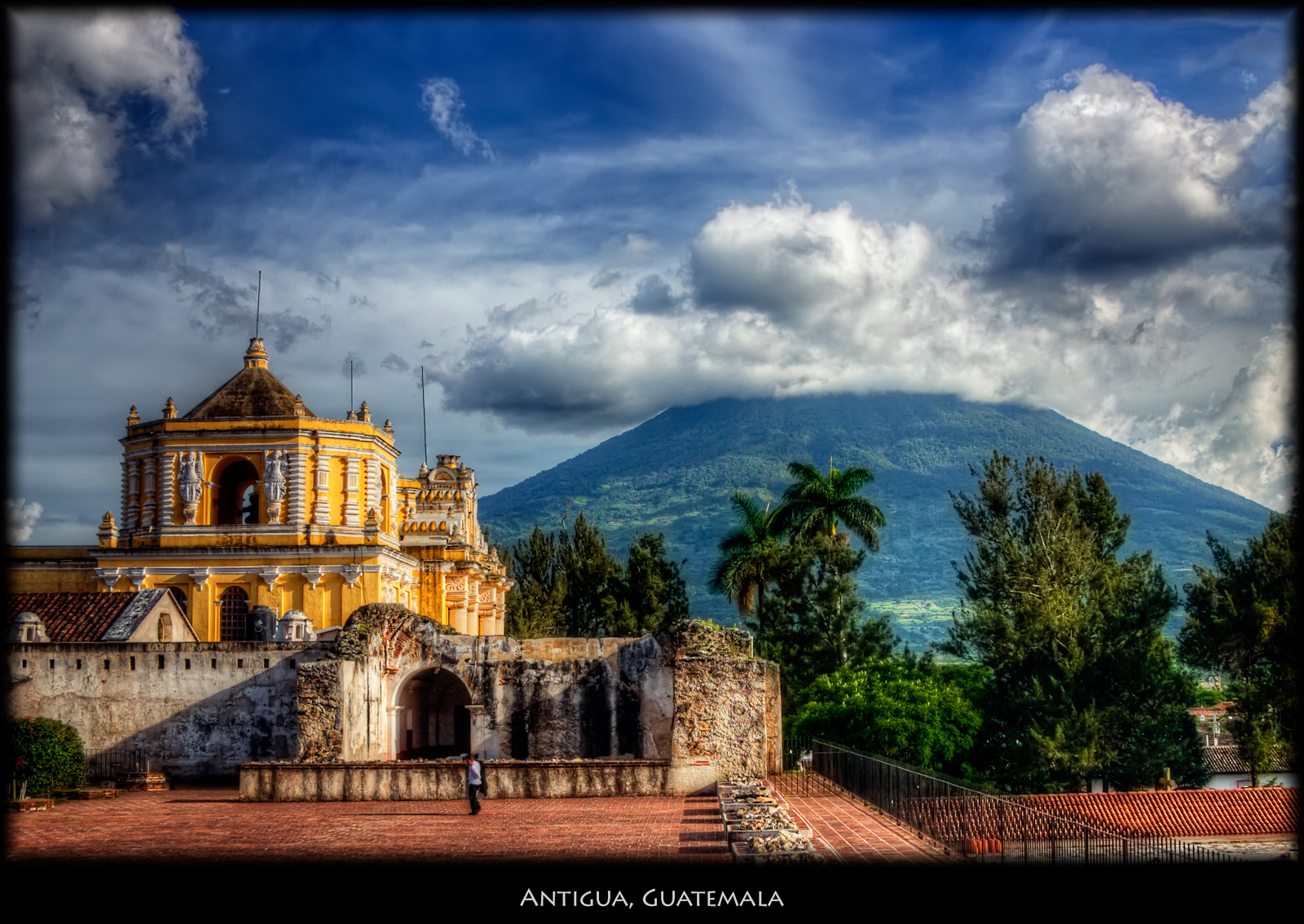
Iglesia de La Merced, Antigua Guatemala
When the Santa Marta earthquakes leveled most of Antigua Guatemala in 1773, the Iglesia de la Merced barely flinched. Completed just six years earlier using construction techniques advanced enough to resist the seismic violence that had destroyed its predecessors, the church stood intact while the cathedral, the palace, and dozens of other buildings crumbled around it. But surviving the earthquake was only the beginning of La Merced's trials. Colonial authorities, determined to force the population to relocate to the new capital, would soon weaponize the church's most treasured possession against it -- removing the beloved image of Jesus Nazareno de la Merced by force, knowing that where the sculpture went, the faithful would follow.
The Mercedarians Arrive
The Mercedarian order reached Guatemala with the earliest wave of Spanish colonization. Friar Marcos Dardon arrived with the conquistadors, and Bishop Francisco Marroquin brought the order to Guatemala around 1537. The Mercedarians first settled in the Almolonga Valley, then relocated to the Panchoy Valley after a catastrophic landslide from Volcan de Agua destroyed the original settlement. From this new base -- what would become Antigua Guatemala -- they expanded across Central America. By 1561, the Province of Our Lady of the Mercy of Guatemala encompassed not only Guatemala and Honduras but also El Salvador, Nicaragua, Costa Rica, and briefly Mexico. The order ran sugar mills, operated doctrines for indigenous communities across Quetzaltenango, San Marcos, and Huehuetenango, and built the San Geronimo School, which the crown confiscated in 1763 for lacking a royal license.
A Church Built to Endure
Architect Juan de Dios Estrada began construction in 1749, funded in part by a donation of four thousand pesos from Captain General Alonso Fernandez de Heredia, who arrived in 1761. The church was dedicated in 1767 in the Guatemalan Churrigueresque style, with twin bell towers and a facade populated with Mercedarian saints: Peter Nolasco, the order's founder, at the top; the Virgin of Mercy and the Mercedarian shield below; Saints Raymond Nonnatus and Pedro Armengol on the left; Saints Peter Pascual and Mary de Cervellione, the first Mercedarian nun, on the right. Behind the church, the cloister contains the Fountain of los Pescados, an eighteenth-century basin twenty-seven meters in diameter -- one of the largest colonial fountains in Latin America. Shaped like a water lily, it echoes Maya cosmology, in which the gods themselves emerged from such a flower.
The Sculpture That Moved a City
After the 1773 earthquakes, Captain General Martin de Mayorga needed to force Antigua's population to the new capital. His most effective weapon was not a decree but an image. In 1778, he ordered the removal of the Jesus Nazareno de la Merced -- the most venerated sculpture in the city -- knowing that the faithful would follow their Christ. The transfer was wrenching. Indigenous workers tasked with moving the heavy sculpture took their time, while parishioners prayed and wept outside the church. When the image finally departed in its box, the people accompanied it to the Animas sentry box on the outskirts of the city. One devotee carried the cross all the way to San Lucas, fifteen kilometers from the Mercedarian convent. After stops in San Lucas Sacatepequez and Mixco, the image arrived in Nueva Guatemala de la Asuncion by night, received first by the Franciscans, then the Mercedarians. Mayorga himself came to inspect the sculpture. The most painful chapter of the capital's relocation was complete.
The Second Nazarene
With its great image gone, La Merced stood bereft. But Antigua's residents were not easily defeated. To prevent a repeat of the violent riots that had erupted in the new capital, authorities allowed the image of Jesus Nazareno from the hermitage of San Geronimo in the Mulato neighborhood to remain. This second Nazarene was transferred to the parish of San Sebastian in 1804 and then, permanently, to the Iglesia de la Merced. Modern research has corrected a long-held belief that this image came from the Ermita de la Santa Cruz; it originated instead at the Ermita de San Geronimo. Over the centuries, this replacement became the most symbolic figure of Holy Week in Antigua Guatemala, carried through the streets each spring in processions that draw visitors from around the world. The church that survived the earthquake, lost its greatest treasure, and adopted another has become inseparable from Antigua's identity.
From the Air
Located at 14.562N, 90.734W in the northern part of Antigua Guatemala's colonial grid. The church's distinctive yellow Churrigueresque facade and twin bell towers are identifiable from low altitude. The large cloister and fountain courtyard are visible behind the main structure. Volcan de Agua rises dramatically to the south, providing a striking backdrop. Nearest major airport is La Aurora International Airport (MGGT) in Guatemala City, approximately 25 km east. The church sits along the Brother Pedro Commemorative Tourist Route, a few blocks north of the Central Square.