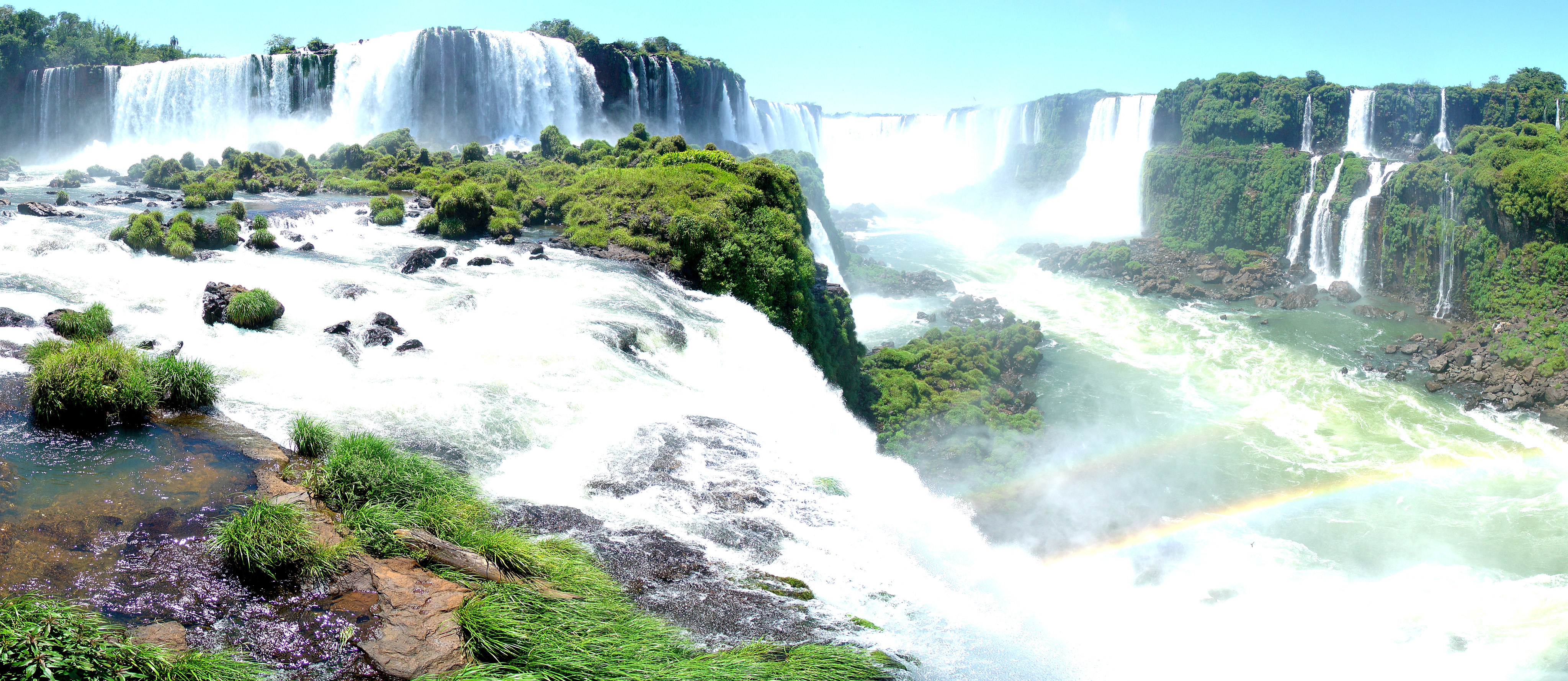
Iguazu Falls
Iguazu Falls overwhelms every expectation. Wider than Victoria Falls, taller than Niagara, set in subtropical rainforest where toucans fly and coatis beg for scraps, these cataracts at the Argentina-Brazil border represent nature's most spectacular plumbing. The Guarani people who named them called this place 'big water' - a vast understatement for 275 individual falls spread across nearly three kilometers, fed by the Iguazu River draining one of South America's largest watersheds. When Eleanor Roosevelt first saw them, she allegedly said 'Poor Niagara!' - though the quote may be apocryphal, the sentiment is universal among visitors. UNESCO recognized both national parks flanking the falls, and the site was elected one of the New Seven Wonders of Nature. Yet despite annual visitor numbers approaching two million, the falls still have the power to silence conversation, to make cameras seem inadequate, to remind humans exactly how small we are when water decides to drop.
Two Countries, Two Experiences
The falls straddle Argentina and Brazil, and the two sides offer fundamentally different experiences. Argentina contains most of the falls - around 80 percent - and its national park provides up-close encounters via an extensive system of walkways and trails. You can stand at the edge of cascades, feel spray drench your clothes, watch swifts nesting behind curtains of falling water. The Brazilian side has fewer falls but offers the panoramic view that appears in every photograph: the entire horseshoe visible across the gorge, the Devil's Throat smoking with mist in the distance. Serious visitors spend a day on each side; those with limited time must choose. Argentina offers intimacy and variety; Brazil offers perspective and the classic shot. Both charge substantial entrance fees that increase for foreign visitors.
The Devil's Throat
Garganta del Diablo - the Devil's Throat - forms the heart of Iguazu, a U-shaped chasm where fourteen falls converge into a continuous wall of water 82 meters high and 150 meters wide. From the Argentine side, a small train carries visitors to the start of a kilometer-long boardwalk extending across the upper river to platforms perched just meters from the plunging chaos. Standing there, enveloped in permanent mist, the roar making conversation impossible, watching countless tons of water disappear into clouds of spray that rise back up past the viewing level, is an experience that defies adequate description. The platforms can be closed when water levels rise dangerously high. From the Brazilian side, the Devil's Throat appears across the canyon, an impressive view but lacking the visceral power of standing at its edge.
Rainforest Setting
The falls exist within one of the last significant fragments of Atlantic Forest, a subtropical ecosystem separate from the Amazon that once covered much of southeastern South America. Both national parks protect this habitat and the wildlife it supports. Coatis - raccoon-like mammals - have become famously bold around visitor areas, stealing food from the unwary. Capuchin monkeys patrol the forest trails. Toucans of five different species nest in the trees; the great dusky swift makes its home on rock faces behind the falls themselves. Bigger animals - jaguars, tapirs, giant anteaters - live in the parks but rarely reveal themselves to tourists. The forest adds immeasurably to the falls experience; this isn't just water tumbling over a ledge but an entire ecosystem centered on the cataract, life evolved around permanent mist and constant thunder.
Gateway Towns
Three cities serve as bases for visiting the falls. Foz do Iguacu on the Brazilian side is the largest and feels the most urban - a working city with supermarkets, nightlife, and reasonable prices. Puerto Iguazu in Argentina is smaller and prettier, more purely oriented toward tourism with a pleasant town center and easy access to the Argentine park. Ciudad del Este in Paraguay sits just across the bridge from Brazil, famous for contraband electronics and a chaotic energy that some find exciting and others best avoided. Most visitors choose between Brazilian and Argentine accommodation based on which side they want to prioritize. The two parks require crossing an international border, which adds bureaucratic complexity but remains fairly relaxed - authorities assume most people are day-trippers.
Visiting the Falls
Both sides offer boat trips that take visitors into the falls themselves, returning passengers thoroughly drenched but exhilarated. The Argentine side features multiple trail circuits - Upper, Lower, San Martin Island - requiring a full day to properly explore. The Brazilian side can be covered in half a day, though the boat trip and jungle trails extend the experience. Both parks open at 8 AM; arriving early avoids the largest crowds. Waterproof protection for cameras and phones is essential near the falls; waterproof bags work, as do underwater camera housings. July through October brings lower water levels and clearer views; November through February sees the falls at their most powerful but often shrouded in mist. Either way, the falls deliver - this is not a destination that disappoints.
From the Air
Located at 25.70°S, 54.44°W on the Argentina-Brazil border. The falls span the Iguazu River in a distinctive horseshoe shape visible from altitude, with mist often rising from the Devil's Throat section. The Brazilian Foz do Iguacu International Airport (IGU) lies 13km from the falls; Argentina's Cataratas del Iguazu International Airport (IGR) is 20km away. Both national parks are visible as dark green rainforest contrasting with surrounding agricultural land. Ciudad del Este, Paraguay is visible across the Parana River from Foz do Iguacu.