Iiyama Castle: The Fortress That Changed Hands With Every War
Every great castle in Japan has a story about who built it. Iiyama Castle has a story about everyone who took it. Sitting on a 30-meter hill where the Chikuma River bends through the northeast edge of the Nagano plain, this fortress spent four centuries being conquered, rebuilt, handed over, modernized, reassigned, and finally burned to the ground -- by troops loyal to the same Tokugawa shogunate the castle had served for over 250 years. The Takanashi, Uesugi, Takeda, Oda, Toyotomi, Tokugawa, and Honda clans all held these walls at one point or another. Today, cherry blossoms bloom where samurai fought, and a Shinto shrine stands on the inner bailey where castle lords once planned campaigns.
Crossroads at the River's Bend
Iiyama's strategic value was geographic. The castle commanded the intersection of two vital roads: the Iiyama kaido running to the Joetsu area and the Tani kaido connecting to the Uonuma region in the heart of Echigo Province. Any army moving between Shinano and Echigo had to pass through this chokepoint. A town grew here during the Kamakura period, fed by trade flowing along these routes. The Takanashi clan governed the area from the late Heian period onward, rising to power as retainers of Minamoto Yoshinaka. Through the Muromachi period, they expanded aggressively, defeating the Nakano clan and seizing control of northeastern Shinano. But the Takanashi were middleweight warriors in a world that increasingly belonged to heavyweights, and when the Sengoku period erupted across Japan, they found themselves squeezed between Takeda Shingen from the south and their own uneasy alliance with Uesugi Kenshin to the north.
Kenshin's Final Line
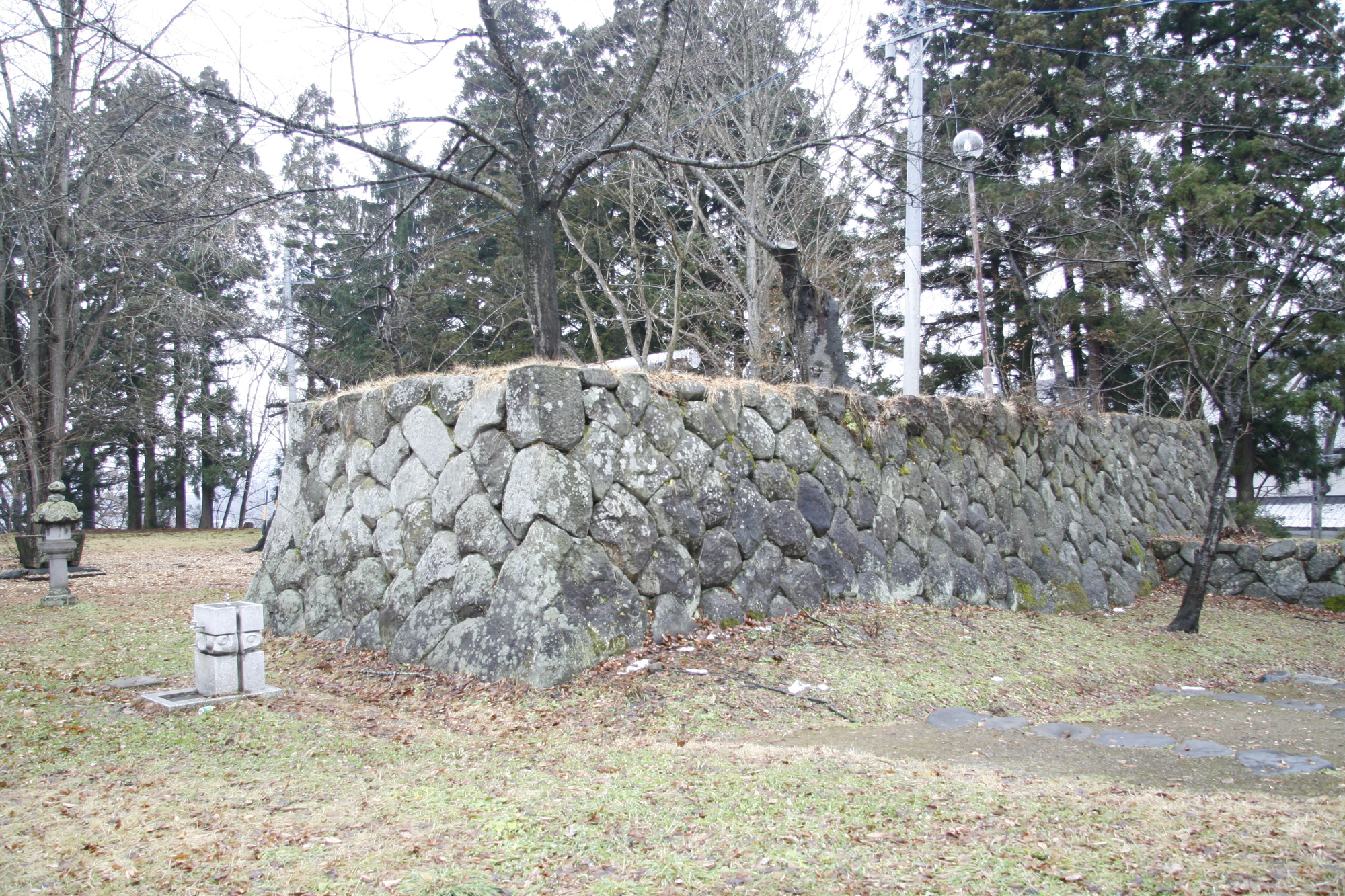
Around 1560, Uesugi Kenshin rebuilt Iiyama Castle as his last defensive position in Shinano Province. The reconstruction reflected the seriousness of the threat: three kuruwa enclosures crowned the hilltop, with steep cliffs dropping to the Chikuma River protecting the rear. Two smaller enclosures guarded the main gate halfway up the slope. A water moat, connected directly to the river, surrounded the entire fortification. Kenshin had a personal connection to the region -- he was the grandson of a Takanashi woman -- but sentiment alone did not drive the alliance. Iiyama was the cork in the bottle: if it fell, the road to Echigo lay open. The castle endured repeated attacks throughout the Kawanakajima campaigns from 1553 to 1564, holding the line between Takeda and Uesugi territory. Stone walls were added to reinforce the enclosures, fragments of which survive to this day, embedded in the hillside like teeth in an old jaw.
A Castle for Every Master
After Uesugi Kenshin died in 1578, his successor Uesugi Kagekatsu ceded Iiyama to Takeda Katsuyori, Shingen's son, as part of a peace treaty. Four years later, Oda Nobunaga destroyed the Takeda clan entirely and handed the castle to his general Mori Nagayoshi. When Nobunaga himself was assassinated at Honno-ji that same year, 1582, Uesugi Kagekatsu swooped back in and reclaimed Iiyama, modernizing its defenses as a border fortress. But the Uesugi were relocated to Aizu by Toyotomi Hideyoshi in 1598, and Iiyama was reassigned to Seki Kazumasa. Under the Tokugawa shogunate, the castle became part of a 180,000-koku domain controlled by Matsudaira Tadateru, who assigned it with 40,000 koku to Minagawa Hiroteru. The castle continued to change hands among various clans until a cadet branch of the Honda family took possession in 1717 and finally held it through to the Meiji Restoration -- the longest tenure in the castle's turbulent history.
Burned by Its Own Side
The final chapter came during the Boshin War, when Japan tore itself apart over the question of imperial restoration versus shogunal authority. The Shohōtai, an elite brigade of troops still loyal to the Tokugawa shogunate, attacked Iiyama Castle and burned it to the ground. There is a bitter irony in the castle's end: after centuries of serving as a military stronghold for one ruling power after another, it was destroyed by soldiers fighting for the very government it had most recently served. The fire consumed the wooden structures that had been rebuilt and reinforced across generations.
Cherry Blossoms on the Ruins
What remains of Iiyama Castle today tells its story in fragments. The inner bailey has become a Shinto shrine. The second bailey is a public park, famous across the region for its sakura -- cherry blossoms that draw visitors each spring to walk among stone wall remnants, earthen ramparts, and old moat channels. Three of the castle's original gates have survived, scattered across the region: one was at a temple in Iiyama city before being relocated back to the castle grounds, another sits at a temple in Nagano, and two more are in private hands. These gates are the castle's true survivors, wooden structures that outlasted the fortress they once guarded. The site is designated a Prefectural Historic Site of Nagano Prefecture. Standing on the hilltop in spring, surrounded by falling petals, it takes effort to imagine the 6,000-strong Takeda army that once besieged these slopes, or the Shohōtai troops who finally put the castle to the torch. The Chikuma River still bends around the hill below, following the same course it carved when this crossroads was worth fighting over.
From the Air
Located at 36.86°N, 138.37°E on a 30-meter hilltop above the Chikuma River in Iiyama, Nagano Prefecture. The castle ruins are visible from altitude as a park and shrine complex on a low hill at the river bend, at the northeast edge of the Nagano plain. The Chikuma River curves around the site's eastern and northern sides. Best viewed at 2,000-4,000 feet AGL. The nearest major airport is Matsumoto Airport (RJAF), approximately 55 nautical miles to the south-southwest. Niigata Airport (RJSN) lies roughly 60 nautical miles to the north. The terrain transitions from flat plains to mountainous terrain toward Echigo Province to the north, illustrating the castle's strategic position at the gateway between the two regions.