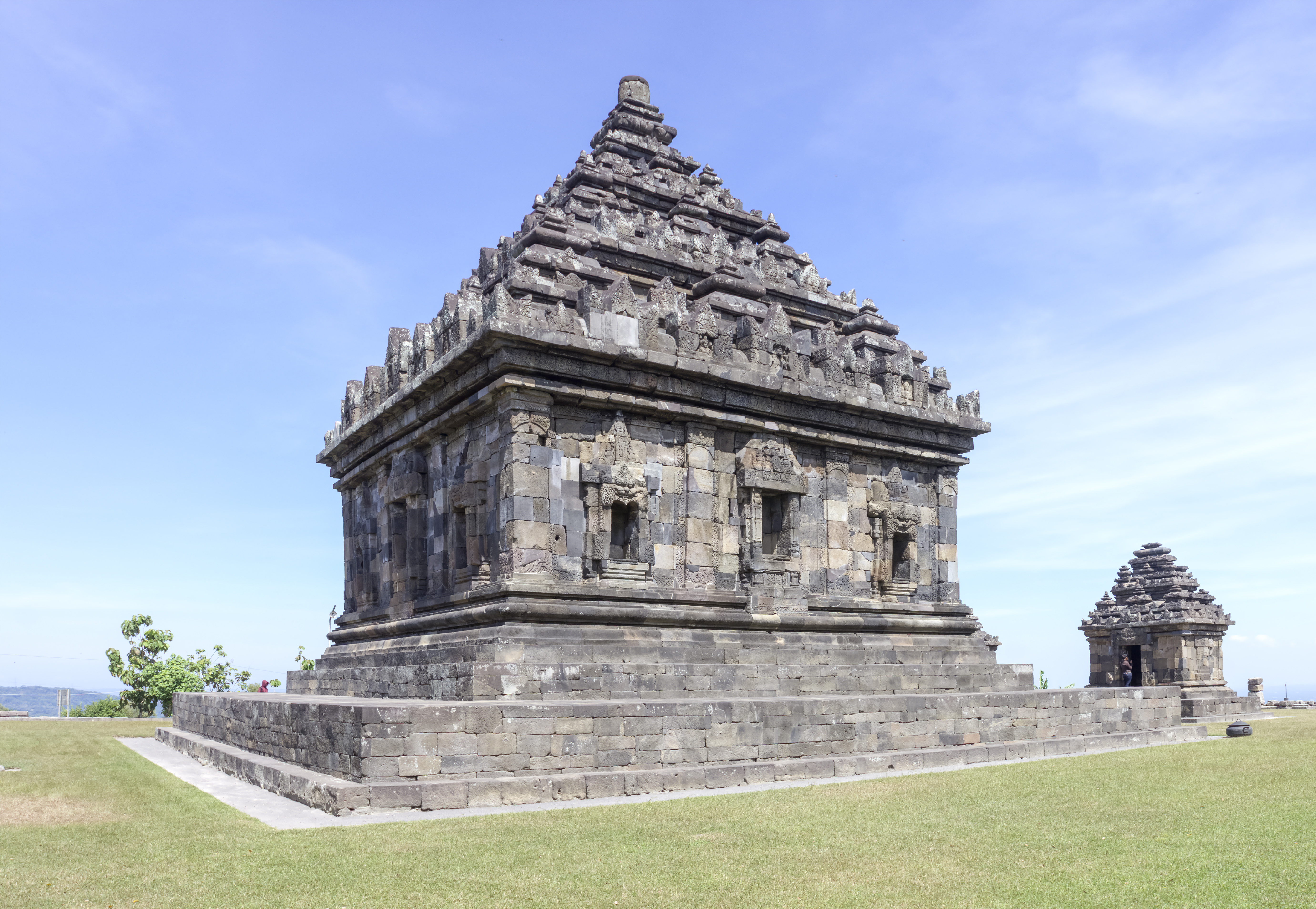
Ijo Temple
At 410 meters above sea level, Ijo Temple holds a distinction no other candi in Yogyakarta can claim: it is the highest. Built between the 10th and 11th centuries during the Mataram kingdom period, the temple compound climbs the western slope of Gumuk Ijo hill, its name taken directly from the hill itself. From the uppermost terrace, the view opens west across rice paddies and village rooftops all the way to the runway of Adisucipto International Airport. The juxtaposition is striking, a thousand-year-old shrine watching modern aircraft descend into the plain below.
Ascending the Green Hill
The temple compound stretches from the foot of Gumuk Ijo upward to its western slope, spanning an estimated 0.8 hectares in its current excavated extent. Archaeologists believe the original compound was far larger. Scattered ruins and buried foundations on the lower slopes suggest the complex once reached from the base of the hill all the way to the summit terrace, with more than ten perwara, or lesser temples, still awaiting excavation beneath the earth. The site unfolds across several terraces that follow the hill's natural topography, each level climbing eastward toward the main temple. Walking up through the terraces is itself a kind of pilgrimage, the world growing quieter and the views expanding with each step.
Three Temples for Three Gods
The uppermost terrace holds the heart of the complex: one large main temple facing west and three smaller perwara temples arranged before it, facing east. These three shrines honor the Trimurti, the three supreme deities of Hinduism: Brahma the creator, Vishnu the preserver, and Shiva the destroyer. Each perwara contains a cella, an enclosed chamber, with windows perforated in a distinctive rhombus pattern that filters light into geometric fragments on the stone floor. The roofs rise in three diminishing stages, each tier adorned with rows of ratnas, ornamental jewel-shaped finials that catch the afternoon sun. Small as they are compared to the main temple, these three structures carry the full weight of Hindu cosmology in their design.
Stone Parrots and Serpent Guardians
The main temple rewards close inspection. Its square plan is entered from the west through a doorway set 1.2 meters above ground level, reached by stairs flanked with carved makaras, the mythical sea creatures of Hindu tradition. Above the entrance, a kala head spreads its fearsome grin, its body flowing down each side of the gate as intertwined makaras. Look carefully inside the makaras' open mouths and you will find small stone parrots, an unexpected detail that reveals the sculptors' playfulness amid their devotional work. The kala-makara motif appears throughout ancient Javanese temple architecture, but here the parrots add a distinctive touch. Niches on the north, east, and southern walls once held Hindu statues, now long vanished, their absence leaving the temple's walls with a haunted emptiness.
The Sacred Union Within
Inside the main chamber stands the temple's most significant object: a large linga and yoni adorned with a naga serpent. The linga, a phallic stone pillar, rises from the yoni, its feminine counterpart, together symbolizing the cosmic union of Shiva and his consort Parvati. The naga serpent coiled around them adds a layer of protective power drawn from the underworld. Three niches line each interior wall, flanked by pairs of carved devatas, lesser deities depicted in flight, their bodies angled toward the niches as though converging on sacred ground. The roof above follows the exterior's stepped pyramid form, diminishing in three terraces crowned by a single large ratna. Between the temple body and the roofline, bands of floral patterns alternate with gana, the dwarf figures that serve as celestial attendants in Hindu iconography.
A Quiet Corner of a Sacred Plain
Ijo Temple sits about four kilometers southeast of the Ratu Boko archaeological compound and roughly eighteen kilometers east of central Yogyakarta, in the village of Sambirejo within Prambanan district. It belongs to the same constellation of Hindu and Buddhist monuments that dot the Prambanan plain, yet it draws far fewer visitors than its more famous neighbors. That relative solitude is part of its appeal. Without the crowds that press around Prambanan's towering spires, Ijo offers something rarer: the chance to stand alone among stones that have watched the valley below for a millennium. The hill's green slopes, the terraced compound, and the wide-open view to the west compose a scene that feels less like a tourist site and more like a place that simply endures.
From the Air
Located at 7.78S, 110.51E on the western slope of Gumuk Ijo hill, at an elevation of 410 meters above sea level. The temple is about 4 km southeast of the Ratu Boko complex and 18 km east of central Yogyakarta. Look for a green hilltop rising above rice paddies in the Prambanan district. Adisucipto International Airport (WAHH) is visible to the west from the temple terrace. The larger Prambanan temple compound is about 3 km to the northwest. Best viewed at moderate altitude where the terraced compound on the hillslope becomes distinguishable from the surrounding vegetation.