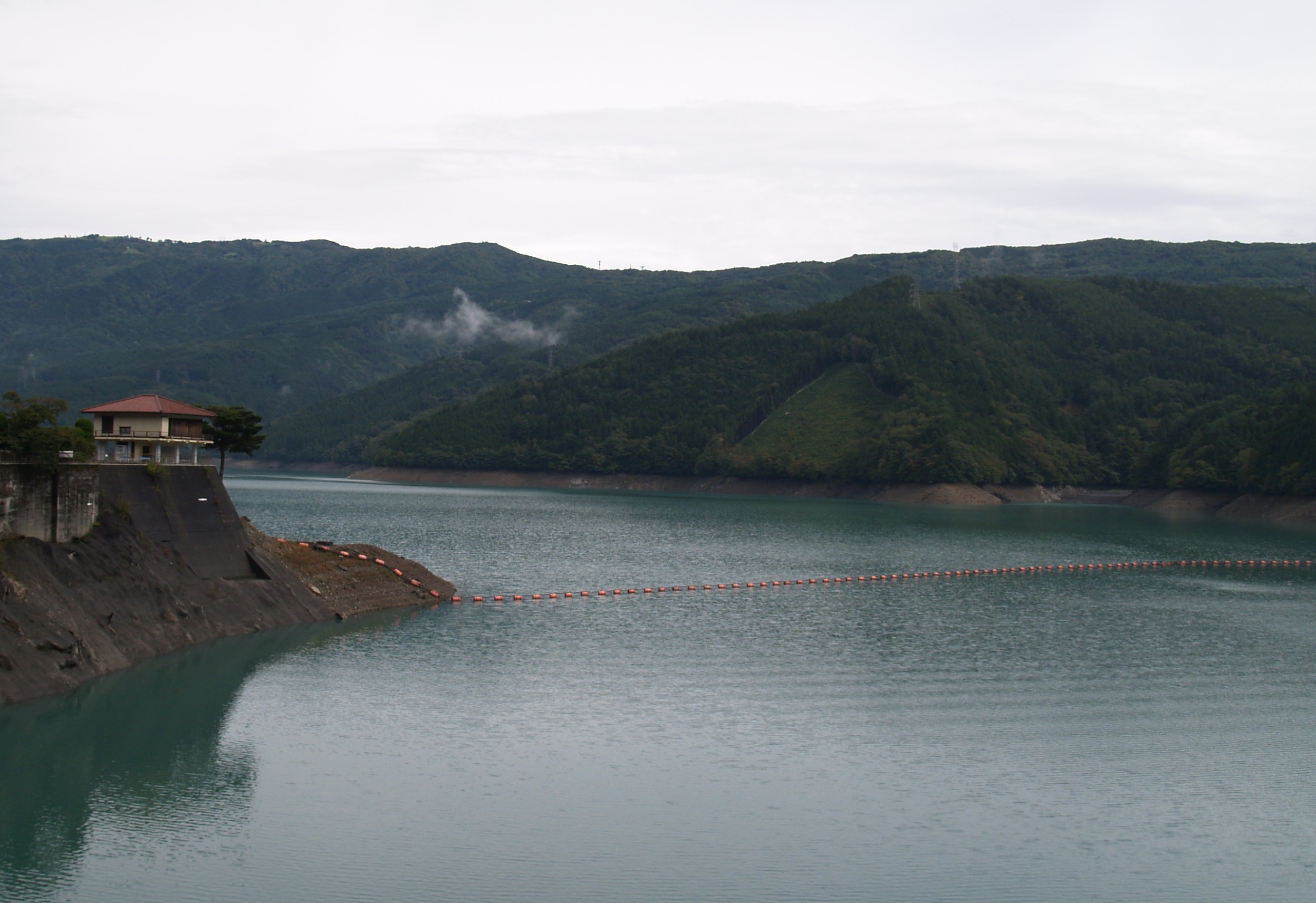
Ikawa Dam
Five hundred and fifty households disappeared beneath the rising water. When the Ikawa Dam was completed in 1957, the village of Ikawa, tucked into a narrow valley on the upper Oi River, ceased to exist as a place where people lived. Its residents were relocated, their homes submerged under a reservoir that would supply hydroelectric power to fuel Japan's postwar industrial surge. The dam itself was a first for the country: a hollow-core concrete gravity dam, a technique imported from earthquake-prone northern Italy, proving that a structure full of air could hold back a mountain river as effectively as one made of solid stone.
A British-Japanese Venture, A Century of Ambition
The story of Ikawa Dam begins not in the 1950s but in 1906, when a joint venture company was established to study the hydroelectric potential of the Oi and Fuji rivers in Shizuoka Prefecture. British investors saw opportunity in the fast-flowing mountain streams, the steep valleys, and the abundant rainfall. Their interests were bought out by 1921, and by 1938 the Japanese government had nationalized electrical production. The first dams on the Oi appeared in the late 1920s and early 1930s, but the Great Depression and then World War II halted expansion. When the war ended, Japan's regional power utilities were reorganized, and the Oi River dams fell under the control of the newly created Chubu Electric Power Company. The river's story had only just begun.
An Italian Idea in Japanese Mountains
Design work on the Ikawa Dam started in 1951, and construction began the following year, funded by a foreign aid grant facilitated by the American occupation authorities. The dam's most significant innovation was its hollow-core construction. Rather than building a solid concrete wall across the valley, engineers created an internal structure of chambers and buttresses, dramatically reducing the volume of concrete required. The technique had been proven in Italy, where engineers had used it successfully in the seismically active north. Japanese civil engineers initially resisted. Their concern was reasonable: Japan sits on the Pacific Ring of Fire, and earthquakes are not theoretical risks but regular occurrences. But the Italian precedent in similarly earthquake-prone terrain, combined with the economic appeal of using less concrete, won the argument. At 103.6 meters tall, the Ikawa Dam became the proof that hollow-core construction could work in Japan.
The Railway to the Dam Site
Getting construction materials to a remote mountain gorge required creative logistics. The Oigawa Railway Ikawa Line, which had been operating since 1935 as a supply route for earlier dam projects, provided the answer. This narrow-gauge railway climbs through some of the most dramatic terrain in central Japan, navigating 61 tunnels and crossing 51 bridges along 25.5 kilometers. Its rack-and-pinion section, the only one still operating in Japan, was engineered to handle gradients that would defeat conventional trains. The railway carried the concrete, steel, and workers that built the Ikawa Dam. Without it, construction in such an isolated valley would have been far more difficult and expensive. The line's terminus at Ikawa Station sits near the dam, a reminder that this scenic tourist railway was born from industrial necessity.
Life After Drowning
The lake that replaced the village of Ikawa has taken on a life of its own. Stocked with cherry salmon, carp, and trout, it draws anglers to a body of water surrounded by the forested slopes of the Minami Alps. A museum established by Chubu Electric Power near the lakeshore tells the story of the dam's construction and the broader history of hydroelectric development on the Oi River. The reservoir serves as a vital source of tap water, industrial water, and irrigation for Shizuoka Prefecture. Public access comes via Prefectural Road 60, with bus connections to Shizuoka Station. The 62,000-kilowatt Ikawa Hydroelectric Power Plant continues to generate electricity, its turbines spinning as they have since 1957, converting the force of falling mountain water into current that flows to factories and homes across central Japan.
Proof of Concept
Ikawa Dam's legacy extends beyond the power it generates. As Japan's first hollow-core gravity dam, it validated a construction technique that would be applied at larger scale just a few years later, when the neighboring Hatanagi-I Dam rose to 125 meters using the same principle. The skepticism of Japanese engineers gave way to confidence, and the Oi River valley became a laboratory for pushing dam technology forward. The decision to build hollow rather than solid, to trust Italian experience over domestic caution, reflected a broader pattern in postwar Japan: a willingness to adapt foreign innovation to local conditions and then surpass the original. Ikawa Dam still stands in its mountain gorge, holding back the Oi River with walls that are partly air, a quiet monument to the ambition that rebuilt a nation.
From the Air
Located at 35.21N, 138.22E in the upper Oi River valley. The dam and its reservoir are visible as a distinct body of water in a narrow mountain gorge. The Oigawa Railway Ikawa Line terminus is nearby. Surrounding terrain exceeds 2,000 meters on ridgelines; maintain safe altitude. The downstream Hatanagi dams are visible along the same river corridor. Nearest airport is RJNS (Shizuoka Airport) approximately 80 km south. Mountain weather produces rapid cloud buildup; best viewed in clear conditions.