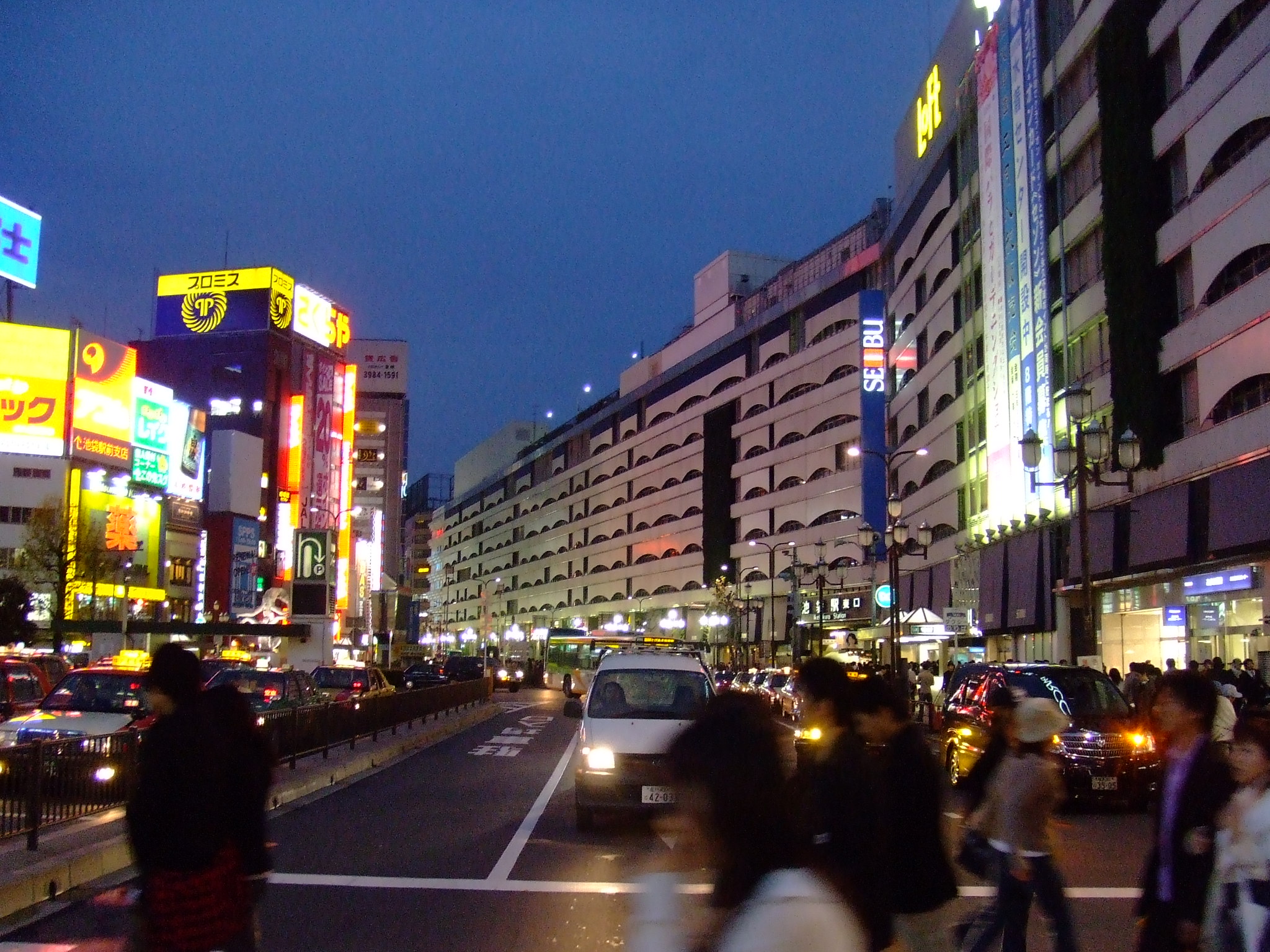
Ikebukuro
The owl statue outside Ikebukuro Station's west exit is a pun. The neighborhood's name means "pond bag" -- ike (pond) and fukuro (bag) -- but fukuro sounds nearly identical to the Japanese word for owl, fukurou. So the locals built an owl and made it a meeting spot to rival the famous Hachiko statue at Shibuya. That playful sense of identity runs through everything about Ikebukuro: a district that cheerfully defies easy categorization, blending department stores and cat cafes, anime culture and Chinese restaurants, a Frank Lloyd Wright building and a yakuza syndicate headquarters into one of Tokyo's most energetic urban centers.
From Ponds to Platforms
The Ikebukuro that exists today bears almost no resemblance to its origins. The old village stood to the northwest of the current station, and most of the land now packed with skyscrapers was historically known as Sugamo. During the Taisho and Showa periods, cheap land prices drew artists and foreign workers to the area, lending it a cosmopolitan character unusual for Tokyo at the time. Until October 1, 1932, when Toshima ward was established, Ikebukuro was an independent municipality. The transformation into a major urban hub came with the railways. Today Ikebukuro Station is the third-busiest in Japan and the world, serving JR East, the Seibu Ikebukuro Line, and the Tobu Tojo Line. The station is less a building than a small city underground, channeling millions of commuters daily through a maze of platforms, corridors, and subterranean shopping arcades.
A Skyscraper on a Prison's Grave
East of the station, the 240-meter Sunshine 60 tower rises from a site with a grim history. This was Sugamo Prison, where Allied war crimes tribunals held and executed convicted war criminals after World War II. When the prison was demolished, the tower that replaced it became the tallest building in Asia at the time of its 1978 completion. Today Sunshine City, the complex surrounding the tower, is a sprawling entertainment and shopping destination that includes an aquarium, a Pokemon Center, cat cafes, and observation decks. The contrast between the site's past and present is one of Ikebukuro's most striking features -- a place that chose reinvention over remembrance.
East Side, West Side
Ikebukuro has a geographic joke built into its department stores. Seibu, whose name uses the characters for "west," sits on the east side of the station. Tobu, written with the characters for "east," occupies the west side. The reversal is a quirk of railway company naming conventions, but it perfectly captures the neighborhood's contrarian spirit. Beyond the department stores, each side of the station has developed its own personality. The east side leans commercial and touristy, anchored by Sunshine City and the electronics retailer Bic Camera. Nearby, Otome Road caters to female otaku culture with shops selling anime and manga merchandise. The west side tends more cultural: the Tokyo Metropolitan Theater, opened in 1990, hosts concerts and performances, and in 2020 the Hareza Ikebukuro complex added eight more theaters to the district. Tucked into the Nishiikebukuro residential streets, the Jiyu Gakuen Myonichikan -- a school designed by Frank Lloyd Wright in 1921 -- survives as a quiet architectural treasure.
Chinatown and the Cosmopolitan Edge
Since the 1980s, Ikebukuro has become the center of Tokyo's Chinese community. The arrival of ethnic Chinese residents brought a profusion of Chinese restaurants, grocery stores, and services that now dot the district, particularly around the north exit of the station. The resulting Chinatown is smaller and less formal than the famous one in Yokohama to the south, but it reflects something essential about Ikebukuro's character: this has always been a neighborhood that absorbs newcomers. From the artists and foreign workers of the Taisho era to the Chinese community of today, Ikebukuro's identity has been shaped by whoever shows up. Even the Kyokuto-kai, one of Japan's designated yakuza syndicates, maintains its headquarters here -- another layer in a district that contains multitudes without apology.
From the Air
Located at 35.730N, 139.711E in Toshima ward, northern Tokyo. The Sunshine 60 tower (240 meters) is the primary visual landmark, visible as a tall white building east of the dense station area. The district fills a roughly one-kilometer radius around Ikebukuro Station. Nearest major airport is Tokyo Haneda (RJTT), approximately 20 km south. Narita International (RJAA) is 70 km east. From altitude, Ikebukuro reads as a tight cluster of high-rises along the Yamanote Line loop, distinguishable from Shinjuku to the southwest by the Sunshine 60 tower.